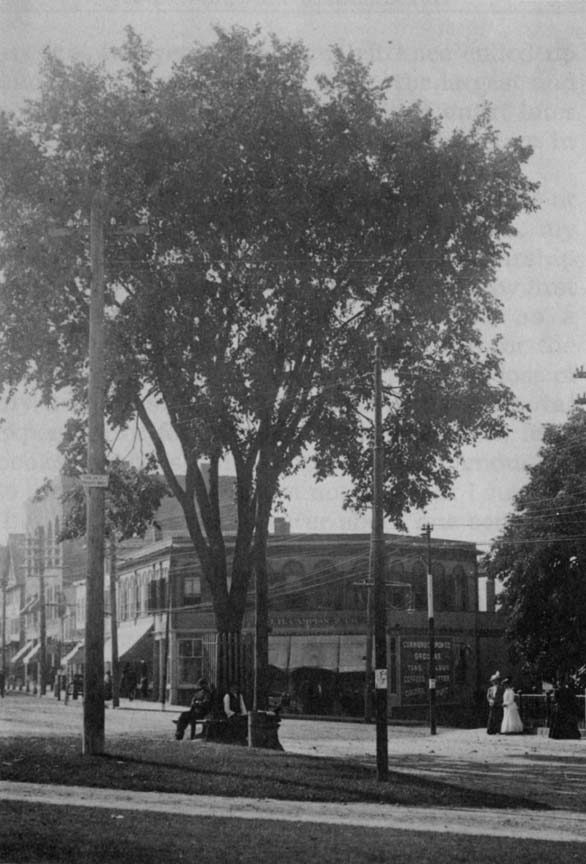
My earliest recollections of my hometown were centered for the most part around the central business district and the trolley lines that took us to Lawrence. Andover was a sleepy town, except for bustling Shawsheen Village. The Marland, or Stevens, Mill on Stevens Street and the Tyer Rubber Company with its new building on Railroad Street (or Free Church Road as it was still called by the real old timers) made up the bulk of the manufacturing, along with the Smith & Dove Manufacturing Co., located across the tracks from the railroad station, now a restaurant.
Tyer Rubber's old plant was on North Main Street where the fire station is now. The "new" plant was recently converted to apartments by the John M. Corcoran Company. North Main Street from Elm Square to South Broadway in Lawrence was a relatively narrow tar road, with a slight crown so that it would shed the rainwater.
Where the Texaco station is now located was a three-story wooden block---the Daly Block---owned by Patrick Daly, who operated a grocery store on the first floor while he and his family lived in the upper floors.
Daly's son Bill and daughter Julia ran the store. Another son, John, was a doctor in Lynn. His third son Martin, who married one of our early employees, Dorothy Cederberg, graduated from Boston College and worked in the local post office until his retirement a few years ago. He and Dorothy live on Wolcott Avenue at this writing.
Dr. Jeremiah (Jerry) Daly had two daughters and one son. Eleanor married a college classmate of mine, Dr. Phil Doyle, a dentist. Phil had his practice in their home, a stucco house on Chestnut Street that Dr. Jerry had built in the mid-1920s. Billy and Josephine, Irish twins (born 11 months apart), both went through St. Augustine's and Punchard with me. All three children are now deceased, as is Phil Doyle, but to this day, I cherish their memories.
Jerry Daly was a very smart businessman as well as being a fine family physician. He had a very extensive medical practice in both Andover and North Andover, and he invested well in the stock market. He was elected to the board of selectmen after the death of Roy Bowman and served in that capacity for several years, earning a reputation as a fine administrator. He was especially hard on welfare applicants who did not want to work. (Welfare was administered by the towns in those days, and there was a lot less waste than nowadays). However, his efficiency did him in, and he was eventually defeated for re-election by Roy Hardy.
The Memorial Hall Library was always where it is---although it has had three additions in my time. The first was the junior, or children's, room, which is to the right of the main building as you look at it from across the square. The wing to the left, which almost hangs out over Essex Street, was built (I think) in the 1960s. The last major expansion was the recent large addition on the rear and the entire renovation of the interior of the building.
I cannot help but be reminded of the changes of another nature in the library over last sixty years. In my very early years, the front desk was presided over by Miss Edna Brown and her associate Miss Twitchell. I never knew how smart they were, but no one, regardless of age, sex, or economic stratum, ever dared raise his voice above a very discreet whisper. Anyone who ventured to challenge their authority soon found himself out on the sidewalk in Elm Square. I don't mean to imply that there is no discipline in the system today, but the atmosphere is much more relaxed and young people are not at all discouraged from using the facility. I'm not sure it was that way many years ago.
In my opinion, things began to change noticeably when Miriam Putnam became the librarian. She is a very fine person, and it is nice to see her around town these days enjoying her retirement.
Moving across the head of Essex and Central Streets to what is now Macartney's was John H. Campion's grocery store. The entrance was at, what are now the side windows of Macartney's. Campion's three or four delivery wagons and horses were stalled in a barn that sat almost exactly where the telephone company dial office building is now (just to the rear of the Doherty Insurance and Realty Agencies) on Elm Street. It was quite a sight to see the wagons backed in to the curbing in the morning, and the horses waiting patiently while the clerks loaded the wagons with grocery orders for delivery around the town. Housewives would either phone in their order or place their order at the store in person and have it delivered later that day or early the next day. When filled, the wagons would set out around town on their routes. One might head south up the hill around the Academy and end up in Ballardvale. A second would cover the center of town, where most of the residents lived. A third would head for Shawsheen and possibly parts of sparsely populated West Andover. Most of the settlers in West Andover were farmers, who had to come into town in their own wagons and who also raised a lot of their own produce.
Some of the men who worked for Mr. Campion in the early years were Frank Valentine, whose daughter married George Collins (Everett's brother). Alter his death, she married Percy Crosby, who was the janitor of the Stowe School for many years. Al McKee drove delivery wagons for several years; Al and his brother were the "most horrible" of the horribles in the annual Fourth of July Horribles parades in the 1920s. Al later served with distinction for many years as the police chief in North Andover. There was also a clerk named Mr. Maguire. The sole survivor of that era is Francis Kelley, whom I still see at 4:00 mass on Saturday at St. Augustine's Church.
In later years, that same barn on Elm Street housed the fleet of small delivery trucks that performed the same task as the horse-drawn vehicles, but were owned by Jim Greeley, who operated the Rockport Market on Essex Street. That market occupied all of what had been the post office, prior to its move to Main Street. The building later housed Town Printing, owned and operated by George Durant and Pat Bissonette, and it is now the home of Topham Fardy and Co., Accountants.
In the late 1930s, it was quite an experience to stand in front of the Musgrove Building as the "cowboys" who drove the Greeley fleet came down Elm Street into the square, in close formation, and made a 360-degree turn around the traffic blinker---to the dismay of thru traffic and the utter frustration of the police officer who stood in front of Simeone's Drug Storeand just as quickly proceeded in orderly fashion down Essex Street to the store. The drivers were Phil Higgins, Tom Duff, Eddie Gill, and a fourth whom I can't remember. Later in the morning, Jim Greeley, in response to a call from the police station, would line the boys up and give them a stern lecture on proper rules of the road. A very kindly soul, he might read the riot act to "his boys," but he would never allow anyone else, even the police, to criticize them.
Jim Greeley was quite a character. His wife died when their daughter, Anna, was quite young. He was truly a self-made man and completed his job with no parts missing. My most memorable experience with him happened soon after I started in the insurance agency. He was granted one of the first package store licenses following the repeal of the Eighteenth Amendment and its acceptance by the town. I was trying to sell him fire insurance on the contents of the package store, which was located on Barnard Street where the Butler's Pantry is now. We were down in the back room at the store on Essex Street and he was insisting he did not need fire insurance because his merchandise was all liquid and there was practically no chance for a fire. Jim had a meat cleaver in his hand, and to drive home his point with an air of finality, he brought the weapon down with a resounding thud on the block. Undaunted, I looked him straight in the eye with a smile and responded, "Well, why do we call it fire water?" The cleaver was lifted high above the head once again for a very brief moment, and as it came down slowly, he broke into a broad grin. "Cover me for $1500."
Let's get back up to the Main Street. Cross Coal Co. maintained a very small collection office on the corner of the Macartney building between the entrance to the upstairs and the end wall of the building. Mrs. Fairweather was the clerk. Her husband (or former husband, I never really knew) was the janitor of the building. He was also the caretaker of the American Legion quarters on the second floor of the Barnard block where Bel Canto restaurant is now located. Jim and his wife had two daughters who were a few years ahead of me in high school.
Next door, Carl Elander ran a small tailor shop. Carl later teamed up with Stanley Swanton, a much younger man, to establish a men's clothing store where the CVS store was until recently, in the ARCO block.
The rest of what is now Macartney's store was a collection office for the Lawrence Gas and Electric Company. These "collection offices" may sound peculiar to the present generation, but it should be pointed out that few if any private citizens had bank checking accounts. Only the most sophisticated citizens used checks for transactions. Almost all consumer business was handled in cash, and so communities were dotted with convenient collection offices for utilities, coal, and many other services.
The gas and electric power supplies were two divisions of one management company in those days. In my very earliest days, my mother did all her cooking with a coal-burning, steam-generation boiler, and we lighted by gas light. This was standard practice before World War I. In the 1920s, the changes came with the widespread shift to electric lighting, to gas stoves for kitchen use, and slowly but surely, to oil burners for heating. The dirty, black, dust-covered coal man became history, to be replaced by the uniformed oil delivery man. As our history progresses, we now find that we use electricity to light, to heat, to cool, to wash, to dry, and to operate the many convenient household appliances that modern technology has supplied---and almost all paid for by sending a check through the mail. And so, the collection offices, following the lead of John Campion's horse-drawn grocery wagons, are now obsolete.
Upstairs in the Campion Block were offices. Sam Hulme had a small insurance and real estate business, and he collected rents for the building. I think that there was a watch repair shop there, even before Kendall Longe, who was a jeweler there in the 1930s. Dr. Malcolm MacTernen's dentistry office was up there too. (His father was a selectman, defeated by Howell Shepard about 1934 or 1935. And the doctor himself served on the school committee for several years.)
Next, as we move south along the west side of Main Street in the early 1920s, we come to Flanders Lunch, which later became Andover Lunch operated by Greg and Steve Christie.
Greg's daughter, Bessie, is the wife of Charlie Liponis, who owns the Andover Tractor Trailer School. (In the very early days, the second floor over the restaurant was a pool hall. I just can't seem to remember the name of the owner; I was never up there and knew nothing about it; it went out of business about 1930.)
When Bessie Christie was about six years old, she was hit by the seat of a swing on the Central Playground, which was in the rear of the Stowe School on Bartlet Street. I was a playground instructor at the time, and someone came running up to me carrying this little girl with a gash on her chin. I took her in my arms and ran into the school basement to the first aid cabinet, got a gauze compress, and rushed her out to my car. Resting her head on my lap and holding the compress with one hand, I negotiated the distance to the office of Dr. John J. Hartigan, 7 Locke Street.
Dr. John graciously left his supper and sewed or clipped the pretty little girl's chin and put her back in my arms. I delivered Bessie to her mother and father at the restaurant and the whole ordeal seemed like about 20 minutes. It was a nasty cut, a little to the side of the center of the chin, but to this day, I defy anyone to detect that location. Bessie was a very lovely child and she has maintained her beauty through the years. She is still one of my favorite playground "kids."
Next door, at number 13, was the Burns Co., a very high grade men's furnishings store, operated by Billy Burns and his brother Dave. They catered, mostly, to the Phillips Academy students. Prior to the Great Depression, it was customary for students to arrive in September and head with their parents to the Burns Co. to get outfitted for the school year. Phillips was a wealthy boys' school in those days, and many of the students stopped in throughout the year to replenish their wardrobes, asking the bill to be sent home to Dad. There was a rumor that some even used the sanctuary of the upstairs tailor shop for a forbidden cigarette, but I have no proof of that. Perhaps my good friend Phil Allen could verify the fact or fiction of that story.
During the 1930s the student body became more heterogeneous, less affluent. The practice of graduating from a local high school and then spending up to four years at Phillips before going on to Yale dwindled, and with it the business at the Burns Co. Billy Burns died and Dave was in poor health during his later years. Billy never married, and Dave's one son, "Butch" or David Jr., took over a salvage yard in Portland, which had been left by his mother's brother. His daughters, Sally and Nancy, were not interested in the business apparently and the store was sold to Holden and O'Sullivan. The financing was supplied by O'Sullivan, but he had other interests, and before long, the once-fine store with a national reputation went out and was replaced by Reinhold's shoe store.
That enterprise went well for several years but went downhill after the death of Bill Reinhold, and then passed through a succession of tenants. The store has of late housed a lady's boutique, The Elephant's Trunk (a not very flattering name for a dress shop, but nobody asked for my opinion) and is now a card and novelty shop, Strawberry Tree.
Next door to Reinhold's used to be a small grocery store but it soon gave way to a barber shop. The shop has passed through many hands over a period of sixty years, from Bennie to Steve to Joe to Charlie, and perhaps one or two in between. It is, I guess, the best-known and busiest shop in town.
Now to continue back up Main Street on our tour. The National Bank was and is where it is today. The Andover National Bank---now, after many changes, the BayBank Merrimack Valley--occupied one half of the first floor and the Andover Savings Bank was a tenant in the other half. Upstairs on the second floor was located Smart & Flagg, "The Insurance Offices" as they advertised themselves in those days, and the Cambridge and Merrimack Mutual Fire Insurance Companies, in later years located in Shawsheen Village and now in elegant new offices in West Andover. The third floor was the meeting hall of St. Matthew's Lodge, Ancient Free and Accepted Masons. I shall return in a later chapter to a discussion of the far-reaching ramifications of this remarkable power structure.
Next to the bank building, as we travel south along Main Street, was an alley and then two large frame buildings, one three stories tall and the other four, but I cannot remember which was which. The upper stories of both were occupied as tenements.
In the first building, next to the bank, was Mrs. Basso's fruit store. Mrs. Basso, a very gracious lady, always had a very inviting display of fresh fruits and vegetables---many from her husband's large farm on Chestnut Street, where the senior housing center is now located, and just east of the Playstead baseball diamond, the principle athletic complex in town until the high school was moved to Shawsheen Road. The Bassos had three children: Theresa was in St. Augustine's School with my sister; Joe, who later became an aviator because this earth could never keep him grounded, was a classmate of my brother Joe; Austin graduated from St. Augustine's with me. At this writing he is living on a farm off North Street in West Andover.
Next to the fruit and vegetables was the entryway to the upper-floor tenements. Then came the hardware store of Walter I. Morse. Walter operated the store until it was sold in about 1927 to W. R. Hill, who operated a greatly expanded business farther up the street and in time sold to Tim Scanlon. (Scanlon Hardware was moved to the Barnard Block on the east side of Main Street by his son Bill, but it went out of business in 1990.)
The hardware store held quite a fascination for me at one season of the year---Christmas---because Walter Morse always had a display of toys. And being a carpenter, my Dad spent a lot of time in the hardware store. If I was on the ball, and on my best behavior, Santa Claus could always be depended upon to leave that cast iron circus wagon or fire department steamer or horse-drawn ladder wagon under the tree. It was some time later before I realized that Dad and Walter Morse had collaborated on the deal.
The neighboring building housed the Candy Kitchen, an ice cream and candy store owned and operated by Paul Gigis. Paul had one son, Bobby, who is still around the area, and two daughters. Helen, who succeeded Anne Beer McCarthy in Sam Resnik's office (Sam owned the Musgrove Building, Post Office Avenue, the Theatre on Essex Street, and the buildings across the street now occupied by Ginny's and the law offices of Asoian and Tully), and Betty, married and still living in town.
I seldom frequented the Candy Kitchen, simply because we were always very close to the Simeone family, and they had a similar store in the Musgrove Building at the corner of Elm Street.
Next door, beyond the entrance to the upper floors, was Mike O'Dowd's First National Store. (Mike's name was Dowd, but he always added an O!) This was a very deep building, running back quite a distance, and to the rear, beyond the entrance to the upper floors, the Smith and Coutts print shop was located. I know nothing of Smith, but Dave Coutts ran the shop. He lived on Elm Street, across from the Free Christian Church, and he had two children---Gordon, a fine football player at Punchard in the mid-1920s, and later a member of the Andover Fire Department, and Marion, who married Walter Pearson, a fine football and baseball player who was a teammate of mine in the early 1930s. Walter sold Ford automobiles for Shawsheen Motor Mart, served with me on the town recreation committee, and was one of the original movers and shakers of the Andover Boosters Club. Smith and Coutts was taken over eventually by Elmer Grover, who had bought the Andover Townsman from Phil Cole's family.
But to get back to Mike Dowd---or O'Dowd, if you wish. Mike managed the grocery store, one of the forerunners of what later became the giant First National Stores. He had a quick wit and a ready answer for every complaint from every shopper who came into the store. My brother Bill worked for him after school and on Saturdays while he was in grammar school. Bill always claimed that he brought his pay home in the form of groceries in his cart, a contraption that someone in the family still had until a few years ago.
Bill loved to tell about putting up bags of sugar, potatoes, and other commodities from the bulk bins. The ability to carve out a single pound of butter from the large tub in the ice box---no refrigeration in those days---was the ultimate accomplishment. You were not a real clerk until you could perform that trick on the first try.
The store was eventually closed, Mike retired, and the First National, a combination of the O'Keefe, O'Connor and Ginta chains, opened a larger store across the street where Gentry will open shortly. In his time, Mike Dowd, with his Irish wit and the twinkle in his eye and his engaging smile, was one of the real personalities of the Main Street. Going into "Mike's" was always a treat and a memorable experience.
Mike and his wife Jennie---a very pleasant and friendly woman---lived on Chestnut Street, opposite the Park. They had four children, Tommy (I've lost track of him) and three girls, including a set of twins who, I think, are still living in town.
With Mike went one of the last grocery stores in which all or most of the merchandise sat on shelves behind the counter and had to be placed in front of the shopper by the clerk. Clerks had to be able to manipulate that longhandled gadget that could pick a box of shredded wheat off the top of the fifth shelf without bringing down about fifteen other boxes. There were no adding machines, automatic cash registers, or computers in those days and I used to marvel at the ability of the clerk to take a large paper bag, pull the ever-present pencil from behind his ear, write down a long list of prices---sometimes fifteen to twenty items---check the number of items with the number of charges on the bag, add up the columns of figures, doublecheck his addition, and almost never be as much as a penny off. I wonder how many young people today would even attempt that without mechanical assistance.
In the 1920s and 1930s the food business was controlled in great part by the Great Atlantic and Pacific Tea Co.---A&P---the First National Stores, a New England chain---and the Vermont Tea and Butter Co., which was confined mostly to the Merrimack Valley. These chains had stores in every community, and in a city like Lawrence they might well plant small stores in every neighborhood. They were "dry" stores in the sense that they carried almost no fresh meat or produce. That service was handled by another phenomenon, which I will address elsewhere.
Moving on. Now comes one of my most difficult memory challenges. Next to Mike's was a small frame building, set back from the other building about thirty feet. In one half there was a dressmaker, Miss Riley; I have no idea of the correct spelling of her name. Miss Riley was quite elderly and had a little thread and needle shop, where my mother bought some of her supplies. In the other half was Miller's Shoe Store. Henry Miller later built a larger building just to the south and moved into it. I don't know what ever happened to Miss Riley's shop. Rod Hill moved the hardware store into one half of Miller's building, and Mr. Ferguson, a jeweler, was in between them.
About 1932, I think, John Grecoe came to Andover from Vermont, bought out Ferguson, and shortly after moved across the street to a "one-hair" store with Carl Elander, the tailor who had been working in the Campion Building. That was about where the CVS checkout counter was in the 1980s. The Miller building had to be constructed to accommodate the Rogers Brook, which ran under Main Street and down in an open bed, except under roadways, all the way to the Shawsheen River, south of the Smith & Dove complex.
A large house stood on the corner of Chestnut Street where the Andover Savings Bank is now. Along about 1922 or 1923 the savings bank acquired the property and moved the house to the rear of the property on Chestnut Street. I remember standing with my Uncle Martin in front of Billy Higgins's house at 15 Chestnut Street (more recently the home of my brother Bill and his wife Muriel). The manner in which that big house was moved really fascinated me. First it was jacked up on railroad ties and placed on rollers. Then with a series of pulleys arranged to give the maximum mechanical advantage, the rope finally was wound around a capstan and turned at a very slow pace by a horse, walking around the capstan, always picking up its legs to avoid tripping over the rope. At intervals the horse was relieved and its teammate took up the task.
It may have taken two or three weeks almost seventy years ago to move the big house down to its new location, but I can see it in my memory as though it happened only last week. The house became the joint home of the Knights of Columbus and the Catholic Daughters of America. A large hall was added onto the rear and six or eight bowling alleys were in the basement. Those organizations occupied it until the 1930s when the Depression took its toll. It was converted into four or five apartments, later into offices, and finally torn down to make way for parking for the bank.
The bank built a beautiful building on the corner, grew and prospered, and the Andover National took over the entire floor space vacated back at 21 Main.
That house on the corner was a very imposing structure, with very ornate gingerbread trim, and a nice low fence along Main Street and around the corner down Chestnut Street. There was a driveway and, I think, a barn. In those days we all had barns; garages came in later. The property was owned and inhabited by a family by the name of Swift. I seem to recall that at least one or two elderly ladies lived there. There was another Swift family, relatives, who lived at the corner of Central and Brook Streets---later the home of Rod Hill, the hardware store owner, and now the law offices of Reginald Marden. I do remember the lady who lived in that house because that was my route to and from St. Augustine's School for eight years. She was a very dignified but pleasant woman who got her fresh air and exercise by strolling the sidewalk around her property.
I have no recollection of any male members of the Swift family, although it was my understanding that they had been prominent and well-respected members of the community. The Main Street estate, by the way, extended down Chestnut Street to include the land now occupied by the Doyle family---grandchildren of Dr. Jerry Daly and children of Eleanor Daly Doyle and Dr. Phil Doyle, my college classmateand the brick house, built and occupied by Bernard L. McDonald and his family and now owned and occupied by Attorney Helen Comeau. Stop and consider for a moment the value of that strip of land in today's real estate market in downtown Andover.
Crossing Chestnut Street and still moving south on the west side of Main Street, there was a vacant field where the Gulf station is located now. A fence surrounded it and we boys used to play there after school.
Billy Burns, of the Burns Co., owned the lot, and O. P. Chase, who owned the "paper" store, used to erect a stand and sell "fireworks" there for two weeks before every July 4th. (Fireworks were legal in those days.) There were two other fireworks outlets as I recall: one was operated by a relative of Sam Resnik at the entrance to Post Office Avenue, just outside Stacey's Drug Store, now Enzo's of Andover. The other, my supplier, was operated by Bob Franz on the little plot beside his store on North Main Street at the corner of Harding Street. The interior decorator shop there now was expanded some years ago and covers the little plot where the stand was.
These other two pyrotechnics stands were not really stores, merely canvas-covered wood frames. Bob Franz had my father build a solid closed-in structure that he could set up and take down in sections. Because it was built by my dad, I am sure it was watertight and airtight---and was as strong and sturdy in its last years of service as it was in its first. Fireworks in the 1920s were a big business and every kid in town, it seemed, had a supply of torpedoes, salutes, lady-fingers, sparklers---for the young ones---and at least one or two "Roman candles." Actually, the 5-inch salute was outlawed in Massachusetts even in those days---2 Inches was the limit---but just as now, the more daring would import the big ones from New Hampshire.
To get back to our trip up Main Street, Billy Burns sold the corner lot to Gulf Oil and the gas station was built. Next, on a higher plateau was an old house that I have no knowledge of beyond the fact that it was there. It was large, gray I think, but I have no idea who lived there. In any event it was bought by the General Services Administration and the post office was built and occupied in the fall of 1931. The building was dedicated on a Saturday afternoon and I think we were playing football in Danvers that day. Brother Bill did not get down to the game because he had to cover the ceremonies in Andover for the Tribune; that was unfortunate, I thought at the time, because that Saturday I had one of my best days of that undefeated season.
I presume that Edith Nourse Rogers of Lowell, our congresswoman, was present, along with Fred Cheever, our postmaster. The post office remained in operation through the years until the new facility was built on Stevens Street and occupied in January 1989. Over time, we have been served by several postmasters, Democrats or Republicans based on the party occupying the White House.
The first one I recall was John McDonald, whose son lives on Park Street; then John Angus, whose wife was Annie Smart, daughter of Joseph Smart, president of the insurance companies and a partner in the insurance agency Smart & Flagg, now part of the Fred C. Church Agency of Lowell; Fred Cheever, who later was a very successful real estate agent; Frank McDonald, father of Bill, who taught at Punchard and later served for many years with the FBI; Steve Boland, husband of Marie Daly, and a star fullback on Gene Lovely's first Punchard football team in 1911. Steve's brother, Fr. Frank Boland of the Holy Cross fathers, had been dean of discipline---as they called it in those days---at Notre Dame University, and he was sent on to establish Stonehilll College in North Easton in 1947, the same year that Fr. Vincent McQuade and the Augustinian fathers arrived from Villanova to establish Merrimack College.
After Steve Boland came Frank Mooney, Steve's long-time assistant postmaster, and Eddie Morrissey. And it was only a few years ago that Tony Mendoza took over the post. Through all the years one of the constants that I am impressed with in our town has been the friendly, courteous service of the personnel in the post office. This is true from the early days of Arthur Bliss, John Nelligan, and Henry Dolan right on up through Martin Daly, John Murphy, and now my friend Roland, who goes that extra yard to see that I get everything that should go into our box.
In more recent times the counter has been enhanced by the appearance of young female clerks who always seem to have a ready smile when I appear at their station. For years the only female employee of the postal service in Andover was Marie Daly, who married Steve Boland when they were both clerks.
From the post office site to the corner of Locke Street ranged a series of old, somewhat stately homes. The first, where the House of Clean and Warren Savings Bank now stand, was occupied by Mrs. Grout, a widow, with her son, her daughter, and her brother-in-law Jack Grout. I have lost track of all of them even though the children were younger than I. Next, behind the still-rugged stone wall with the sharp vertical stones to discourage youngsters from walking on it, was the very pretentious home of David and Lucy Shaw. The Shaw property encompassed all of the current municipal parking lot; it was shaped like the letter T with the right side of the cross-piece shorter than the left. The house itself was very large with a circular drive and tarmac on the left side leading to a barn that was more sturdily built than most of the houses in town. The several large rooms on the first floor had heavy hardwood paneling and high ceilings. I was never upstairs, but I understand that there were about four bedrooms there and more rooms in the attic. The cellar was always very clean, high-studded and quite impressive. The back yard was complete with flower gardens, fruit trees, and raspberry, blackberry, and currant bushes.
My Aunt Jennie Doherty, my father's older sister, worked for the Shaws as a domestic. Mr. Shaw was a partner in Lee-Higginson, one of the old line brokerage and investment bankers in Boston. They had no children, but plenty of money. The couple spent the entire summer in Sagamore on the Cape and the winters in some warmer climate. My memory of them is that at least in my youth they spent very little time in Andover. Along about 1930 Mrs. Shaw suffered what was probably a stroke; afterward, she was bedridden as little more than a vegetable until her death some ten years later.
Meanwhile Mr. Shaw, two or three years after his wife was afflicted, also suffered a stroke and died almost immediately. Mrs. Shaw had three sisters, a Mrs. Anderson in North Andover, a Mrs. Russell in Swampscott, and a third who lived in West Roxbury. Burton Flagg, the executor of the wills, kept everything going as before for the benefit of Mrs. Shaw, except that she never left the house at 85 Main Street.
The gardens and grounds were kept by Mr. Jenkins, a black man who lived at the corner of North Main and Lewis Streets. He was a very kind and gentle man and he worked for three or four of the monied families on School Street. There was also a housekeeper and a private nurse for Mrs. Shaw and any time either of them wanted a few hours off, my aunt would fill in for her. From my earliest days until I was out of college, it was routine to go up to the Shaws with Uncle Martin and pick currants, blackberries, or apples; the only stipulation seemed to be that we would take an occasional box of berries to North Andover and also to Swampscott. Martin died in 1937, and for a few years before he died, and of course afterward, I was the chauffeur. I think I could go straight to those sisters' houses today.
Occasionally, as I sit at the counter in the Lantern Brunch and converse in Greek with Angie, I remember a conversation that took place down by the currant bushes in the summer of 1936. Uncle Martin and I were picking the fruit and Jack Grout, brother-in-law of the lady who owned the house next door, wandered over to speak to us. During the course of the small talk, he mentioned that the house was for sale and that Mrs. Grout wanted $6,500 for it. With a tone of finality in his voice Martin declared, "Well, she'll never get it."
So much for the foresight of the older generation. Now to make the cheese more binding listen to the next episode. No one was closer to Mrs. Shaw's heirs than Jennie Doherty. Alter Mrs. Shaw's death, Burton Flagg seemed to be in no hurry to sell off the property. Of course Depression drifted into wartime and there was not much loose money around. He finally sold the property to the town for about $11,000.
I am certain that the heirs, who were putting pressure on Flagg to sell and settle the estate, would have been happy to see Jennie and her family get the property. It really hurts today to sit and realize that we might, have had all of that property for about $17,000. What makes it more regrettable-the Dohertys had the cash right down the street in the Andover Savings Bank. Did somebody say "deal"?
At any rate the property was eventually purchased by the town toward the end of World War II. I believe that the selling point was that it would serve as the site for a new town office building, since the "old" town house was rapidly becoming too small for the expanding town government. Bob Phinney and his father operated their radio and TV sales and service out of the house for several years as tenants of the town and the barn was used for a children's theatre group. Eventually the buildings were razed and the parking lot as you know it today was built in the 1950s.
One of the most amazing (to me) episodes in town meeting history occurred in 1949 or 1950. Roy Hardy, a part owner of the old bowling alleys on Park Street, had been chairman of the board of selectmen for over ten years and had retired a few years after the war. He was appointed chairman of a committee to study the feasibility of new town office facilities. He was a logical choice since he had presided over the many changes that had taken place in the interior appearance of the old building.
The committee had been created as a result of a vote at the town meeting the previous year, and thus its members were appointed by the moderator, Arthur Sweeney. Before the advent of the "manager charter," all committees authorized by town meeting action were appointed by the chairman of that meeting, the moderator. Since the new charter, all committees except the finance committee are appointed by the town manager. I might say in passing that I am happy with that procedure. I spend enough time trying to find finance committee appointees to give that board the proper blend. (I will put forth my philosophy on that subject later.)
To get back to Roy Hardy: he was a tall, friendly, well-educated man. Along with his partner Jimmy Ross, he owned the bowling alleys in Lawrence, at the corner of Hampshire and Methuen Streets. Together they took over the small setup on Essex Street in Andover, next to Jimmy Heifetz's diner, beside the Colonial Theatre, later the Andover Playhouse---all of which made up the area now occupied by the recent addition to the Memorial Hall Library.
Hardy and Ross moved out of Essex Street and converted to alleys the garage on Park Street that had formerly housed the Andover annex of the Smith Motor Car Co. of Lawrence, a Chevrolet and Buick dealership owned by Wilbert Smith who lived on Elm Street opposite Wolcott Avenue. To take over that garage building and install the lanes and equipment called for a lot of money and the venture capital supplied by the Andover Bank was tremendous by 1940 standards. Thus, one more business and its owners fell under the influence of the Andover Vault. (I will expand on that issue later, also.)
Anyway, Roy approached the microphone at the Memorial Auditorium and with ever-present self-assurance presented the plan for a new town office building on the site of the Shaw property. As I recall, the project had a price tag estimated at around $350,000; there might be some financial benefit by disposing of the old town office site. Well, Fred Cheever, a real estate developer, no friend of the powers because Burton Flagg had refused to give him a job when he was dismissed as postmaster after Roosevelt's election, made a most impassioned plea for retention of the old town house, and several others attacked the money issue as fiscally irresponsible. This was really the first solid, full-blown assault on the power and authority of the money power base that was firmly held in the then capable-or-otherwise hands of Burton S. Flagg.
This group, with Flagg at the top of the pyramid, had gained power back in the 1920s when Billy Wood died and the power, money, and pressure of the American Woolen Co. suddenly left town and with it the dream that was Shawsheen Village. The quite docile people of Andover stood by, and a small group took over.
During the Great Depression years of the 1930s people were destitute. Jobs were scarce and low paying. To get on the town payroll in any capacity was an achievement. Young people coming out of high school were most fortunate if they could get a job working for $12 per week in one of the banks, the insurance companies, either of the academies, Tyer Rubber Company or the Marland Mills. They were all tied together in a common bond. Flagg was president of the Andover Savings Bank and a director of the Andover National, president of the insurance companies, and owner of Smart & Flagg Insurance Agency. He was also treasurer of the board of trustees at Abbott Academy and graced the campus with his presence by living in a house owned by the academy.
The treasurer of Phillips sat on the board of the insurance companies, the treasurer of Tyer Rubber sat on both bank boards and the Stevens family of North Andover, owner of Marland Mills, controlled most of the stock of the Andover National. And Nat Stevens put up half of the $14,000 guaranteed fund that was required by the State Insurance Commissioner in 1932 or 1933 to keep the Merrimack and Cambridge Mutual Insurance Companies afloat. (The interest on those funds, according to Best's Insurance reports of those days, was much higher than was being paid on most investments.)
That was the true picture of Andover in the 1930 Depression years. And that was the secure position of public officials in those days. If you wanted a job in any of the above institutions, you had better have your mortgage and house insurance in the right place---Bill and I learned that early. Some of our best friends would be afraid to do business with us.
Shopkeepers soon learned not to push their luck. After John Grecoe, the jeweler, bought a small policy from Bill, the Abbott girls seemed to stop going into his store. He asked a young girl whom he knew quite well if there was something wrong. She sheepishly admitted that the girls had been "advised" to shop at Billings. John got the message fast, but when Bill told him why, he went to the source and the "boycott" was lifted.
The Abbott girls never went into Bill Simeone's drug store either, but he didn't care. He and Bill Doherty grew up together, went through school as friends and played side by side on the football team, traveled together and were very close right up until my brother's death. Bill Simeone died during the writing of this chapter. His family has told us that he had been losing ground ever since brother Bill died. They were great friends and no amount of political or economic pressure would keep him from buying his insurance from his friend. That might just be why I still get medication and prescriptions from the Simeone pharmacy even though I might save a dollar up the street.
Perhaps I should not get off the track this way but it is all part of how the center of town during the 1920s and 1930s---the political and economic life of the community---functioned. With the end of the war and the changes in the population that I referred to in earlier pages, Roy Hardy, representing the "old guard" and the business-as-usual point of view, ran up against a lot of new people at the town meeting.
They were not the usual docile citizens who had never questioned him when he was chairman of the board of selectmen. His advice and suggestions to the voters had been accepted as if they had come directly from Mount Olympus. This is not to imply that he was wrong. Roy Hardy was smart and dedicated, and was almost certainly convinced that he was acting independently of any outside force. He probably thought that the bankers and others in the "Vault" were smart because they agreed with him. It just seemed amazingly coincidental that so many decisions concerning town politics and municipal operations always---I repeat, always---proved to benefit a certain small group.
It reminds me of the philosophical argument about creation of our universe, the proof from reason for the existence of a Supreme Being as the ultimate cause or creator of our minutely ordered world. The doubter or atheist maintains that everything happened by chance. Oh? Then take the finest Swiss movement watch, disassemble it into all of its individual component parts, piece by piece, screw by screw, take it in your hand to the top of the Sears Tower in Chicago, throw the handful of parts out into the winds. Does anyone expect it might ever by chance assemble in flight and land on the street in the midst of early morning rush hour traffic in perfect working order? It is a pleasing fantasy, but it defies reason.
Many other interesting and enlightening events and situations will be discussed as we go along, but the main point here is that suddenly, it seemed, the voters had been turned loose and were ready to strike out in an independent manner. They refused to be led like sheep, and they defeated the proposal for a new town office building to be built on land that Mr. Flagg was able to dump on the hands of the taxpayers in order to settle an estate at a time when there were no real takers. The vote was about two to one against on a motion that would have required a two-thirds vote for enactment. I can still see the look of disbelief on Roy Hardy's face as the vote was announced. He shrugged, turned, walked to his seat---and I never saw him at a town meeting again.
As I put the pieces together now, I realize that on that nigh---just as I had witnessed the end of the American Woolen Co. influence on the hot afternoon in the West Parish Cemetery--- I was witnessing the first break in the very solid coalition that had controlled the town for a quarter century.
A new bank was coming to town; new businesses were springing up; Shirley Barnard and the Doherty boys were beginning to pick up a bit of the insurance business. Life would never be the same again in Andover---at least not in my lifetime.
Let us now return to our walk down Main Street, west side, heading south. The house beyond the Shaw estate was the Dr. Scott house, and next to that was the residence of Dr. Hulme. I don't remember what branch of medicine Dr. Scott practised, but Dr. Hulme was a dentist. About thirty years ago, Lincoln Giles, who died last year, using those two houses as anchors, built out front and tied the whole complex into what has long been known as Olde Andover Village. It was quite a project and a novel conversion of two old stately homes.
The Amos Blanchard House, now the home of the Andover Historical Society, was next. I don't recall who lived there in the 1920s. Farther south was the home of Dr. Philip W. Blake, a general practitioner who made house calls. Like his fellow physicians Dr. Look and Dr. Walker, both of whom lived still farther south on the same side of the street, Dr. Blake's standard charge for a house call was $3. Office hours were usually 2:00 to 4:00 in the afternoon and 7:00 to 9:00 in the evening. Office visits were only $2.
There was no medical insurance except for certain workmen's compensation coverage offered by larger employers. In those days the doctors had no receptionists, no nurses---they did all the work themselves. They listened patiently, gave advice, and knew all their patients intimately. They were "specialists" in every area of medicine: they set broken bones, sewed up gashes, and prescribed or dispensed medications for headaches, tummy aches, or ingrown toenails. They came out at 2:00 a.m. on cold winter nights to deliver babies by lamplight and, in short, were really the most respected and appreciated members of the community. Malpractice was just a word in the dictionary. We all respected each other, we thought well of each other, and we lived in an era of mutual respect.
On the corner of Locke Street was the home of the Honorable Colver J. Stone, the judge of the police court in Andover, which I will discuss when I reminisce about the Town Hall later.
Across Locke Street was the home of Bill Odlin, now the Andover Manse. I don't remember whether Bill was a lawyer or a banker; I do recall that he worked in Boston. His claim to fame was that he was credited with teaching the game of football to the students at Dartmouth College.
Next was the Locke Tavern and the residences and offices of Drs. Look and Walker. (There were about three houses in between but I have no recollection of who lived in any of them.) Dr. Look lived at 115 Main Street and Dr. Walker at 123 Main Street. The Locke Tavern, in my memory, was always a two- or three-apartment dwelling. In the late 1920s Leon Davidson took over and operated the Coffee Mill, a luncheonette, very successfully for several years. We ate lunch there with many of the local business men and women for several years after World War II. That area was eventually taken over entirely by the Andover Shop, an exclusive men's clothing store operated by Leon's son Charley. Leon in the meantime joined forces with Eddie Donahue to take over the Andover Country Club from Ellsworth Lewis and Foster Barnard.
Now we are at the corner of Morton Street, and everything south of that corner had a distinct Academy flavor or influence; I will go into that in more detail in a later chapter.