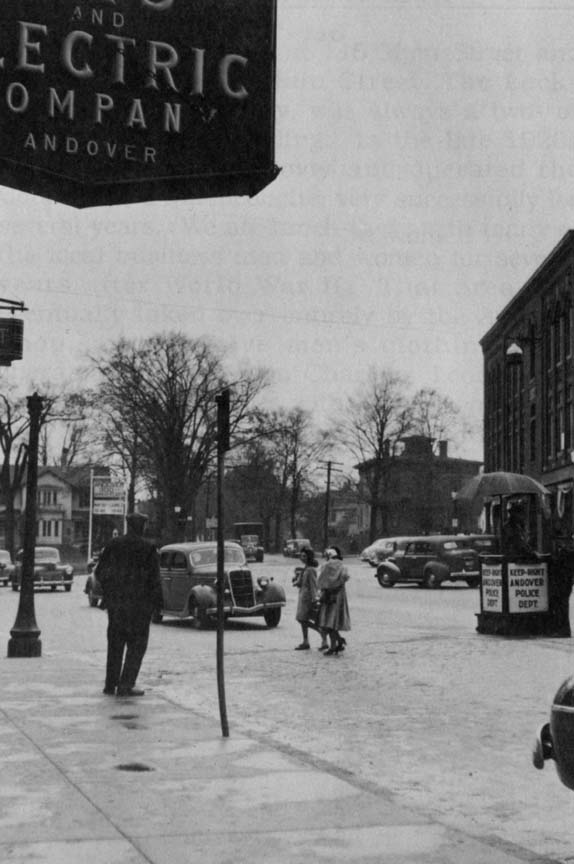
Crossing Main Street and turning back northward toward the center of town puts us facing a string of nice homes, with varying period architecture---many of them now apartment houses---until we get to the corner of Punchard Avenue. There, in the early 1920s, John F. O'Connell, an advertising executive in Boston, and his brother-in-law, a Mr. Carroll from Lawrence, bought the property at the corner, moved the existing big house back on to Punchard Avenue, and built the Caronel apartments. The name is a contraction of Carroll and O'Connell.
Mr. O'Connell was a fine-looking, tall, white-haired gentleman who was a regular contributor at town meetings. He was an active member of the Andover Taxpayers Association, one of its organizers and a one-time president. He was a very imposing and articulate voice, always on the side of fiscal conservatism, but never a pennypincher to the detriment of the town. He was one of the first to push for the purchase of a town ambulance and he was an early sponsor of the development of the swimming beach at Pomp's Pond. I think that in his later years he was a candidate for town moderator.
When I think back on all the personalities who have had a profound impact on our system of open meeting self-government, without themselves ever having held public office, John F. O'Connell ranks as one of the very outstanding movers and shakers between 1925 and 1950. His daughter, Claire Sullivan, now lives at 1 Punchard Avenue, the house moved back from the corner, and her son, Atty. Phil Sullivan, practices law in his office in Olde Andover Village. Phil once reminded me that the Caronel apartments were the first in this entire region to boast a refrigerator in every unit, the beginning of the end of the "ice man." I'll bet that the larger end units probably rented for as much as $35 per month. I will discuss commodity prices and wages in more detail later in my story.
As we cross the street to the northeast corner of Main and Punchard, we come to a block that has seen tremendous changes in sixty years. And yet it missed, or escaped, one of the most "revolutionary" changes ever proposed for any section of the town---John N. Cole's "Civic Center" dream.
The house where Andy Shea now has his law office on Punchard Avenue used to sit out on the corner with a little room around it. In the 1920s it was moved back and a string of stores was built on the Main Street frontage. No doubt it was economically justified, but from the standpoint of esthetics, I have always thought it left a lot to be desired. However, as with the name of the dress shop down the street, no one ever asked for my opinion.
The big brick building that has seen many and varied tenants over the years was originally built as a garage, Myerscough and Buchan. It was equipped with a freight elevator in the back corner and cars could be stored on the second floor. Over the years, it has served as a grocery store (A&P), a school (Andover Institute of Business), retail complex, fitness center, and ice cream parlor, among other functions.
There was a house about where the Bank of New England/Fleet Bank building stands now and the very same retaining wall that fronts the Barnard Arms ran up to the driveway. In the rear there were either two or three houses, all owned by Fred Smith. Irving Whitcomb's family lived in there. Irving is one of the few remaining true "old townies" around today. He retired several years ago from Smart & Flagg and now lives in the Cross apartments on Central Street with his wife, Alice. He had three brothers, of whom I think he is the sole survivor, a grand guy. Gertrude Shea McDonough and her husband Jack, who built the garage/bowling alley/shooting gallery on Park Street, lived in one of the houses with her two nieces, Mary and Katherine Hastings. Mary was the wife of Dr. Richard McGovern, descendent of a well-known West Andover family; she died several years ago. Her sister Katherine is the "right-hand man" of the president of Boston College. A brilliant administrator and highly regarded throughout the academic community, she also serves on the board of trustees at Merrimack College.
Fred Smith asked us to sell the property for him more than thirty years ago. I think he wanted somewhere between $40,000 and $50,000. At the time there were no takers; the Bay State Bank, with Howell Stillman as president, later purchased it and "dared" to expand into the backyard of the two entrenched local banks.
Moving along we come to the large stucco house that was the residence of E. W. Pitman, whose company did most of the construction work in Shawsheen Village. I have no recollection of Mr. Pitman---like so many others, he apparently departed this world without leaving any forwarding address. As you get older you realize that, generally speaking, even your friends of long standing will do that. G. Morton Fuller and his wife, one of the Cutler sistersaunt of Georgia Stanley---converted the big house into several small apartments. Shirley Barnard bought it in the early 1950s and it is now owned by Dick Lally.
Just to the north, in what is now the Barcelos Plaza, stood the home of Dr. Charles Abbott, the dean of the distinguished group of family doctors who served the town in the first half of this century. I think that Dr. Abbott may have been president of or at least was active in the Andover Historical Society. In addition to making house calls, all of those early physicians rendered some form of public service not directly connected with their practice: Dr. Walker served on the school committee; Dr. Look was a member of the board of health; and Dr. Daly was a selectman. They were followed by Dr. Harry East, still an avid walker although retired from practice; Dr. John J. Hartigan, who advised me in 1924 not to participate in sports because my heart was weakened from early bouts with pneumonia and other illnesses (it was a long time before I was willing to accept him); Dr. Charles Currier, whose office was in Dr. Abbott's house; and Dr. John McArdle, the one doctor in later years who could be depended upon to answer police calls at all hours of the night. I guess Dr. Bill O'Reilly handles that detail these days, or nights.
At this point I want to pay tribute to all of the aforementioned doctors who have served our town and its people for so many years. The early ones had to harness a horse and hitch it to a small wagon or sleigh before venturing out at any hour of the day or night. They worked long hours, and alone for the most part: nurses worked at the hospital or on private duty cases at home, and there were no nursing homes. And the doctors labored without benefit of all the wonder drugs that have made an appearance in the last fifty years. They were a breed apart, they blazed a trail, and I am sure that God, in his goodness, has already granted them their just reward.
In my very earliest years I remember one or two long low tenement houses on the southeast corner of Main and Chestnut Streets. They were razed in the early 1920s and the present building on the corner was built. Dan Hartigan, Dr. John's adopted brother, who had worked in Stacey's Drug Store in the Musgrove Building, opened a drug store on the corner. Kirk Temple had a radio repair and record store, managed by Harold Phinney---Bob's father---who later bought out Kirk and ran the operation himself. There was one other store on that ground floor but I cannot identify it.
Upstairs, over the drug store, was the office of Dr. William A. Fleming, a dentist, the son of the only resident of Shawsheen Village ever to stand up to Billy Wood and the American Woolen Co. steamroller. A hairdresser worked across the hail and most of the rest of the floor was a series of studio apartments. There was a bakery on Chestnut Street behind the drug store and a small furniture or antique store on the end.
Three houses on Chestnut Street just off Main Street, along with the Dr. Abbott house on Main Street, were razed to accommodate the Andover Consumer Cooperative, a grocery market that was owned by the consumers, and that liquidated fifteen or more years ago.
The two-story building on the northeast corner of Main and Chestnut Streets was the Andover Press Building, with the Andover Book Store holding down the corner. For years, the students at Phillips Academy obtained all of their books and supplies at this store. Needless to say, mid-September was bedlam as several hundred young hopefuls crowded in to get what they needed. The school business was indeed a bonanza for the family of John N. Cole, who owned the book store, the printing press and who also published the Andover Townsman. The store carried a fine line of books, not unlike---although not nearly as extensive as---the present store of the same name operated in the 1980s by Jerry and Ethel Cross and now by Bill and Carolyn Dalton.
The Andover Press, the print shop, was truly a quality shop. It turned out the yearbooks for most of the colleges in the Northeast. Harold Johnson and Dino VaIz traveled extensively to college campuses to handle the annual class book business. Every fall they printed the weekly programs for the big football schools---Harvard, Yale, Princeton, Dartmouth, Cornell, Pennsylvania, and the service academies. I remember Percy Dole telling us about leaving Andover on a Friday night with a tractor trailer load of programs for the Army-Navy game in Philadelphia and arriving at the stadium in midmorning to unload at the various entrances just three or four hours before game time.
The contracts for those football programs in those days must have been awesome. The Harvard Stadium would sell out to 50,000 people two or three times a season, and the Yale Bowl in New Haven to 70,000. There was no television to broadcast the games and even radio was still an experiment in the early 1920s. My first recollection of a serious attempt at nationwide radio coverage of a World Series was in 1926. The St. Louis Cardinals beat the Yankees in seven games. With the score 3 to 2 in the top of the ninth inning of the seventh game in St. Louis, Grover Cleveland Alexander walked Babe Ruth with two out (he wouldn't take a chance on him), and Bob O'Farrell threw out Ruth trying to steal second base. Rogers Hornsby was at second and Tommy Thevenow was at shortstop, and I have to admit that I do not recall which one put the tag on Ruth. (I presume it was Hornsby because Bob Muesel, the batter, was right-handed.) Graham McNamee was at the microphone. So much for the early days of radio and its impact on my memory.
The Andover Press was selected to print my own Boston College yearbook, the Class of 1937. I don't suppose the press ever knew it, but the selection committee from my class asked me about the company, which was one of three finalists as I recall. Well, by the time I finished a sales pitch on behalf of my hometown printer, there was no question as to who would get the job. Even in those days I was trying to promote local industry.
Come to think of it, over the last fifty or more years I have never missed an opportunity to promote Andover businesses, institutions, or people. I am considered more provincial and parochial by my friends outside Andover than I have ever been in town. My wife and children are aware of some of the little boosts and pushes that I have exerted on behalf of relatives and friends---many times even they have not known. And I am certain that the beneficiaries are completely unaware, but I never did it with the desire or expectation of thanks or appreciation. It always seemed reward enough to know that I had been able to do some good. There is nothing quite as satisfying as being able to put down the phone alter a conversation with someone in position of authority with whom I have had good relations, and realize that I have set in motion or wrapped up an action that will bring good fortune and happiness to some individual or institution or organization. And it was especially fun if the recipient or beneficiary never knew what overgrown leprechaun had moved the big rock that had blocked the path.
But to get back to the Press building. On the second floor in the front, over the book store, was the office of the Andover Townsman, the very same publication that we still read every Thursday. It published on Fridays then, was full newspaper size as opposed to the present tabloid, and the publisher was John N. Cole. At its hundredth anniversary celebration about a year ago, the Townsman published a well-documented history of the paper, so I will not dwell on that. I remember the then editor-reporter was Bessie P. Goldsmith. She has been erroneously referred to by some people as Andover's first female police officer. She was the second; the first was Esther Smith, who lived on Shawsheen Road. I think, although I might be wrong on this, that Esther was a descendent of Smith & Dove magnate Peter D. Smith, who lived in a mansion on land now taken up by the first two or three houses on the right as you enter Beech Circle. The Smith family owned the land now occupied by the West Middle School, Andover High School, and the entire athletic complex, which was bought by the town in the mid-1950s. Esther usually wore a tailored jacket and skirt and walked with a rather mannish gait. I never knew her personally, but I remember that she drove an early edition of a station wagon.
Getting back to Bessie Punchard Goldsmith: her father had been a friend of Benjamin Punchard, who set up the trust for the Punchard Free School, the original Punchard High School that was recognized far and wide as the high school in Andover (more about the school in the education chapter). Bessie was really a character and I say that in a very benevolent and fond sense. Brother Bill always credited her with having helped him a great deal when he started to cover Andover for the Lawrence papers. She could dress up in all her finery one night and be the perfect lady at an affair at the November Club or the Historical Society and the next night sit in the police station and discuss the relative merits of her latest brand of pipe tobacco while she and Police Chief Frank Smith competed at blowing smoke rings. I never witnessed this, but brother Bill swears that it was a standard procedure.
I never knew what Bessie's educational background was but she was a tremendous source of information on Andover and its history. She filled many of the blank spaces for Bill in his early years on the job and the two of them always remained good friends. She was also quite a walker. It was not unusual to see her in army-style shirt and baggy knickers hiking out on the back roads on Sunday mornings with her friend Pat Hannon, a neighbor. With a keen sense of humor and an ability to respond when necessary with the sharp retort, Bessie Goldsmith was one of the true personalities of Andover in my early days.
Her employer, John N. Cole, as I recall, was a very distinguished, well-educated, and very proper at all times "Andoverian." He ruled over the Andover Press enterprises; he had represented Andover in the state legislature, and before he died in the mid-1920s, he put forth a proposal for the town which was, in fact, at least fifty years ahead of its time.
Like his acquaintance Billy Wood in Shawsheen Village, John N. Cole had a dream for a "Civic Center." This center would cover the quadrangle bounded by Main Street, Punchard Avenue, Bartlett Street, and Chestnut Street, and it would include a town office building, police and fire stations, town hail or auditorium, and as I recall, the public works department and possibly school department administrative offices as well. It was well conceived, but it lost any possibility of being anything but a dream when Cole's untimely death took one of the real true statesmen out of the town's political and economic picture. I don't think that the plan was ever considered in any quarters after his death, and I don't suppose that there are a handful of people still living in town who would recall it.
Like John O'Connell, who came along several years after him, John N. Cole was a strong voice at town meeting, they said. I never had the pleasure of seeing him in action, but my ancestors always spoke well of him.
Tucked in beside the book store was Lowe's Pharmacy, which moved to Crowley's Corner, Main and Park Streets, where Alan Hughes had his pharmacy for many years. It was succeeded in that location by J. Harry Playdon's florist shop. In the early school days, the boys and girls in the first and second grades marched in the "40 Hours Devotion" procession at St. Augustine's. We all had to be dressed in white with black shoes, absolutely no exceptions. Each child carried a bouquet of three carnations. Not four, not two, and not roses. There were about forty to fifty children in the procession, so Harry Playdon did all right at least one day every September, and again in the spring when we all marched again on Holy Thursday.
Harry Playdon was for several years a member of the board of public works. His greenhouse was located on Lowell Street, a short distance up from the Shawsheen Square on the right, in an area now vacant. He had a monopoly on the flower business in town until the Livingston brothers started on Abbot Street, perhaps along about 1930.
Next to the florist came the Western Union office. In those days before telephones became a necessity in every household, it was customary to communicate with relatives, friends, or business associates by means of the telegraph. When a message from some distant location came in over the wire to the office on Main Street, it would be hand-delivered to the addressee by a young fellow in a uniform riding a bicycle. The Western Union offices were always easily identified from a distance by their distinctive bicycle rack on the sidewalk outside.
In the early days, the messages were sent and received over the air by telegraphers experienced in using Morse code, but in later years the teletype printers replaced the telegraphers key. During World War II, I was assigned to radio school at Scott Field in Belleville, Illinois, and a few of the civilian instructors there could send and receive as fast as their fingers could press the "send" key or punch out the reception on a typewriter. They were quite a phenomenon to someone like me. I was never bothered by the dots and dashes; it was the spaces in between that confused me. (That remark probably means nothing if you are not familiar with Morse code.)
I am not aware of who or what building was next in line on Main Street. Perhaps Western Union occupied the whole storefront and later, about 1930, retrenched and Carl Elander moved over there with his tailor shop. Along about 1933 or 1935, Carl subdivided his store and rented the north side to John Grecoe, who moved his jewelry business across the street because Rod Hill needed more room for the hardware store.
Next came the paper store owned and operated by Orner P. Chase. He was the town distributor for most of the daily papers, and he carried magazines, tobacco products, and perhaps candy. I seem to recall that he was killed when a car hit his wagon early one Sunday morning. He had probably just picked up the last shipment of Sunday papers left at the railroad station by the "Paper Train" that left Boston about 2:30 every morning and dropped off papers at every station all the way to Portland, Maine.
Chase's store was taken over by Penry Leroy Wilson from Amesbury. Roy was a very pleasant, likeable fellow who quickly settled into the life of the community, and in a few years he ran for and was elected to the board of public works.
You may have noticed by now that it was customary for downtown businessmen to be elected to public office. Among other reasons, they were well known, respected, and available. They were responsive to the people and to the needs of the town. Remarkably, they spent no money on their election campaigns beyond a single ad in the Townsman and Tribune. Campaign funds and expenditure of money---at least above board---did not surface until about 1935 when Howell Shepard ran against and defeated Andy McTernen. It was said that Shep spent several hundred dollars to get elected. He was the treasurer and principal owner of Watson-Park, a chemical company in Lowell Junction.
Howell Shepard turned out to be an excellent selectman and was a credit to himself and to the town. He served in the Coast Guard for part of the war and came back to serve one year as town moderator (in 1945, I think). Unfortunately, domestic problems over a divorce forced him to live in New Hampshire; he died a few short years ago in the Granite State. I had one short, steamy exchange with him back about 1937, when I was working on the town playgrounds. In those days we gave out a "gold medal" to the outstanding child on each playground. Our playground in Shawsheen, at the Richardson school grounds on Lowell Street, attracted several children from across the South Lawrence line. As long as the children behaved and participated, we did not care where they came from, and a young lad from the Mt. Vernon Street neighborhood worked hard all season, was helpful to the instructors, and qualified for the medal. On the final night of the season, a lot of adults along with the children were on hand for festivities. Stafford Lindsay, who represented Shawsheen on the recreation committee, wanted a member of the board of selectmen to award the medal. I was busy making some routine announcements and was aware only that there was quite a discussion off to the side.
Margaret Davis, "mother" of or founder of our playground system, was blasting Shepard about something; she finally came over to me and asked me to announce that there would be no gold medal award that night. It seems that Shepard refused to award a medal on an Andover playground maintained by Andover taxpayers to a thirteen-year-old boy from Lawrence. The playground staff stood together and refused to name anyone else. Shep looked to me and I merely said, "Shep, the boy earned it. We never told him he was not welcome in our town." We hurt a young boy that night. I hope it did not leave any lasting scar. He had played the game. He had worked hard. It was not his fault that accident or fate had caused him to be raised on the wrong side of an imaginary "political" line. (I am reminded of some of our narrow decisions in recent times in the town.) There is a lesson to be learned there and I hope it is heeded.
Suffice it to say that up to the time that I left the recreation department as its director, no office holder was ever again invited to make any presentation on any of our installations. You may think that this is a condemnation of one man. It is not. Howell Shepard was, I repeat, an excellent public official, smart, honest, and very capable. I merely point out that sometimes politics gets in the way of good sound common sense and someone usually gets hurt as a result.
I'm not sure what all that has to do with the "paper store," as it was known, but let us continue our walk down the Main Street. Next to the paper store was the entrance to the upstairs of the block. I am not sure, but I think that all of the second floor was occupied by the Briggs-Allen school or kindergarten. I don't seem to have any clear recollection of Miss Briggs, except that she was a rather large woman, but that might be only because I was small. She either retired or went to her eternal reward early, at least before I had a chance to check her out.
The school was carried on by Lucy Allen Eaton, wife of Thaxter Eaton, who served for many years as town treasurer. I suppose that the school was a preschool or kindergarten type of institution, although I never knew anyone who attended. I always understood that it had a fine reputation, but when Lucy Eaton, a very fine lady whom I did know, retired, whatever was left of the student body probably transferred to the Pike School when that opened up in the former administration building in Shawsheen, now known as the Balmoral.
Next, on the ground floor, was the S. K. Ames butter and egg store. This market was part of a chain that specialized in dairy products and some cheeses---very limited---and jelly and jam preserves. Next door to that was the H. F. Chase sporting goods store. Herb Chase used to sell school athletic equipment to Phillips Academy teams as well as to all of the student body, who participated in the compulsory program. His store also outfitted the Punchard High squads---football and baseball---and was, in those days, about the only place you could buy football shoes, baseball cleats, or track spikes.
One day my Uncle Martin stopped the car outside the block and gave me two cents to run in and get the Boston Post -known in those days as the "breakfast table paper" of New England. I jumped out of the car and dashed into the nearer "Chase" store. Bill Poland came out of the back room as I put the pennies on the counter and asked for a Post. Bill looked at me and then at the two coins on the counter, sized up the situation, and with a smile said, "You.want Chase, the paper store, two doors up." Some of those episodes help me to remember my town as it looked sixty odd years ago. I sometimes wonder if we today are as kind, gentle, and understanding when a ten-year-old youngster interrupts our day in some of our downtown stores. I hope so, because they are our customers of tomorrow, and they remember.
As we leave that ARCO building---Andover Realty Company, now a pharmaceutical chain outlet---we come upon a very interesting bit of the town's geography of the 1920s. Where Raspberries is now located, a boardwalk ran back from the street, anchored on both sides by the two buildings. It gave access to a barber shop in the back side of the next building and also access to the upstairs. I think that the name of the barber was John Seams, although I never knew him to be called anything other than "Johnny Shoestrings"---and I haven't clue one as to the meaning of that nickname.
What fascinated me about that boardwalk was that under it---running from back to front---flowed Rogers Brook. At certain times of the year, as you can well imagine, it was quite a young torrent, strong enough even to carry with it an old mattress or whatever other unwanted piece of furniture or similar junk someone might toss into the open ditch upstream.
The water entered a culvert under Main Street, came out into the open on the west side of Main, was an open brook through what is now the savings bank parking lot, was tunneled under Central Street, again an open brook behind the houses on the northeast side of Brook Street, under Brook Street and behind the houses on Ridge Street, under School Street, open through Rogers Dell, under Lupine Road, under what is now Ron Abraham's parking lot, under the railroad tracks, back out into the open between the Smith & Dove mills and the Cricket Field, and finally into the Shawsheen River. It was quite a brook and it was, at long last, channeled into a culvert all the way from the east end of the park at Whittier Street extension to the final approach to the river in 1962 or 1963.
I hated to see them cover it over where it had flowed through the Park so peacefully and quietly---most of the time---but no one ever asked my opinion about that either. Being by nature very shy and retiring, I never mentioned it to anyone. Well, I guess our first town manager, Tom Duff, probably wished that he had never left Claremont, N.H. Poor Tom arrived after most of the engineering work had been done, and it was too late to change plans. Perhaps it is safer now, but I always thought that the open brook was a beautiful feature of our town.
Incidentally, this might be a good time to give young newspaper reporters a few tips on proper names to be used when referring to certain areas of the town. The area bounded by Chestnut, Bartlet, and Whittier Streets is "The Park." It is not Central Park, or Whittier Park, or anything else. The auditorium that faces the Park is the Memorial Auditorium, dedicated to the memory of the Veterans of World War I. The railroad bridge over the lower end of Central Street is the Hartwell Abbott Bridge. A young woman reporter for a well-known paper about 30 years ago was apparently too lazy to ask anyone about it, and because there was a traffic caution painted on the granite wall, she decided it must be the Horn Bridge. I never knew how she would have identified the bridge over Burnham Road. Good thing she was not covering the story when three locomotives crashed there about sixty years ago. Two going one way and one going the other on the same track met at that overpass in the early morning hours.
Where Regina's gift store is now was a frame building that housed Frank Cole's clothing store on the first floor. (I think there was an apartment on the second floor.) Frank Cole was the superintendent of the board of public works. His store carried a line of work clothes---overalls, work gloves, shoes, boots, heavy shirts, and suspenders---just the opposite of the Burns Co. across the street.
I don't recall where Frank Cole came from. He was not connected to the Andover Press family, and I am not sure whether he was related to Joe Cole, a partner of Hardy and Cole, the building contractor for whom my father worked and learned his carpentry trade.
I smile now when I read and hear about "conflicts of interest." Here was Frank Cole, a town administrator, and all public works employees and those who wished to do business with his department bought their work clothes from him. Walter Morse was across the street in the hardware business. Morse was a member of the board of public works; Cole worked for him. If we got a foot of snow, and the town needed a dozen shovels, where do you think they got them? That is the way the town operated. Graft or conflict were never an issue. If we got a foot of snow, everyone felt happy that Walter Morse, a nice fellow, was able to make a dollar.
Next was the brick building that anchors the corner of Barnard Street at Main. Where John Simko's Andover Optical is located was a food store. My earliest recollection was that it was called the Evergood Store, owned by H. P. Hood, the well-known milk and ice cream distributor. The first manager I recall was Martin "Buster" Fitzgerald. Buster took over the ownership of the store eventually and operated a very successful and well-regarded business until the time of his untimely accidental death while attending a meeting in New Hampshire. I was fortunate enough to count Buster among my good friends on the street. I knew his mother, sisters, brothers, wife, and of course all his sons, most of whom still live in the Greater Lawrence area.
Then there was what we would call today a frame shop, owned by Billy Higgins. Billy lived in the house next to the Gulf station on Chestnut Street, built by my father around the turn of the century. It was, I have been told, the first job that Hardy & Cole entrusted to their new young foreman Will Doherty. His son, my brother Bill, bought the house in the early 1950s and lived there up to the time of his death two years ago. The property at this writing is still in the Doherty family.
But back to Billy Higgins. He had owned and operated a livery stable in the rear of what was first Cole's then Scanlon's hardware store. Before the Barnard Building was built in about 1905, there was a driveway in the middle of the block leading into the stable. What was left of the stable was demolished recently and the Barnard block now extends back into that area. When I came on the scene, of course, the big block was in place, and livery stables were on the way out.
Billy Higgins had become a real estate agent, with an office in the little store, which was managed for him by Nell Hickey. Nell was a somewhat younger friend of my mother, so when we were uptown shopping it was customary to stop in and say hello to her. Incidentally, Nell later married Bill Young from Lawrence. Bill was an electrical contractor and ended his active life as the town electrical inspector. He and Mr. Thompson, the plumbing inspector, were breakfast buddies of mine in Lee's Restaurant in the post-World War II era.
If you were to ask me just what it was that Billy Higgins sold in his store, I'd be at a loss to put a handle on it. He did picture framing and sold small prints and similar decorative accessories. Sorry I cannot be more explicit, but his store never interested me like the food stores did, or Walter Morse's hardware store where the toys appeared at Christmas.
On the corner was Rivard's jewelry store. I suppose it was a nice store, but I don't recall ever being in it until Walter Billings came into town from Haverhill and bought out Mr. Rivard. In those days my family had no need for jewelry. It was hard enough for my father to put food on our table and clothes on our backs. As I think back now I believe my mother always knew where the next meal was coming from---it was the one after that that kept her guessing. We were never destitute, thank God, but we were never affluent either. We all struggled, helped each other, and managed to stay above the poverty line.
Well, enough of that for the moment. Let's now turn the corner and go east on Barnard Street. In that block on the corner were one or two upstairs tenements. Eddie McCabe and his mother lived in one of them. Eddie was, I think, the first person drafted from Andover in the "goldfish bowl" lottery of September 16, 1940, my twenty-fifth birthday. Eddie was due to serve for one year. Within that year it soon became "for the duration." I have no idea what ever happened to Eddie. I presume he is dead. I would like to be in error. He would be almost eighty by now.
Next was the "Pork Store." Emma Stevens's father worked there. Emma worked for Smart & Flagg for several years, joined the WAVES---the Women's Navy---and was eventually the equivalent of the executive secretary to Admiral Forrest Sherman, who was Chief of Naval Operations during the later stages of World War II. His brother, Kenneth, was principal of the Andover Junior High School and later superintendent of schools in Andover. More about him later.
Lannam's Meat Market was also in that area. The building that houses John Cronin's law office was the Barnard Shoe Factory. In addition to their very, very extensive real estate holdings in Andover, Lawrence, Haverhill, and Newmarket, N.H., the Barnard family operated a small shoe factory. I don't think I ever knew how comprehensive it was or what kinds of shoes it produced, but it was there. Going back a step, Mr. Reynolds, a lame man, had a shoe repair business in the building adjacent to the shoe shop.
The rest of Barnard Street on the south side was taken up with two or three dwellings. On the north side at the corner of Bartlet and heading toward Main were the back end of Shorten's Garage, the public works department, and the back of the fire station. The public scales were behind the town hall between Park and Barnard Streets. Anyone wishing to weigh a load of hay, or coal, or any other bulk commodity could drive a wagon or later a truck onto the wooden platform, and the town hall janitor would operate the scales mechanism inside the building. The Town Hall, of course, was just where it stands now. I will return to a story about that later when I trace the history of the changing governmental climate.
Before returning to Main Street, perhaps we should go back up Park and Barnard Streets to the corner of Bartlet Street. Situated on the corner of Park and Bartlet, beyond Shorten's Garage, was the Anderson & Bowman blacksmith shop. It was a large brown two-story building doing a fairly steady business in my very early years. Mr. Anderson was the grandfather of Ruth and John---Ruth now Mrs. David MacDonald, wife of the "Ad King," and John, who died within the past two years, the husband of Ann Scanlon, whose mother and father both worked in the J. E. Greeley market. Mrs. Scanlon, Florence O'Connell, was a neighbor of my family, having lived on High Street. She was the "May Queen" in the first May Procession at St. Augustine's school, way back in 1918 or possibly a year later.
Mr. Bowman served during the 1920s as a member of the board of selectmen. He had two sons, Roy and Charles, both of whom were excellent baseball players, and a daughter, Belle, who was a soloist in the St. Augustine's choir. She died recently.
Next beyond that on Park Street was Morrison's carriage shop. I don't recall that they were in business in my time. I only remember that J. W. Robinson, the Dodge dealer in Lawrence, had a sales and service operation there in the 1940s.
A big house with a large barn in the rear, the home and business location of the Nuckley Ice Company, was next. Refrigeration as we know it today did not exist then and every household had an "ice chest." The ice man came around about three times a week and someone in the family caught blazes if the "ice card" was not showing prominently in a window in the front of the house. Frank and Joe Nuckley operated the business, certainly one of the most essential operations in town. Someone in the Nuckley family was related in some way to the Doherty family. I don't recall the connection at the moment, but after they all died, it was my job to cut the grass on the Nuckley family plot in St. Augustine's cemetery.
The ice was harvested every winter on the local ponds and stored in large wooden ice houses on site. There was one at Hussey's Pond in Shawsheen, one at Pomp's Pond one at Foster's Pond, and a very large one at Martin's Pond in North Reading. Ice harvesting was quite an operation. I remember watching the workers in Shawsheen when I was very young. One man would saw the ice with a huge circular saw mounted on wheels. Others would guide it through the water to a point where it could be secured by a harness or chain and drawn by a horse---yes, a horse out on the ice---up to a point where it could be run onto an endless belt, or escalator, and into the ice house. There it was stored, protected by straw, and drawn out as needed when spring and summer heat dictated. I don't think that there is even the remains of any of those old structures on the pond shores now, but seventy years and more ago it was a fascinating and prevalent winter occupation.
Because of the lack of what we now know as adequate, safe refrigeration, it was impossible to keep perishable food for more than a couple of days. For that reason we had the phenomenon of the almost daily presence of the ice man, the milk man, the fish man, the butter and egg man, the fruit and vegetable man, and even the baker. In my earliest days these neighborhood regulars all arrived in the neighborhood by horse and wagon. Because of the weight of its cargo, the ice wagon was drawn by a pair of big, strong horses. The others were hauled by singles, and the horse on the milk wagon always stopped at precisely the right spot, always took the right turn, and when the route was finished, always broke into a trot and headed back to the stable in Lawrence, or wherever. In due time the horses, and the blacksmiths, were replaced by trucks; by the end of World War II, they all had been supplanted by huge supermarkets, refrigerators, and weekly shopping trips.
The next business on the south side of the street was just what you would expect to find in town in the days of the horse. "John Shea, Hay and Grain" was a big business in Lawrence, and they had a branch outlet in Andover, managed by Paul Ward, who lived on Lowell Street on a farm that now covers Arthur Road and that area. I well remember stopping at Shea's many times with my father while he picked up a bag of feed grain or a bale of hay for our horse. You see, Grampy always had a horse, until about 1927. He had to have a horse and wagon in his business, just as every tradesman today has a pick-up truck or van.
The concrete aisle down the center of the building was lined on either side with feed supplies piled on pallet-like platforms. It was possible to drive in through the front doors, load up, and drive out the back, around the building, and back to the street.
Time and progress rendered the horses and their suppliers obsolete, and before 1930 the building became the White-Hall Garage, an auto repair enterprise. It passed through many hands: Eddie Ellis had a business there for a while before the war, and Joe Connor and Walter Pearson ran it as an adjunct to their Elm Street service station. By the 1950s it became the body shop for Clark Motor Company, the Chrysler-Plymouth dealer whose main location and sales room was back at the site of the blacksmith shop. Those were great days, the 1950s. Clark was owned by Irving Leoff and Bob Barenboim; their office manager was Raymond Edwards and their service manager was Walter Christie. We were all back out of military service, most of us recently married and struggling to bring along young families. We would meet at Ford's for coffee in the morning. Ford's was owned by Harold Heseltine, father of George and Charley, and Norma Gammon. Heseltine sold the business to Tom and Stella Koravos, who came down to Andover from Lowell, and are still---more than thirty years later---serving me my coffee and muffin every morning, in the same seat in the same location. I refer to Stella as my campaign manager. Since I first ran for office, Stella has always taken my nomination papers and, by herself, secured more than enough signatures to qualify me for nomination. But I am getting ahead of myself. I will have more to say about Ford's when our excursion gets to the Barnard Block.
The last business on the southeasternmost point on Park Street was J. E. Pitman Lumber Company, located on what is now Park Street Village, owned by Bob Finlayson. The store with paints and a limited hardware inventory was out front and the lumber storage sheds were in the driveway to the east. Joe Pitman had two daughters. The younger, "Dodi," married Lee Noyes. Lee and his brother Forrest operated the business after Joe died. Lee and his wife have both died in recent years, and Forrest is the well-liked, friendly game warden, locksmith, precinct warden, and generally pleasant man-about-town. Nice people all of them. We could use more like them.
Abutting Pitman's was the home of Lewis and Eva Muise, the parents of our present town treasurer, Mike, and his sister, Dorothy Volker. The next house was occupied by a man by the last name of Ray, and I can't recall whether his first name was Charley or Billy. He had a team of horses, and I seem to recall being told that at one time he drove the team that pulled the old steam pumper for the fire department. Bill Collins, who drove the team of horses for the public works department, lived in the last house on the right, now occupied by Jack McDonald. The house and barn on Whittier Street, just opposite Park, was the residence and place of business of Scott Shattuck, Shattuck's Express. All of this home/business combination was of course long before the enactment of the first zoning laws in town. Coming back down Park Street on the north side, the second house, where Danny Morin lives now, was the home and business of Charley Emerson. Charley was not only fire chief but also a furniture mover. He had the mandatory team of horses and a large wagon. Charley was a quiet, friendly person who had quite a collection of characters serving under his authority---some permanent and some volunteer or call men. These latter just loved the smell of smoke and the thrill of chasing fires. They received a fee of $200 per year, but were docked about $2 for every alarm to which they failed to respond.
I am getting ahead of myself a bit. I am not really ready for the the fire department just yet! Next to Charley Emerson was Frank Dodge, the brick mason, who lived where Bob Lane opened a funeral home about 1960, and the property now houses several offices and business. Next was the home of Roy Bowman, the blacksmith, a selectman in the 1920s. I have no recollection of who lived then in the house at the corner of Florence Street, although Tim Mahoney lived there in the late 1930s.
Crossing Florence Street and coming past the garages, we now find a junk yard. The building to the rear used to be a livery stable. (Just before my time there would be at least one livery stable in every town.) There were horses and wagons or carriages available, with or without drivers for hire, for any stranger on business or for a fellow who wished to take his "date" for a ride or for the family man who wanted to drive wife and children for an outing on a Sunday afternoon. You might say that liveries were the forerunners of the car rental agencies. You see, there is really nothing new under the sun.
The building that now houses the Cleancraft laundromat used to be a very large three-story building known as the Fraternal Building, so named because it was jointly owned by several fraternal organizations. I hesitate to name them because all of the organizations in the town did not participate. This was a most important facet of life in Andover in the 1920s and 30s. When I deal with the social aspects of life in Andover in those days as I recall it, I will have more to report on the Fraternal Hall. To the rear of the hall a few sheds and appendages included Matty Burns's blacksmith shop. (Remember that name because I will have more to say about Matty when we get to the town government and town meeting.)
Next was a very large horse stable with stalls for nearly twenty horses. I don't know whether Jack McDonough owned this barn but he did build the structure that has been the subject of some considerable controversy in town recently, when the present owners proposed converting it into a shooting gallery. Along about 1926, the barn, with about ten horses, harnesses, a few fancy carriages, and a loftfull of hay, were all completely destroyed by fire one night. As I recall, firefighters did save four or five horses but most of them died. One of the lost horses was the property of Dr. Charles Cumer, a high school student at the time, who served the Andover community as a family doctor until shortly before his death a few years ago.
It might seem ironic that a structure like that could be completely destroyed when the fire station stood just across the street. I have no idea what caused the fire, but with all the dry hay all around, a carelessly dropped cigarette butt might have done it. Perhaps even a shipment of green hay, not fully dried, could have been loaded in, and the fear of every farmer in those day---spontaneous combustion---could have enveloped the structure in moments. In any event, the fire set the stage for the eventual construction of the present brick building.
Alongside the stable, to the west, was a small dwelling that in some mysterious way was saved with only a few scorched clapboards. It was a tribute to the dedicated volunteer "call" firemen that the home and its inhabitants were spared. The home's garage, which eventually housed Morrissey's Taxi business, owned and operated by Paul Collins, and later Buchika's Ski and Bicycle Shop, also survived the flames.
Coming along Park Street and directly across from the fire station was the office of Buchan and McNally, Plumbers. Jack Buchan was the master plumber and Joe McNally was the inside man. They had quite a business and employed such people as Joe Myatt and Andrew Croy. My father was very friendly with all of these men, especially Joe McNally, who was our neighbor on High Street near the corner of Harding Street.
A note of interest here, at least to me, was the fact that two of my high school classmates were daughters of this plumbing partnership---Betty Buchan, now living in Florida, and Betty Croy Fitzgerald, wife of my very good friend Fred Fitzgerald of Central Street. That is the way life was in Andover fifty to sixty years ago. Most of us had deep roots in the community.
The second floor of that building was a large hail that served as the meeting place and club rooms of the Andover Council #1078 Knights of Columbus. The building now houses Grecoe Jewelers and other retail establishments and offices. At one time the upstairs contained three or four small apartments. In fact, the town board of public works offices were there for a few years before the second floor of the Town Hail was converted into offices.
The space that is now Justin's restaurant hosted a combination of different occupants. There was another shoe fix in there, a small bakery, and a "Mr. Fixit" shop where Henry Fisher and later George Potier would mend or repair almost anything mechanical: they cut keys, repaired and sharpened lawn mowers, sharpened skates, and repaired many household utensils and appliances. George Potier could make almost anything work---but the world had to wait for George, especially if it was time for his cup of coffee and his cigarette.
The next building, where the Andover Thrift Shop is now located, tells quite a story. At the east end, where the entrance to the upper floor is now, was a gas station owned and operated by the Lyle brothers, Bill and Bert. There was an old-fashioned pump with a hand crank and a long hose that extended on an arm out over the sidewalk. The gas tank on most cars in those days was located under the front seat on the passenger side. To fill up, you had to remove the seat, unscrew the cap and insert the nozzle, and then turn the crank until you reached the desired number of gallons. To be sure that you got all that you were paying for (gasoline in those days was about ten cents per gallon), the attendant, when he finished pumping, would hold up the hose so that gravity would empty the line into your tank. I stopped there many times with Uncle Martin and witnessed the procedure. It was a far cry from today's precise metered system for which we pay so much more.
Also on that first floor was a bakery, and Franklin Belcour's barber shop. It was a common occurrence in those days for men to get a shave with their haircut, and many of the regular customers kept their own personal shaving mug and brush at the shop. I can still picture the glass case with its rows of shining mugs bearing patrons' names, initials, or distinctive markings. I don't remember ever seeing the mugs in Joe Bouleau's shop in the Musgrove Building where we all went; I suspect that they were at the rear of the shop.
The second and third floors were used for furniture storage, I think. That is one of the very few downtown locations that remain hazy. I don't think that I ever knew what was up there.
The next small, freestanding building was to me the most fascinating store in town. It was called the "What-Not" and it was owned by Charley Francis, who lived in the house on Central Street opposite the head of Brook Street. That store had just about anything and everything that you could imagine: pots and pans and every imaginable kitchen utensil, dishes, glasses, thread, needles, tables, small desks and chairs, some toys, some yard goods, and virtually anything else that you could not buy anywhere else. Everything, I guess, except food.
That brings us back to Main Street, at the corner of Park. The Barnard Building was built in 1905 by the Barnard family interests headed by Jacob W. Barnard. Still a fine two-story brick retail and office building, it replaced some nondescript frame buildings with the center driveway that led to Billy Higgins's livery stable in the rear. Billy was the same man who had the card shop up the street and who lived at 15 Chestnut Street where my brother Bill lived.
My early recollections place Bill Crowley's drug store on the corner. Bill sold out to Lowe's, which moved down the street from the Press Building. Lowe's later sold to Charley Dalton, an employee, and father of Bucky, former selectman and moderator Bill, and Bobby. In turn Charley sold to Hughes; Alan Hughes ran the pharmacy until his sudden death last year.
Next, where Ford's Coffee Shop is now was the Family Shoe Store. Harry Hyland managed this store but I never knew whether he owned it or whether some outside interest controlled it. With five children my mother was a pretty regular customer.
The center of the building housed the Buchan and Francis furniture store. A wide stairway in the middle of the store provided access to the basement and also to the second floor. The Buchan name appears in at least three partnerships in the business district---Myerscough and Buchan, the garage at 90 Main Street, the Buchan and McNally plumbing contractors, and this furniture store. The furniture store moved out in the mid-1920s and a series of stores went in there. Langrock's, a fine men's clothier, was there for a while but could not compete with the Burns Co. across the street. Langrock's was Andover's first casualty of the Depression.
Eventually the First National Stores took over about one half of the first floor of the Barnard Building and operated a most successful market there until the late 1950s, when the supermarket concept forced them to abandon the location because of a lack of space. Two inventions sounded the death knell of the small local food stores and the delivery man: the home refrigerator and the automobile. Food could be stored safely for several days in the refrigerator at an even cold temperature: and of course the automobile made it possible for a family to drive to a large convenient parking lot and fill the trunk with a week's supply of food, thus eliminating the need for daily trips to the corner store and freeing up the housewife from staying home and waiting for the butcher, baker, butter and egg man, fruit and vegetable peddler, and the fish man (on Friday).
These people were all an important part of the daily life of any community. The day started with the delivery by the milkman, unless you were like us and got your milk from the farm across the street. Then followed, at intervals throughout the day, the ice man and then all the food peddlers. Because almost all of them traveled in horsewagons, if the stop at one location was unusually long, the horse was sure to leave a calling card. Today in its place you get an oil slick from a leaking crankcase. I sometimes wonder which was or is more healthy.
Pardon my diversion from discussion of the Barnard block. The last store on the north end of the building was Miss Hiller's, a woman I don't think I ever saw. (She lived down in the Ipswich area.) Her store was managed by Gertrude Shea, a very smart and attractive young lady who later married John McDonough, the owner of the burned stable on Park Street. She was the aunt of Katherine Hastings, who, I mentioned earlier, virtually runs Boston College.
Miss Hiller's store was strictly a women's store, offering thread, buttons, yard goods, and ready-to-wear shirts, blouses, and dresses. Among the salesgirls were Katherine Hurley (whose father was a carpenter and often worked with my dad), Madeline Fitzgerald from Walnut Avenue, and a young woman by the name of Irma Beene. Irma survived all the others and eventually came to own the store. She lived so long that she will be remembered by many people around town who have never heard of the vast majority of names I have been mentioning.
The second floor of the block, with access onto Park Street, housed the headquarters and meeting rooms of Andover Post #8 American Legion. The legion post was a strong social and, at times, a strong political force in the town during the twenty years following the first World War. Most of the officeholders in town were veterans and members of the post, and yet, in spite of their seeming political power, the real power rested in the hands of Burton S. Flagg, the insurance executive/banker across the street. But I am getting ahead of myself. That can wait until I deal with the economic and political history of Andover which I will address shortly.
The northern end of the second floor, which had been part of the furniture store, was taken over eventually by Smith & Coutts, the job printers, who moved across the street from behind the Candy Kitchen. Dave Coutts sold out to Elmer Grover, the editor of the Townsman, having succeeded Bessie Goldsmith in the early 1930s.
Elmer Grover was an honor student through Phillips and a Phi Beta Kappa college man at Harvard. Elmer bought out the Townsman and ran the whole operation until shortly after World War II. He eventually sold out to Joe Lilly, the heir to the Eli Lilly pharmaceutical empire in Indianapolis. Joe was part of our business community for only a couple of years, when the death of either his father or grandfather forced him to return to the family business. At that point he sold the paper to Irving Rogers, Sr., publisher and owner of the Tribune, and the paper has been in the Rogers family since.
I was sorry to see Joe leave town. He was a very friendly fellow, smart and innovative. He liked New England and when he and I had lunch together a day or two before he left, he expressed his hope that some day, even in retirement, he would return to this part of the country. I understand that he is now living, in retirement, in North Falmouth, where the Lilly family has always had a summer residence.
Don't take my lament at Andover's loss of Joe Lilly from its business community and its hometown journal as disapproval or disappointment that the paper was taken over by the Rogers family. I have been acquainted with five generations of that family and have always had a fond appreciation of the members of each generation.
The Barnard Block, after being taken over by Bill Scanlon of Scanlon Hardware, saw many changes. The hardware store took over most of the first floor for several years, and was developed for retail space. The second floor has had the ceiling dropped and a third floor added. Seems like too much but I wish Bill Scanlon success.
Where the Simeone Block now stands was a real "Dodge City" of a structure. It was a frame two-story building with a "porch" across the front, raised a few inches above the level of the sidewalk. We would consider it a hazard today but in those days the porch was designed to shed the rain and snow away from the building. Besides, anyone who tripped and fell in those days would consider it the result of his own clumsiness; he never would think to blame (and sue) someone else for his own inattention. Whatever happened to that good old rugged individualism of which we were so proud in those days? Today any type of accident is considered a free ticket for litigation megabucks, and the way courts respond, it seems as though only one lottery ticket exists.
At the corner of Post Office Avenue where the Simeone Pharmacy (also known as Andover Home Health) now stands was a shoe repair shop. It was really the only place in town where you could get a shoeshine for a dime. Joe Eno, the shine boy in those days, probably made as much as $2 on a Saturday night. Joe was a redhead and lived somewhere in Abbott Village; the owner came from Lawrence.
The rest of the first floor was occupied by Valpey's Market. I don't recall ever being in the store. It went out of business in the late 1920s and was succeeded by the Epicure Market.
In 1933, Paul Simeone, who owned an ice cream and tobacco shop at the opposite end of the Musgrove, built the present Simeone Block, and set up his son Bill, who had just graduated from the Massachusetts School of Pharmacy. Paul moved his tobacco and paper store next door on a smaller scale, and the rest of the storefront was a restaurant opened by the son-in-law of Emanuel Baduvakis, the shoe repair man in the Musgrove. The restaurant struggled and then closed when the son-in-law was killed when hit by a speeding car as he crossed the street near his home on North Main Street.
Paul Simeone, Jr., Bill's younger brother, opened and operated a dry cleaning business for several years until his untimely death from a heart attack in the early 1950s.
In March of 1953, the Doherty Insurance and Real Estate Agencies moved to the Simeone Block from the second floor of the Musgrove Building and took over both stores. We stayed until we built our own building on Elm Street in 1964.
Bill Allen, who owned the building, had a music store on the second floor. I never knew how much business he did, but I guess he didn't have to do much. He owned that building, he had sold the drug store in the Musgrove Building to Stacey, and he had some other interests and properties around town. I remember him as a very serious, no-nonsense type of individual, although I never heard anything bad or unseemly about him.
Going up Post Office Avenue---so named because the post office was located in the Musgrove Building before it moved to 26 Essex Street into the building now owned by Topham Fardy and Co.---the first doorway was a Chinese laundry, operated by Chin Suey. He was a big man and was assisted by a younger, smaller fellow countryman. In the mid- 1920s, he moved to the first floor of a three-story building that sat directly behind Macartney's on the Central Street frontage. Fred and Anna Yancy lived upstairs, as did the Saunders family. In the building next to them, where the BayBank parking lot is now, lived the Gordons---Edith and Dorothy and Hank and family, and Russell Blunt and his mother. Fred Yancy, at the time of his death, was perhaps Bill Doherty's closest friend. In the 1960s when the push came to establish an ABC program (A Better Chance) at Andover High School for the benefit of disadvantaged students from the inner city ghettos, Bill, as a member of the school committee, refused to just rubber stamp the program as his school board colleagues wanted. He held the whole program up and forced it onto the floor of town meeting, where it was overwhelmingly accepted by the townspeople.
Some people in town who didn't know Bill thought that he was a bigot, but he didn't care. He proved his point. He had spent long hours discussing the matter with Fred and Anna Yancy. They had agreed that unless the townspeople in general had an opportunity to approve or disapprove such a radical program through a secret ballot, it would be a mistake to bring these children into a hostile environment.
That is a story that I feel has never been told. However, it is indicative of the way in which Bill operated during his thirty-nine years on the school board. If he wanted to know something about the buildings, he talked to the janitor. If the problem dealt with transportation, he went to the bus drivers. If the problem was in the classroom, he knew enough of the teachers to consult with them. He knew them all and never had to be introduced to any of them. They all realized that the welfare of the school children was his main concern and nothing ever came ahead of that. In the chapter on education, I will present a few very good examples of his priorities.
Next door to Chin Suey was another shoe repair shop. You may be getting the impression that Andover's central business district was nothing but grocery stores and shoe repair shops. The shoe cobblers came and went, and indeed there were always four or five of them around town. In those days it cost about $1.75 to $2 for a complete sole and heel replacement. You now may pay $20 to $25.
Next was a vacant store and then Hoffman's Lunch. Charley Hoffman ran what was probably the only "speakeasy" in town during the Prohibition era. It was at one time known as Ptomaine Charley's, but it was said that on Friday noons he made the best fish chowder in town. Most of Andover's day-laborers made a point of stopping in at Hoffman's on their way home, especially on Tuesdays, which was payday in those days.
The last of that set of buildings was Jesse West's bakery---later MacGregor's bakery. There were tenements above Chin Suey and Charley Hoffman's. All of those buildings (and they were all a fire waiting around to happen) were owned by Sam Resnik, who owned the Musgrove Building, the Theatre on Essex Street, the Second-hand store where Ginny's is now, and the brick tenement block on Essex where Dick Asoian and Mark Tully have their law offices.
The last building on the right, now apartments, was the Andover Steam Laundry. Allie Badger owned and operated the laundry until John Hewitt came to work with him a few years after the war. In time, home washers and dryers put the commercial laundries out of business. Allie died and John Hewitt became one of the area's most successful real estate brokers, along with his wife Rita, who retired from teaching to devote full time to real estate.
At the very end of Post Office Avenue as you looked up from Main Street was the office and workshop of W. H. Welch, plumbing contractor. The old building outlasted Mr. Welch and most of his family. It was taken over by Jimmy Heifetz, Arthur's father, and was finally razed by Arthur to be used as a parking lot.
When I joined Bill in the insurance and real estate agency in 1937, our office windows looked out on this scene. The chimneys all "leaned" to the southeast, and I remember Walter Kenward, a special agent for the United Firemen's Insurance Company, remark one cold January afternoon: "There is not much question about the direction of the prevailing wind."
I wondered in those days what morning we would arrive at the office and look out on a pile of ashes and rubble. Well, incredibly, they have all survived---except the laundry building, which did burn one night---and they have all been renovated and they are all occupied. Not exactly Urban Renewal, but that's the subject of another chapter.
The back end of the Musgrove Building, where the entrance to the upper floors is now located, was the home of A. A. Roesch's Ford dealership. Mr. Roesch operated successfully there for several years during the early 1920s; he liquidated and moved to Brooklyn in 1926.
He and his family lived at 10 Walnut Avenue, more recently the home of Brendan Quinn. Brendan was a long time employee of Donnie Lundgren in the Lundgren Funeral Home across the street from us on Elm Street, where Rembrandt's Restaurant is now located.
There were six Roesch children. Raymond, who was a year older than me, played ball with five or six of us in the neighborhood morning, afternoon, and night in the summertime. We needed no uniforms, coaches, or cheering fans. We played and played and played---three on a side, and on a good day we could muster four on a side. We played out behind the Roesch house in Flint's Field, now Flint Circle. The baseballs were usually taped and lopsided and the bats were often cracked, held together with a screw or nail deftly inserted by my father. What a far cry from these days of sophisticated Little League. I never had a pair of baseball shoes or a pair of uniform pants until I was in high school, but I wager that in one summer vacation we played more innings than the present young generation will play in an entire Little League career.
Our sporting life as kids simply can't be compared with today's Little League baseball or Church League basketball or Pee Wee football. Most of the sandlots where we played are now housing developments. We grew up in a different age. We were allowed to grow up at our own pace without the stress and pressure to which youngsters are subjected today. Are we really doing them a favor when we try to structure their lives from the time that they are able to walk and talk? I'm no psychologist, but I have my own ideas.
Before I leave the Roesch family, I must report that I heard that Raymond entered a novitiate of either the Marist or Xaverian Brothers, and ended up as president of Dayton University. The other children were Rita, my age, Walter, Fred, Eileen, and the baby Anna, who was only about a year and a half old when they moved.
The front corner of the Musgrove Building, facing the square, contained Frank Stacey's drug store. Frank was the chairman of the board of health. Dan Hartigan, adopted brother of Dr. John, was Stacey's pharmacist there. Dan later opened his own drug store at the corner of Chestnut Street and operated it for many years, turning it over to Jimmy Sullivan, who died only a few weeks ago. Lotta Johnson, Andover's public health nurse, operated the business of the board of health out of the back room of the drug store. Latta was about as big as Frank Stacey was small. For anyone in town who remembers that dynamic duo, no further word is necessary. For those of you who did not know them, no description is possible.
When Stacey's went out, Ernie Verrette moved his restaurant from Elm Street---where the Spa is now---into that spot, to be succeeded successively by Tony D'Amore's shoe repair, Travel Anywhere, and now Enzo's of Andover, custom clothing. The rest of the front of the building, facing the library, was Remick's Andover Coal Co. office, Joe Bouleau's barber shop---where I got my first haircut---and several others that came and went but did not last. There always seemed to be at least one empty storefront that could be secured by some group-church society, veterans' auxiliary, "Mothers' Club," or fraternal organization---for a Saturday afternoon bake sale. This was quite a phenomenon of those days.
The store that Enzo Fosella has in recent years turned into an elegant designer clothing shop, was in the old days split in the middle. On the right, as you looked at the building, was the barber shop, operated successively after Joe Bouleau, by John Bell, Freddie Grasso, Vito Consoli, and now moved over to the old entranceway and still operated as a hair salon. On the left side was a shoe fix operated by a native of the island of Crete, Emanual Baduvakis. Manual was a good friend of ours and he was quite pleased when I was studying Greek in college. He helped me to adjust some of my classical Greek to modern-day conversational Greek. You might say that he helped me to become very friendly with Paul Tsongas, Mike Dukakis, Mike Demoulas, Tom and Stella Koravos, and George and Priscilla Doukas at the Lantern Brunch. Manual sold out eventually to Tony D'Amore, who later moved to the end of the building.
Out at the bend of the building, where the street starts to turn up Elm Street, was the ice cream, candy, tobacco, and magazine store of Paul Simeone. Mr. Simeone, the immigrant to whom my father insisted on renting the house at 68-70 High Street, was a very well-educated gentleman. He was very musical, with an intimate knowledge of all the Italian operas. His two sons, Bill and Paul, played saxophone in local dance orchestras for several years. Simeone's was a great gathering place for many of us of different age brackets.
In summertime, traffic coming up High Street or down Elm Street would be quite heavy in the evening---and that was in the days of rumble seats. There were no interstate highways, and the Route 125 Bypass was only a dream in the mind of some influential trustee at Phillips Academy---more on that later. So the flow coming into Elm Square was slowed considerably. Alter an afternoon of baseball, those of us who could muster fifteen cents would get a hall-pint of ice cream in a cardboard cylindrical container with a wooden spoon and go across the street to sit on the wall at the head of High Street. When we finished our ice cream, the deal was to roll the carton out onto the roadway and see whose carton would last the longest before being crushed. The rest of the time we exchanged pleasantries with the occupants of the rumble seats.
In the very corner of the building where Post Office Avenue comes out to meet Elm Street was a small grocery store, E. E. Gray. It was not successful, went out early, and left a vacant spot for a long time.
The next building, the Yunggebauer Block, housed the Andover Market---more meats than groceries---owned and operated by Fred Yunggebauer. Valentine's retail flower shop is there now. In the other storefront was the original A&P store, operated by a husband and wife team---I cannot remember their name at present. As I recall, she really ran the show; at least she talked a great game. In the middle, as now, were the entrances and stairs to the four apartments on the second and third floors.
Everett Lundgren, Donnie's father, operated his undertaking business from the rear of that same building. There were no funeral homes as such in those days. All wakes and funerals were held in the family's home; to find the home, mourners simply looked for the spray of flowers bound with a purple ribbon and hung beside the front door. What happened if a casket had to be brought down from a third floor flat? That was when Percy J. Dole, Inc., was called in; Percy would remove a window casing, set up a block and tackle hooked on to the roof, swing the casket out the window, and lower it to the ground, to where the waiting hearse could then head off to the church or cemetery. It was not until the 1930s that Lundgren moved across Elm Street and Mike Burke set up his funeral parlor on North Main Street in the second house above the entrance to Sweeney Court. In those days the embalming was done right in the bedroom where the person died. Of course, most people died at home then. Elderly were cared for at home by the extended family---long stays in nursing homes and heavy use of ambulance service to hospitals would come many years later.
The masonry block building that now houses the Andover Spa was occupied by a confectionery and newspaper store operated by George and Peter Dantos, with George's son Phideas running it through the second generation. They occupied only the lower side. The upper side, next to the gas station, was originally Ward's Lunch and later taken over by Ernie Verrette. He later moved to the Musgrove, where Ernie Jr. succeeded him and operated for several years.
The quaint gas station was built along about the early 1920s. A yellow house that had been on the site was moved to the rear and eventually razed. I have already talked about the house that stood on the site of our present office building, next in line. Across the street at the intersection of Elm and High Streets stood the Square and Compass Club, the clubhouse of the Ancient Free and Accepted Masons. It had once been the home of John H. Flint, who had built the Musgrove Building back just before the turn of the century. It was told to me that Flint undertook the project with money left to his wife by an ancestor, Lord John Musgrove, Lord Mayor of London. Be it fact or fiction, I know not---but it sounds like a good story.
The barn to the rear was turned into a hall or meeting room, and it was there in 1938 that I first worked as an election officer in precinct 2. I got my early polls training with Joe McCarthy, Mark Keane, Norman MacLeish, Bill Young, and others. Shortly after we returned from World War II, most of those fellows had retired or died, and I moved up to the position of precinct warden. About 1955, when we moved to Juniper Road, I moved up to precinct 4, where I served as warden until I ran for moderator. In those days the warden ran the election in his precinct; he made decisions, settled disputes, and was responsible for everything that happened on the premises on voting day. Now that all precincts vote in one place, practically all problems are solved by the town clerk, who is present all day.
When I started in the world of politics, the polls were open from 6:00 a.m. to 6:00 p.m. Voters marked paper ballots with a pencil. If all election officers in the precinct agreed in writing, we could start to count as soon as the first fifty ballots were cast. I used to notice that candidates---or their hatchet men---would come in to the polls around midafternoon and nose around near the tally sheets in an effort to get some flavor for the count. In later years, I kept everyone honest---whether they wanted to be or not---by carrying the master sheet with me, rolled up as I moved around.
Over a period of about thirty-five years, I trained most of the men who took over as wardens in other precincts. Until about the time that I retired as a warden, that position was strictly male dominated. I like to think that I had a hand in bringing women in as election officers, and now they are definitely in the majority. As a matter of fact, they seem by nature to be more methodical and exacting in a job where everything has to come out even at the end of the day. Every ballot, every vote, and every blank has to be accounted for.
It is probably all right to admit it because those of us who lived through those days laugh about it now, but it was said that decisions affecting politics or the business community--that is, action in the banks on Monday morning, or at the selectmen's or board of public works meetings on Monday night, or the school committee meeting on Tuesday night---were discussed thoroughly at the Square and Compass on Saturday night and ratified at the South Church on Sunday morning. This was the way life went in the years up until the middle to late 1950s.
A large part of that period consisted of Depression, wartime, and immediate post-war adjustment. The two banks in town---Andover National and Andover Savings---pretty much controlled the economic life of the town. The same handful of men (never any women, or Blacks, Jews, or Hispanics, and certainly no Catholics) were on the boards of both banks, and they represented all of the major employers in the town. I will provide a more detailed account of this phenomenon later, but the location of the Square and Compass Club brought it to mind.
The Musgrove was really the only multioffice building in the town. Granted, the National Bank second floor contained the home offices of the Merrimack and Cambridge Mutual Fire Insurance Companies and Smart & Flagg Insurance Agency, all of which were dominated by Burton S. Flagg. The companies moved to Shawsheen Village in the 1930s and took over the "Flatiron Building," now the Lawrence Savings Bank, the building that faces the square between North Main and Poor Streets. And as I mentioned earlier, there were three offices on the second floor of the Campion Building, now Macartney's; Sam Hulme's small real estate and insurance business; Dr. Malcolm MacTernen's dentist office; and a small office used by Kendall Longe, jeweler and watch repairman.
But the Musgrove was the place to be. The main entrance, where a hairdresser is now located, was marked by the distinctive arch that is still there. You entered through double swinging doors and walked down a very wide (perhaps twelve feet wide) corridor to a wall that still carried the remnants of the panel for the post office "window." To the left, a broad flight of stairs climbed to two landings and 90-degree turns to the left. At the second floor level, turning right you came to Andover's telephone exchange. (Restrooms were straight ahead!) This is where the "board" was located, accommodating about eight positions for operators. Before the dial system was installed, you picked up your phone and one of the operators would immediately say "Number, please." You gave her the number you wished to call and she plugged you in to your party.
The telephone exchange was operated, of course, twenty-four hours a day every day so the building was never closed. The auxiliary generator installed in the building for an emergency indeed had to be used in the 1936 flood and the 1938 hurricane. In both cases, Bill was able to write his copy for the Tribune there in the exchange office while the rest of the town was in total darkness.
The telephone operators, young girls just out of high school to middle aged women (I'd better be careful, even though those who fell into that category are no longer here to dispute me), served the public faithfully for many years. On many an occasion, their ability to react quickly served to avert many a tragedy in town. Their cooperation with the police and fire departments and their uncanny knack of being able to locate people in emergencies is a chapter (or book) that should be a true part of Andover history. I must suggest the project to Beulah Dennison, a school classmate who was one of those young operators herself. It would take a lot of urging to get Beulah to consent, I'm sure, but it certainly is worth a try. Almost every one of those "girls," at one time or another, was a heroine, even though unknown to the public whom they served from the late 1890s until the dial system was installed about sixty years later.
In the exchange office, we also used to pay our telephone bills in the 1920s, I remember going up there with my mother on that errand and watching the operators plug in the calls. I was so entranced I even walked into a corner post of the stair rail and almost lost my eye.
Next to the phone company along the front of the building was the Barnett Rogers Real Estate and Insurance Office. Barney was the great-grandfather of Irving, Jr., the present publisher of the Tribune and Townsman. I remember him well. He was an immigrant from Scotland, sharp looking, always impeccably dressed, with a small mustache. It was his habit to stand down in the entrance of the building around the noon hour, and I remember speaking to him as I walked by on my way home from school for lunch (no school lunch program in those days). He would always respond with a smile and a "Hello, young Doherty." Needless to say, I was always on my best behavior when I passed the Musgrove, because Mr. Rogers knew my family. I doubt he would have noticed if I were walking on my hands, but my family convinced me anyway.
Barney died in 1926 and the family, his son Alexander, the first publisher of the Eagle-Tribune, turned the downtown business over to George Christie, who had worked off and on for Barney and who was also a correspondent for the Boston Globe. George was not a well man, and the business gradually slipped away. The real estate business drifted off to two newcomers in the 1930s---Shirley Barnard and Fred Cheever---and the insurance business seemed to gravitate to Smart & Flagg. George died in December of 1933, and a day or two after he was buried, Alex Rogers walked into the newsroom at the Tribune and urged Bill Doherty to go see Jim Christie (George's son) and buy the agency. "Go into the business for yourself; you'll never get anywhere working at this business," was the advice as he turned away. As an afterthought, he turned to Andy Coffin, the North Andover reporter who sat at the next desk: "And you go back to North Andover and start up there." Surprisingly, both reporters were in the insurance business about six months later.
Bill talked to Jim Christie, but the business had already been spoken for by Smart & Flagg, so there was no ready business to take over. I have wondered many times since what Bill would ever have used for money to purchase a business. It was the depth of the Depression, he earned $20 a week, was lucky to have a steady job, had to help out at home because my father had no steady work at that time, slowing down after climbing ladders to build and repair for nearly fifty years. Joe had just started to teach in the high school at a reduced rate of pay---as a cadet---and I was a freshman in college.
But I am getting a little ahead of myself. Sam Resnik, the owner of the Musgrove Building by this time, had a small office next to Rogers. When Christie died, Sam took over the additional space. Next to him was the law office of Judge Colver J. Stone, the police court judge in Andover; his courtroom was in the Town Hall. Judge Stone handled minor misdemeanors such as drunkenness, speeding tickets, and occasionally a farmer operating a "still" somewhere on the back forty. In Prohibition days, this was not uncommon. Some of the most respected farmers in town concocted "home brew" in their own distillery. The authorities usually were unaware of these "stills" until they blew up and caused a fire, or until some disgruntled neighbor decided to come to town and tell the police chief about it. The police court closed when Judge Stone retired, and by about 1935 all cases were transferred to the Lawrence District Court. Similar action took place in North Andover and Methuen at about the same time.
Next to Judge Stone's office was Dr. Carrie P. Bacon. Carrie worked both ends of her clients: she was a hairdresser and a foot doctor. In her double suite she conducted both operations at the same time. She managed to hang on until the end of the war, but during her last two or three years, I doubt that she was able to pay the rent. In any event, when we indicated to Sam Resnik that we would have to look elsewhere, that we needed better space, Carrie was on her way to retirement.
The office on the corner looking out onto the Main Street was that of Dr. Thomas J. Kyle, a dentist. He was there for many years; when I got into the business, his practice was starting to level off and he was not very active after about 1940. Kyle's brother, Bill, a former debit collector for the John Hancock Life Insurance Company in the Lawrence area, retired from the Hancock; and opened a general insurance agency in what had been Judge Stone's office about 1939. Bill Kyle was older than me but younger than my brother Bill. After he went into the service in 1943, the family called Bill Doherty to the house one night and asked him to take the files and the business off their hands. They did not know what to do and were much relieved to have someone else take responsibility. Bill Kyle returned from service in 1946, got an administrative job in the office of the board of public works, and died a few years later. There were several similar cases of fellows along in years who were uprooted and sent off to the rigorous routine of Army life; I have always felt that their early and untimely deaths were a direct result of their war years. I never went to medical school and I never performed an autopsy; it just is my opinion.
Across the corridor, with windows facing out onto Post Office Avenue, was the small office where, in June of 1934, Bill Doherty opened his insurance and real estate agency. Behind him, in an even more obscure room, was the law office of Alan Polgreen, a high school classmate of Bill Doherty and Bill Simeone. For the next three years, they all struggled and eked out a very meagre living.
Dr. Thomas Kyle had done well and, as the saying goes, he was fairly "well off." Dr. Carrie Bacon lived in a "camp" on the river bank in Ballardvale and needed very little to sustain herself. Apparently she spent nothing on herself or on her business. Judge Colver Stone retired during this period---he had been a successful Boston attorney. Alan Polgreen struggled along with a few clients but, like so many lawyers, seemed capable of maintaining a reasonable lifestyle. Only Sam Resnik, the lawyer and owner of the Musgrove, the Theatre, and several other business district parcels of rental property, seemed to be free of financial worry.
It was 1934, the Roosevelt administration had just recently taken over in Washington, and people were just beginning to find employment on some of the emergency relief programs. The first glimmer of hope was beginning to manifest itself after the devastation of the disastrous years 1929 -1933. Able bodied heads of families were put to work building roads and sidewalks. Young men were placed in the Civilian Conservation Corps-taken out of the ghettos, placed in military-style uniforms and barracks, and sent out to replant abandoned forests and rebuild public parks and recreation areas.
One such group of several hundred arrived at the Harold Parker Forest in Andover on the July 4th weekend in 1934. That was an historic date in Andover, and when I discuss the development of our educational system, I will explain that remark in some detail.
Through the years, I have always felt that the CCC, as it was called, was one of the best programs to emerge during the Depression. It rescued young, unemployed boys and put them in a healthy environment where they were able to contribute to the betterment of their country and not be abandoned to welfare, alcohol, and drugs. They replanted our forests---something we sorely need today---cleared our parks and recreation areas, built trails, and improved recreation facilities throughout the land.
Today, with auto emissions and salt and sanding of our roads in winter, most of our shade trees are destined to become diseased and die. When we cut them down, we have no well-defined plan to replace them with young stock big enough and strong enough to survive. Thus, our once tree-lined streets, such as High Street, Maple Avenue, and Chestnut and Elm Streets---streets that were originally named for the preponderance of certain species of trees---are now stark reminders of our failure to provide gifts. . . giant shade trees.
I was happy to hear former town manager Ken Mahoney, in one of his last meetings with the board of selectmen before his departure, recite a plan for a town-owned "tree farm"---an area devoted to raising young stock that could be nurtured and eventually transplanted to replace dead trees along our streets. It is a program that has certainly reached its time, and I applaud Ken for his action. This could easily be one of the most important and far-reaching accomplishments of his tenure in Andover.
I well remember that when I was a playground supervisor and director of the recreation program immediately following World War II, I would invariably ask for $500 each year for shade trees for my playgrounds. The item was always cut immediately by the selectmen and finance committees until my last year, when Walter Wilson, chairman of the finance committee, reminded his colleagues that I had come in year after year asking for trees and had repeatedly been turned down. He felt it was time to do something about it. I got two large trees that year---thirty-footers---on the Ballardvale playground. They are still there, even if the summer program is not what it used to be.
The previous paragraphs are certainly a long way from the second floor of the Musgrove Building but I did not promise that I would not wander. This book is intended as a story of my times and memories, not an academic treatise.
At any rate, encouraged by Rogers's advice and the turn of events in the Kyle business, with $25 that my Uncle Martin gave him for the license fee, Bill Doherty went to Boston to the State Insurance Department, took the broker's exam, passed it, and got his license on June 6, 1934. Back in town, Bill made a deal with Sam Resnik for the office---$15 per month for the first year, and eventually increasing to $35 when we moved to the front of the building where Carrie Bacon had worked. Bill went to John Stewart's second-hand store on Essex Street, where Ginny's dress shop is now, and bought the big rolltop desk and chair that had been Barney Rogers's for $15. John Stewart threw in two side chairs---because that was the kind of gent he was.
Bill was finally in business-off and running. He still had a full-lime job working for the paper, so it was not easy. His first fire insurance company was the Scottish Union & National Insurance Company of Edinburgh. That helped; even Eddie Downs, father of our present selectman Bill Downs, wanted his furniture insured with Scottish even if it was going to cost $1.20 more over a three-year period. Fire insurance premiums on household goods were in the range of $6.00 for three years and $9.20 for five years per thousand dollars of insurance and almost all of the working class people carried only that much. Bill was unable to insure the houses themselves because the mortgages, in almost all instances, were in one or the other of the local banks, and people were fearful---I am putting it gently---that they would have trouble if they did not buy their homeowners insurance through Smart & Flagg. You see, during the Depression, the only thing they had to pay on their mortgage was the interest; only a handful were able to amortize any of the principle.
I do not claim that there was coercion, but enough of our good family friends got very tight-lipped whenever we brought up the subject. The reason that I am, today, one of the most outspoken opponents of the admission of banks into the insurance business is because we saw the results of at least the appearance of pressure. Banks should be in the business of banking---period. They control credit and thus they control the economy.
In about 1939, when the Andover National Bank went into auto financing, some of our good friends and customers were advised that if they wanted the bank to finance the purchase of their car, that they would also have to let the bank place the fire, theft, and collision insurance on the auto. That was a sizeable premium in most cases and we agencies had to threaten legal action through the State Insurance and Banking Department to force the banks to back down.
But enough of that for now. The third floor of the Musgrove was devoted to halls and meeting rooms. The Odd Fellows, the Knights of Pythias, the Rebekahs and also the Veterans of Foreign Wars and their auxiliary all met there. The building had more traffic evenings than during most days.
That just about concludes the downtown "geography," so to speak, except for Essex Street. Hetherington's Store was located in the basement of the Andover Baptist Church; that retail spot went out of business in the early to mid-1920s. John Stewart, who lived in what is now the ABC House on the corner of Morton and Main Streets, had a second-hand store in the current Ginny's. (The upper floors were both vacant and unsafe.) Someone had a hay and grain store in the rear. The next building, a handsome brick structure now home to Asoian and Tully, attorneys, was tenement property. Next was the Rockport Market, later renamed after its owner, Jim Greeley. The post office occupied the lower half of the building until moving to Main Street in 1932. George Walsh had his plumbing business and home in the first residential house on Essex. His son George lives there now.
The next house, decorated with gingerbread ornamentation, was the parsonage of the Free Christian Church and thus the home of Rev. Frederick A. Wilson, the pastor. He was a kindly old gent who served his parish and the town well for many many years. Gus Sullivan later lived there and sold it shortly before his death last year at the age of 90. The house at the triangle of Essex and Brook Streets was where Tom Duff and his four sisters all lived. Their Aunt Bridgie ran a little neighborhood convenience store on the Essex Street side.
On the other side of the street, next to the library, was first Jimmy Heifetz's diner, then the Hardy and Ross bowling alley, and the Theatre, formerly the site of the depot for the old railroad line that came up from Wilmington. (The route of the railbed, visible to this day in some locations, was traced in Chapter 1.)
I don't know what the life span of that line was, only that it flourished before Lawrence was settled as a mill town, and ceased soon after, when the Boston & Maine took over on the present route. I was quite grown up before I learned that High Street did not stop at Harding and Walnut, but continued by that name---not the "Old Railroad"---right to the North Andover line. In fact, as I mentioned earlier, the continuation of that road in North Andover was designated Railroad Avenue on the books until a few years ago when some group thought it would be more fashionable to name it Waverly Road, its official name today.
The Colonial Theatre, later named the Andover Playhouse, was the entertainment center of the town for several generations. Like the many theaters in Lawrence, it fell victim to television, outdoor theatres, and finally the cinema complexes of the 1960s. I still remember the silent movies there, interspersed with the dialogue and the ever-present piano player. The first "talkie" in Andover, about 1928, was "The Duncan Sisters." I don't remember the plot or the stars, but I was there and I remember the name. The Saturday afternoon serials like, The Claw," The Masqued Rider," and others, drew full houses every Saturday afternoon; admission, 10 cents, not always easy to come by.
One of the more interesting phenomena of the Theatre in the 1930s was "Bank Night." Any patron could register and have his or her name put into the barrel for the lottery drawing on Monday nights. The prize was $100 and you had to be in the theatre when your name was drawn in order to win. If no one claimed the money, it was put back into the "bank"; the prize the following week increased to $200 and so on until some lucky individual won. I am not sure but I think at one time the "bank" was as high as $600 or $700. That night a police officer was assigned to protect the perimeter of the crowd, which had burgeoned to the outside of the building, under the marquee.
The weekly pick usually took place around 9:00 p.m., and I remember that Bill Simeone used to run out of his drug store at 8:55 and head down the hill for the drawing. I don't think he ever won anything, but he certainly enjoyed the suspense. I myself never registered and I never attended Monday night, because I was never lucky at lotteries---although I did get a low number in the "goldfish bowl" universal draft registration in October of 1940.
Below the Theatre was an open field that gave way to the present building that houses the popular Backstreet Restaurant. It was built around 1930 and had many uses and tenants over the years. Perhaps the most famous---or notorious---were a band of gypsies who settled in there one summer. After a few brawls and one or two stabbings, they were run out of town by George Dane, police chief during that era.
Sam Santore had a dry cleaning business there for several years after the war. Paul Ward opened a small restaurant and sold out to others who followed right up to the present; Richard and Christine D'Angelo ran Backstreet very successfully before selling out about a year ago, and the place still thrives.
The rest of the north side of the street down to the rectory and St. Augustine's Church have remained unchanged in my lifetime except for the razing of two houses to make room for the church parking lot. Two doors below the church was a small neighborhood store that went out when I was very young. And the building just above the railroad crossing was the Railway Express Office.
Railway Express was the UPS of its day in a sense. The company moved packages, trunks, and other items on the railroads. A delivery truck was attached to every local office, and small freight items were picked up, moved across the country on connecting railroad lines, and delivered to far reaches of the land.
In those days, before airplanes, the mail as well was shipped around the country by train, and every passenger train had a mail car. Mail was sorted while in transit and dropped off at the appropriate station. There was also a facility for picking up the mail from way stations. The express train from Lawrence to Boston, for example, would pick up, with an arm or hook, the mail bag from a frame alongside the track. Once in a great while, the bag would be placed on the frame incorrectly, or the arm would malfunction, and mail would be strewn along the track for a mile or more. When this happened, mail inspectors would be on the spot almost immediately, walking the tracks and picking up each piece of mail that had blown astray.
In those days, the trains ran on split-second schedules, and so the mail had to be at the station on time. Inevitably, it left the town on time and came into town on time. There were no delays because of traffic tie-ups or fogged-in airports. It sure seemed like an easier and more dependable system, and a first-class piece of mail posted in Boston on Monday was certain to be delivered in Andover on Tuesday. I still remember getting next-day delivery in our post office box of a letter from upstate New York addressed Jim Doherty, Andover, Mass. With all the sophisticated automation today, that would never have gotten out of the starting block. Of course, all the employees in the local post office in those days were Andover residents. Unfortunately, that is not the case today, certainly not through any fault of the U.S. Postal Service.
This concludes our grand tour of Andover's central business district of times gone by.