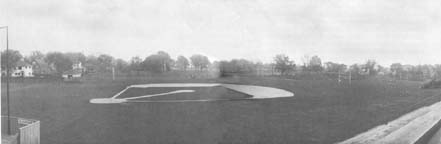
When, therefore, it was reported in 1900 that a new athletic field was being projected, the tidings aroused unbounded enthusiasm. In December of that year Mr. George Brown Knapp (1836-), who had recently been elected a member of the Board of Trustees, offered to the Academy the sum of $7650, subject to a life annuity, for purchasing land for a playing-field. Some twenty-five acres were secured to the east of Highland Road and south of Salem Street; the ground was marshy, --- indeed it had been used up to that time for a skating meadow in winter, --- but it was reasonably level and conveniently located, and it was believed that it could easily be drained and graded. "Brothers' Field," as it was called at Mr. Knapp's request in memory of the affectionate relations between his deceased brother, Arthur Mason Knapp,(1) and himself, was opened and dedicated at Commencement, 1903, with a presentation speech by the donor. As matters turned out, however, the project was much more expensive than had been anticipated. In 1901 Mr. Henry A. Morgan contributed the additional sum of $3000 for the purchase of another strip of land. Since that time the Athletic Association has been obliged to expend rather more than $30,000 in building grandstands, and in draining, leveling, and sodding the field. As it is now completed, Brothers' Field is perfectly arranged for athletic contests; it has a football gridiron and a baseball diamond, both for the use of the school teams; and there is a large amount of ground for practice in these and other sports. On the land still farther to the east a new cinder track and grandstand have been constructed, which were used first at the Andover-Exeter track meet in 1917. (Claude Fuess. An Old New England School. A History of Phillips Academy. Boston: Houghton Mifflin. 1917.)

The real windfall came, however, six months later: on 30 May 1900, George Mason Knapp, a new trustee, offered to "purchase an athletic field for Phillips Academy, the academy to pay during the life of himself and Mrs. Knapp interest at the rate of 4% upon said sum.(7) A letter to the Board from Mr. Knapp at the December meeting of 1900 stated that: "In order that land be secured for use by the students of Phillips Academy for athletic purposes... I hereby offer to give for that purpose $7,650." The Treasurer of the Academy was to pay him and his wife $150 in June and a like amount in December as long as they lived. The Trustees voted to accept the proposal and authorized the purchase of the land to be known as "Brothers Field" in accordance with Mr. Knapp's desire "to associate with himself in this gift the memory of his late brother, Arthur Mason Knapp, sometime a teacher in the academy.(8) In July 1901, Henry Morgan pledged $3,000 to the new athletic field fund, at which point Mr. Knapp offered to purchase the remaining unsold land in the area. The offer was accepted with thanks by the Trustees, who then authorized an advance of $8,000 to the Athletic Association to complete the project.(9) Some twenty-five acres were secured to the east of Highland Road and south of Salem Street. Although it was lowland and wet, adequate drainage was provided for in the construction contract; the field was completed in time for Commencement 1903, which coincided with the 125th Anniversary of the school. At the dedication ceremony, Mr. Knapp, after having paid tribute to the value of athletics and "healthful, manly sports," stated:
It is because my brother and I were more than brothers---good comrades---and, until four years ago, almost inseparable companions, that I have associated myself with him in the name that I have chosen, The Brothers Field. (Fred H. Harrison Athletics for All. Andover: Phillips Academy. 1983.)
Knapp, George Brown. S. of Hiram and Sophronia (Brown),
b. St. Johnsbury, Vt., Ap. 9, 1836. M. A., A. C.,
1862. Psi Upsilon.
Prepared Phillips Acad., Andover. In business St. Johnsbury,
Vt., 1859-62; corresponding clerk for Gardner Brewer & Co.
Boston, 1862-74; clerk and business agent for private estate,
r. Auburndale, 1874-1919. D. Auburndale, D. 21, 1919.
Married S. 2, 1862, Elizabeth D., da. of Alexander H. Strong,
Vicksburg, Miss. (website)
Arthur Mason Knapp came to Phillips Academy in 1863 as a teacher, just out of Harvard. During the year he was injured while playing ball with his students and had to resign; he was on crutches for several years and suffered during the rest of his life. For twenty-four years he held a responsible position in the Boston Public Library. (Claude Fuess. An Old New England School. A History of Phillips Academy. Boston: Houghton Mifflin. 1917.)
A contract was let to J. W. Tarbell of Lowell to provide two football fields and two baseball diamonds. The work was completed in the summer of 1902 but the soft condition of the turf delayed use for athletic events.
George B. Knapp wanted to associate his name with that of his brother, Arthur Mason Knapp --- a teacher at the Academy in 1863, in the memorial so the facility was dedicated in 1903 as Brothers Field. The first contest played there was on November 14, 1903, during which Phillips Academy beat their longstanding rival, Lawrenceville.
Miss Katherine Knapp, sister of George and Arthur, willed sufficient funds to the Academy for construction of the Knapp Memorial Gateway located at the entrance to the playing area just west of the Cage and facing the Main Street-Highland Road triangle. (Robert A. Domingue. Phillips Academy, Andover, Massachusetts. An Illustrated History of the Property (including Abbot Academy). Wilmington, MA: RAD Publishing, 1990.)
The location of the new Cage posed a problem for the Athletic Department. The football field would now have to be moved one hundred yards to the east on Brothers Field, thereupon encroaching on the infield of the baseball diamond, which then would be turned into an uneven cow pasture every fall. At Director Page's request, the Trustees, early in 1924, voted that a further careful re-study of Brothers Field be made with a view of ascertaining a satisfactory layout of the new football field for next fall's Exeter game.(11) Early that spring they authorized the Treasurer to borrow $28,000 for wooden grandstands on Brothers Field with instructions that the charge for seats in the new stands be fixed at a sum sufficient to insure their amortization.(12) Miraculously, it seemed, the new football field was built and ready for use within one year. Located on a high plateau south and east of the Borden Gymnasium, crowned in the center and beautifully drained, the upper Brothers Field remained a model for athletic playing fields for years thereafter. The new wooden stands could accommodate 7,200 spectators, and the addition of temporary end-zone stands would bring the total to 10,000 people. The Bulletin's description was somewhat whimsical. The field runs north and south, but they had it running east and west "so that the sun will seldom shine in a player's eyes." And the thousands of Phillips Academy hopefuls who have since trudged up the hill from the gymnasium area will be somewhat nonplussed to learn that the distance from one to the other was only one hundred yards.(13) On 15 October 1924, a significant day in Andover football history, the new field was dedicated with a 13-0 victory over the Harvard Freshmen, the unwilling victims of a "ceremony which christened one of the most beautifully equipped and most beautifully situated fields that any school can boast." (Fred H. Harrison Athletics for All. Andover: Phillips Academy. 1983.)
They proposed to the Trustees in the October meeting in 1921 that there existed the possibility of securing for athletic purposes the land adjoining Brothers Field and now included in the so-called Pearson Farm. The Board voted in the proposal at a price of purchase not to exceed $35,000. (Ibid.)
Later the Class of 1922, as their Fiftieth Reunion gift, and again Sumner Smith sponsored the construction of a much-needed Field House on the southwest side of Brothers Field. This building had room for the shelter and repair of four vehicles, two visiting team rooms, and public toilet facilities. (Ibid.)
The growth of the automobile industry made it easier for spectators to come longer distances to see athletic contests. Just before the war, in the years between 1912 and 1917, parking in the vicinity of Brothers Field on the day of the Andover-Exeter football and baseball games was already becoming a problem, which was magnified in the twenties. With the advent of the radio and other improved communication facilities, sports events and their coverage became regional and national, rather than local. A mutually supportive liaison between the media and the athletic departments of educational institutions kept the interested American public constantly and completely informed of the results of athletic contests and the status of the current athletic heroes. These were the years of the racoon coat, the hip flask, and the flashy convertible or coupé. The badge of social respectability was easy to acquire by personal association with sports. One needed only to wear the proper uniform for the occasion and spend every Saturday afternoon cheering unrestrainedly for the school or college team of one's choice. Subway alumni were as heartily welcomed as bonafide graduates. Harvard and Yale had set the stage in the Northeast for the unprecedented growth of enthusiasm for college sports by building spacious outdoor arenas capable of seating tens of thousands of interested viewers. The mania swept the country, and from that day forward, particularly after the war, college athletics had entered the ranks of big business.
Andover and Exeter were inevitably caught up in the frenzied euphoria of the times. The traditional football game at Exeter in 1919 drew 7,500 spectators. The following year at Andover the crowd was estimated at 10,000 people. At the Exeter game on the new Brothers Field in 1924, there were 10,000 spectators. Furthermore, in order to conform to the Trustees' edict to amortize the cost of the new bleachers, the ticket price had been raised to $2 per person. (Ibid.)
Excitement about the prospects for baseball ran high in the spring of 1866. The team would be playing on a new diamond, and there seemed to be an abundance of talent on the campus. Also, everybody was naturally interested in the formation of the first preparatory school nine in the country. The competition for the nine was intense, but all eyes were on Archie Bush. He had entered Andover after having served as a soldier in the Union Army and had the reputation of being a very clever baseball player . During the next five years he would be regarded as one of the best in the country, either amateur or professional. At Andover he was elected captain of the team in his first year, as an underclassman. Under his leadership the team practiced every day and gave a good account of themselves in matches with outside teams. As a coach, Bush established the first training table at the school; as a player, he was a catcher but could play any position if necessary. Both he and Wells from that first Andover team went to Harvard; both played there for four years; and Bush captained the team for three of those years. He was regarded as the finest college baseball player in the country and also voted the most popular man in his class at Harvard. During his four years on the team, Harvard never lost to Yale in baseball. His name is legendary in the annals of both Phillips Academy and Harvard athletics;(28) the present baseball scoreboard on Brothers Field is dedicated to his memory. (Ibid.)
...the football contest between the two arch rivals in 1955 had to be one of the most exciting in modern times. Andover's team, led by Co-captains Trevor Grimm and Bruce Smith, had lost only two games, to Springfield Freshmen and Williams Freshmen, when they met Exeter at Plimpton Field. Andover had a touchdown called back in the early moments of play and seemed to lose confidence and poise. Despite reasonable play on the defense, the offensive machinery could not seem to build momentum and, with six minutes to play, Exeter led by a score of 12-0. Exeter had a third touchdown called back for clipping and could not repeat the score. With six minutes left in the game Perry Hall ran back an Exeter punt 40 yards to the Exeter 35-yard line. With two successive passes from Forstmann to Grimm, Andover scored its first touchdown and Forstmann kicked for a successful conversion. Exeter ran a series of plays and, for some unaccountable reason when they were stalled, kicked on third down. Matt Freeman took the punt on his own 40-yard line and drove to the Exeter 43. Forstmann plunged to a first down and then passed again to Grimm, who made a scooping catch on the Exeter 35-yard line. Andover's quarterback then hit Matt Freeman with a look-in pass down the middle, and he romped into the end zone with no Exeter player within 20 yards. With the Andover stands going wild with delight, Tony Forstmann again kicked for the conversion and, fifty-eight seconds later, Andover had won its fourth straight victory in the football series. An Andover alumnus parent sitting in the stands found the lack of an adequate scoreboard at Plimpton Field particularly frustrating that day because nobody knew the official time as the game was ending in this thrilling fashion. The following fall he made an anonymous gift to Phillips Academy to be used to install a new and more modern scoreboard on Brothers Field. (Ibid.)