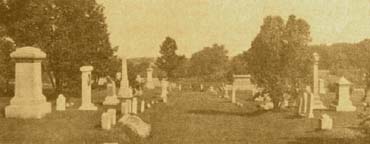
The next addition to the Seminary (and the Academy) was the Chapel Cemetery. This 240 ft. by 300 ft. piece of land was opened as a burying ground in 1810, was deeded to the Seminary in 1820 and to the Academy Trustees in 1908. It is under the charge of an association which was formed on November 8, 1872, and incorporated on May 17, 1907.
This two acre area contains the graves of trustees, professors, benefactors and members of their families, both of the Seminary and the Academy; of scholars and devines who had made Andover their home; of students who died during their course of study. One of the first to be buried there was Lewis Le Conte Congar, a student who died January 6, 1810. The cemetery includes the graves of Leonard Woods, Moses Stuart, Harriet Beecher Stowe and her 19 year old son, Samuel Farrar, Alfred E. Stearns, Cecil P. F. Bancroft, John Dove and many others.
Harriet Beecher Stowe's monument, erected by her children in 1897, is an "Iona cross" of Aberdeen granite resting on a sub-base of American granite. It is about 12 feet high and in the form of the Celtic Cross. The inscription reads "A Tribute of Loving Remembrance Erected by Her Children" on the upper portion; on the base are the words "Her Children Rise up and Call Her Blessed". Over the grave of her husband at the left is a recumbent Latin cross of Wellesley granite and at the right is a white marble cross erected to the memory of their son, Henry White Stowe who was drowned at Dartmouth College in 1857. (This white cross has been vandalized in recent years.) (Robert A. Domingue. Phillips Academy, Andover, Massachusetts. An Illustrated History of the Property (including Abbot Academy). Wilmington, MA: RAD Publishing, 1990.)

The last slave born in Andover was Rose Coburn, who died in 1859, aged ninety-two. Cato Phillips died about seven years before. Slaves were freed here in 1780. Buried in the Chapel Cemetery is the colored servant of President Porter. (Susan E. Jackson. Reminiscences of Andover. Andover: Andover Press, 1914.)
The last days of [Professor Leonard Woods'] life were peaceful, and filled with the faithful work which even the growing infirmities of years did not tempt him to discontinue. If there had come across his vision a glimpse into the troubled future awaiting his beloved Seminary, this holy calm would doubtless have given place to deep anxieties and forebodings; but, fortunately for him, he went home while from the old pulpit there had been uttered no heretical discourses, while Westminster Shorter Catechism still held its revered place by the side of the words of Holy Writ, while second probation was a thing undreamed of, and a trial of a member of the faculty for heresy as impossible to anticipate as the burning of one of them at the stake for too close an adherence to the old theology. He was an old man when he died; and he was buried in the hallowed cemetery behind the chapel which he had, loved, and in which he had taught and preached for so many long years. (Sarah Stuart Robbins. Old Andover Days. Boston: Pilgrim Press, 1908.)
Johnson unfortunately did not rally from the attack, but became gradually weaker, and on April 17, 1837, he sent in his resignation to the Trustees. One of the last acts which he performed was to send fifty dollars to the Foreign Missionary Society without a signature. He died May 9, 1837, and was buried in the Chapel Cemetery, where a monument, erected at the expense of his students, bears a commemorative inscription composed by Professor James L. Kingsley, of Yale College. (Claude Fuess. An Old New England School. A History of Phillips Academy. Boston: Houghton Mifflin. 1917.)
In 1864, Professor Stowe left his position in the Seminary, the family moved to Hartford, Connecticut, and the Andover chapter came to an end. Yet now one of the spots visited by pilgrims to literary shrines is the beautiful Chapel cemetery near her old home, where a tall red granite shaft erected by her children marks her last resting place. (Jane B. Carpenter. Abbot in the Early Days, 1959.)
Professor Churchill, on the Sunday following Dr. Taylor's death, preached an appreciative sermon in the Seminary Chapel. By a vote passed February 27, 1871, the Senior class agreed to prepare a memorial volume, containing Professor Park's eulogy, Professor Churchill's sermon, and other material giving reminiscences of the deceased Principal. A fine tombstone was soon erected to his memory in the cemetery, with an inscription composed by Professor Park. A bronze tablet in the Academy building marks the spot near which he fell. (Claude Fuess. An Old New England School. A History of Phillips Academy. Boston: Houghton Mifflin. 1917.)
The public funeral took place on Monday, October 7, in the Stone Chapel. Twelve of the students acted as bearers, and the cortège was escorted by the entire undergraduate body, the President of the school acting as Chief Marshal. The Chapel exercises were conducted by President Tucker, of Dartmouth College, and a committal service was read by Dr. John Phelps Taylor. Dr. Bancroft was buried in the beautiful cemetery on Andover Hill, where Dr. Samuel H. Taylor had been laid to rest over thirty years before. In 1905 a granite monument, the gift of his pupils, was erected over his grave. (Ibid.)
The dedication was a completely appropriate climax to Jack [Fuess's] long association with Phillips Academy. And how fortunate that he could be there to enjoy the honour! Less than a year later he was dead. Thus closed a long career of service with distinction. The epitaph on his gravestone in the old Phillips Academy cemetery reads: "Wit graced his learning and generous warmth his friendship." (Frederick S. Allis, Jr. Youth from Every Quarter. Andover: Phillips Academy. 1979.)