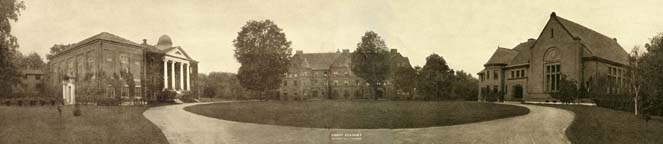
An important part of the campus, literally and symbolically, was and is the "Circle," which was formed when Draper Hall was built in 1890, even before the old Davis Hall was replaced by McKeen, and soon began to be talked about by name. The term was used not only for the walk itself but for the grass plot enclosed by it which, it was authoritatively understood, must never be trod upon except on such great occasions as Commencement in the sunny hours or when it was glorified at night by the ring about it of Japanese lanterns. There was another exception to the rule: Miss Bailey encouraged the girls to stage on the lawn any colorful activities, such as the winding of the Maypole, so as to be seen by Mrs. Draper, whom she called Abbot's fairy godmother, sitting in the window of her house across the way.
As the name gained in popularity, the students followed suit and in 1917 named the senior class book "The Abbot Circle." All sorts of pleasant memories cluster about this spot, spring days with girls strolling round it between classes or after dinner, Phillips serenades, Commencement processions, and the thrilling alumnae parade at the time of the Centennial. Once when unusual weather conditions had provided a snowy crust there was skating on the Circle in the moonlight! This was described as "indeed an event to go down in history, to furnish a convenient date to reckon from, like 'the year of the great earthquake' "--- or the blizzard of '88! In time the Circle became to the alumnae a symbol of unity, something quite precious, as was registered by the way protests were received when in 1941 the proposed changes in Draper Hall threatened a break in the curve. In the end, however, sentiment prevailed. (Jane B. Carpenter. Abbot in the Early Days, 1959.)

Alumnae Day came on Tuesday, June 4. What a day it was! It began with a moving Chapel service in old Abbot Hall and the annual business meeting. Time out for registering and other formalities and for the excited greetings of old friends was followed by a reception on the lawn. In the receiving line were Constance Parker Chipman, 1906, Association President and prime mover in the arrangements for the day, Miss Bailey, Dorothy Bigelow, 1911 (soon to be Mrs. Arms), at that time the only Alumnae Trustee, and eleven Abbot Club presidents.
The next event was the grand parade. The classes forming behind Abbot Hall were guided to their places by blue class pennants and moved forward into the Circle to the music of the band, headed by a representative of 1856, Sarah Abbott Martin. A sixty-year graduate had said laughingly, "My locomotive powers are good, I shall be glad to trudge along with the rest." The gay decorations and class regalia were most effective. For example, the twenty-five year class were in stunning yellow and black with smocks and palettes in honor of their artist Principal, Miss Means. Nineteen hundred and seven was resplendent in boas and big scarlet hats of "Merry Widow" style, while war-time activity was suggested by Red Cross garb and military uniforms. When the long line of marchers, passing in review before Miss Bailey and Miss Kelsey, had completely filled the Circle, the fact that it symbolized the circle of alumnae scattered round the world grew upon the throng and deep emotion was apparent. (Ibid.)
In 1929, because of the change in status of Bradford to a junior college, a Play Day was instituted when instead of competing as usual the girls were divided into color teams irrespective of schools. On the first occasion the Abbot Circle was a gay sight with bright pennants flying from tall white poles. The composite Abbot-Bradford groups took their places under their several assigned colors and as the music sounded moved into the steps of an English country dance. (Ibid.)
Down the hill a bit the Abbot Academy buildings, grouped about the green circle and approached through the dignified Merrill gates, will attract attention. Abbot Hall, the original school building with columns, was erected in 1829. The school was founded by a group of Andover citizens, with assets consisting of a note for one thousand dollars plus one acre of land, given by Madam Sarah Abbot. (Historic Houses in Andover, Massachusetts, 1946.)
IN the following pencilled draft of a talk evidently given by Rev. Samuel C. Jackson at the opening of Smith Hall in 1854, a link is recovered in the chain of circumstances resulting in the founding of the school. The "venerable gentleman" referred to was undoubtedly "Squire" Farrar, who had shortly before resigned his position as trustee after twenty years of energetic service. It was he who is said to have advised Mrs. Sarah Abbot to use her "surplus funds" to "found an academy in Andover for the education of women," and to have been ready with this suggestion because of his long familiarity with the idea through association with his honored friend, Madam Phillips. Mr. Jackson, in this bit of paper, preserved for many years, takes the story further as he had it from the lips of Mr. Farrar himself. (Jane B. Carpenter. Abbot in the Early Days, 1959.)
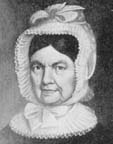
Sarah Abbot was born October 3, 1762, the daughter of George Abbot and Hannah Lovejoy. Her grandmother was Mary Phillips, sister of the Reverend Samuel Phillips. She was thus a second cousin of Judge Phillips. She married Nehemiah Abbot, first Steward of the Seminary, who, at his death, left her the money which she later used for the benefit of Abbot Academy. (Claude Fuess. An Old New England School. A History of Phillips Academy. Boston: Houghton Mifflin. 1917.)
Professor Stone's house was the residence of Mrs. Sarah Abbot at the time of her giving the money which built Abbot Academy. Her maiden name was Abbot --- her birthplace the old homestead on Central Street. Both her husband and herself were descendants of George Abbot, one of Andover's first settlers, who came over in the Arbella with Winthrop and Bradstreet in 1630. One branch of the family married with the Lawrences, whose descendants founded the city of Lawrence. George Abbot built on Central Street before 1676. Mrs. Sarah Abbot is described by early pupils of the school who loved to visit her, as "a small, demure old lady"---"very deaf, but hospitable, and ladylike." Another calls her "a woman of a prayerful spirit."
When the little Hawaiian boy, Obookiah, was brought to Andover by Samuel J. Mills, he was placed in Mrs. Abbot's care for two years. In his memoirs it is recorded that he often came to Mrs. Abbot's room (in the old Stewards House) and knelt by her and prayed --- an incident revealing her kindness and piety. Out of the interest aroused by this little waif grew the missions to his native islands. Mrs. Abbot died February, 1848, aged eighty-six. (Susan E. Jackson. Reminiscences of Andover. Andover: Andover Press, 1914.)