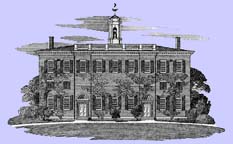
On September 2, 1807, a Constitution of the Seminary, composed mainly by Dr. Pearson, Mr. French, and 'Squire Farrar, was submitted to the Trustees and accepted by that body. By its terms Samuel Abbot promised the sum of $20,000 in trust as a fund for perpetuating a Professorship of Christian Theology; while Madame Phillips and her son, Colonel John, agreed to erect two separate buildings. This happy issue of the matter was due directly to Pearson's perseverance and tireless energy, which encouraged the others and inspired faith in his plans. It was during this period that he climbed the noble old oak tree still standing in the rear of Pearson Hall, in order to map out the campus and fix suitable sites for the proposed houses and halls. (Claude Fuess. An Old New England School. A History of Phillips Academy. Boston: Houghton Mifflin. 1917.)

In 1817, the benevolent William Bartlet, having watched with interest the development of the Seminary, resolved to provide that institution with a suitable Chapel. It is uncertain just how he secured Bulfinch as the architect---possibly through the intervention of His Honor, William Phillips, Lieutenant-Governor of Massachusetts from 1812 to 1823, who had been a Trustee of Phillips Academy since 1791, and who was a friend of Bulfinch, as well as one of his political associates. Nothing can be discovered of the way in which the negotiations were begun; but the building is included in a list made out by Bulfinch himself, where it is designated as "Chapel and Library for Theological Institution." As completed in 1818 and transferred to the Trustees by the donor, it was made of brick, containing a chapel at one end and a library at the other, with recitation rooms above. The total cost was apparently $23,374.
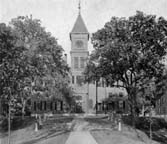
It was this building which was known for more than ninety years as Bartlet Chapel and used by Andover Theological Seminary. In the '70's some ill-advised persons altered it by adding a preposterous clock tower, thus destroying the effect of the Bulfinch façade. In 1908, when the Seminary was moved to Cambridge, the building was purchased by Phillips Academy, rechristened Pearson Hall, to distinguish it from Bartlet Hall (then in use as a dormitory), and divided into recitation rooms. In 1924, it was shifted from its commanding location to a new site to the southeast; the inappropriate tower was taken down and the beautiful Bulfinch lines were restored just as far as that could possibly be done; and it stands to-day much as it was originally constructed, although the interior has been completely changed---not altogether for the better. (Claude Fuess. Men of Andover. Biographical Sketches in Commemoration of the One Hundred and Fiftieth Anniversary of Phillips Academy. New Haven: Phillips Academy. 1928.)
William Bartlet, born in 1747 in Newbury, was apprenticed at an early age to a shoemaker, but gradually acquired the ownership of a large fleet of sailing vessels, through which, in the East India trade, he amassed considerable wealth. He died in Newburyport at the age of ninety-four. Physically he was a large man with a giant frame and a strong step. Even in his old age his eye was not dim nor his natural force abated. He had simple tastes and unassuming manners. His most distinguishing characteristic was his tenacity of purpose. Frugal and parsimonious in small matters, he was generous on a large scale to projects in which he was interested. To Andover Theological Seminary he gave Bartlet Chapel, Bartlet Hall, Phelps House, Stuart House, besides large sums in money. (Claude Fuess. An Old New England School. A History of Phillips Academy. Boston: Houghton Mifflin. 1917.)
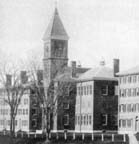
The growth of Andover Theological Seminary --that "citadel of old-fashioned orthodoxy" --- gave Andover more importance, and its new buildings soon transformed the Hill. On September 22, 1818, a great throng of people gathered to hear Dr. Ebenezer Porter's sermon dedicating Bartlet Chapel, now Pearson Hall. This structure, described by a contemporary as "vieing in elegance with any in the United States," was built by William Bartlet, at a cost of $23,374. It soon became the center of Hill life. The chapel room to the right on the first story was used for literary societies, prayer-meetings, elocutionary drill, public lectures, and Commencement exercises. On the platform in this room Mr. Bartlet sat when the artist, without his knowledge, made a sketch of him for the portrait which he had refused to have painted. Here the walls echoed on week-days with the voices of "theologues" practicing their sermons. On the floor above was the library, gradually growing larger. At the north end of each of the three floors was a lecture room for the professors of divinity. (Ibid.)
Bartlet Chapel, the middle of the three stately Seminary buildings was designed by Charles Bulfinch. It was included in a list made out by Bulfinch himself where it is designated as "Chapel and Library for Theological Institution". Construction was funded by William Bartlet, a major benefactor of the Seminary who lived in Newburyport; the final cost of the building was $23,374. The dedication, held September 22, 1818, was an event of general town and gown interest. The schools throughout the town were closed and crowds of people attended the exercises. Prof. Ebenezer Porter delivered the sermon for the occasion.
The bricks for the chapel came from Newburyport being hauled over the distance by four oxen. The original building had its door on the left side of the east face and a false door was placed on the right side for uniformity. On the right side of the entry the structure was two storied, the lower room being the chapel, the upper being the library. On the left side there were three stories, each containing a lecture room --- the first was for Seniors, the second for the Middle Class and the third for Juniors. There was a small round cupola on the top of the building.
The original Chapel had bare white walls, high backed pews with doors and an old-fashioned pulpit box. Later pews were of the conventional style shown in the picture below. Mrs. Robbins mentioned the custom of leaving the Chapel at the close of a service one tier of seats at a time. This pattern was necessary since there was but one aisle and the long pews on either side held ten persons. The theologues occupied the back seats on the right of the entrance, the Phillipians those on the left and those on both sides of the pulpit which were at right angles to the body pews. (Robert A. Domingue. Phillips Academy, Andover, Massachusetts. An Illustrated History of the Property (including Abbot Academy). Wilmington, MA: RAD Publishing, 1990.)

It is not too much to say that the Seminary was the most important single influence on the School; but during its hundred years of existence, it set the intellectual and religious tone of Andover Hill as well. It soon eclipsed Phillips Academy in endowment, buildings, and reputation. A few years after its founding, it included two large brick dormitories---the present Foxcroft and Bartlet Halls---with a chapel and recitation building, the present Pearson Hall, located between them to make an impressive façade in the eastern part of the campus. (Frederick S. Allis, Jr. Youth from Every Quarter. Andover: Phillips Academy. 1979.)
With the legal difficulties in connection with the Seminary's move to Cambridge successfully overcome, and with an agreement for the purchase of the Seminary property signed, sealed, and delivered, the last remaining problem was how to pay for it all. Since the Trustees had no money for this purpose, they obtained it by a fund drive, and in the fall of 1908 the "Seminary Purchase Fund" was established. In addition to the purchase price of $200,000, another $50,000 was added for the remodeling of Seminary buildings; Bartlett Chapel, now Pearson Hall, for example, needed to be converted into a recitation building. (Ibid.)
With the school year opening September 16, 1908, Phillips Academy entered upon what has proved to be almost a new era in its history. Bartlet Hall and Phillips Hall, renovated during the preceding summer, were put into use as dormitories for the boys. Bartlet Chapel, rechristened "Pearson Hall," had been remodeled in the interior as a recitation building. New walks had been laid across the Seminary Campus. (Claude Fuess. An Old New England School. A History of Phillips Academy. Boston: Houghton Mifflin. 1917.)
Of senior Latin in Pearson Hall, and Charlie Forbes (no Hinman he) gently untangling the underbrush of Vergil's Aeneid. What was it that Queen Dido said as Aeneas left her and took off again on his wanderings? . . . "Forsan et haec olim meminisse iuvabit. Someday, perhaps, it will give you pleasure to remember these things ......."
And it does. (Claude Fuess. In My Time. A Medley of Andover Reminiscences. Andover: Phillips Academy. 1959.)
From Jack Fuess, in his big sunny classroom in Pearson Hall, I learned the joy and the basic skills of writing. Jack Fuess cared about writing, knew about it, and worked at it; and he liked students, and wanted them to know, too, and he was crisp and good humored and civilized about it all, and so he got through. I thought then, and I still think, that Jack Fuess was one of the two great school teachers of my time. His manner was to stand straight before us on the low platform, hands cocked on hips, heels together, a knee twitching, now and then the flat of a hand brushing back nervously over the bald head; his smile was broad and confident, his voice quick and firm; here was a friendly, lively, interested man, keen to have you share with him the fun, the work, and the importance of clear, expressive, disciplined writing. For most of college and all of my working life I have thought of myself as dependent for survival mainly on writing, and the solid growing pleasure I take in the use of language I trace back easily to Jack Fuess. (Ibid.)
The result of this joint conference was the establishment of a summer military camp, with Major Davy as Commandant. He had exceptionally able assistants in Lieutenant R. E. Wyatt of the Canadian Expeditionary Forces, Dr. Carl Guthe of the Faculty, and Dr. Pierson S. Page, who served as Medical Officer. Over two hundred boys, three-fourths of them from other schools, enrolled for the course of six weeks, from July 3 to August 14. As matters developed, the camp was ideally situated for military purposes. The Main Campus was a perfect drill and assembly ground. The dormitories, Bartlet, Phillips, and Day, were commodious and comfortable barracks. Pearson Hall was a study and lecture building. (Claude Fuess. Phillips Academy Andover in the Great War, 1920.)
Interest in the Rifle Club increased month by month. During the fall and winter of 1915-16 nearly two hundred students joined and took the course of instruction. The Trustees gladly built an excellent indoor sub-calibre range, seventy-five feet long with six alleys, in the basement of Pearson Hall. There tournaments were frequently held; each member shot under supervision, and his score, in accordance with the National Rifle Association regulations, was carefully checked by inspectors. With the establishment of military training as part of the school program, the rifle range became indispensable and was constantly in use. During the year 1916-17 the Phillips Academy team finished second in the contest of the Massachusetts Association and defeated a team from Exeter by a score of 1157 to 1013. In the spring term all who had qualified on the indoor range were allowed to shoot on the outdoor government ranges at Frye Village, the distance being two hundred yards. In the qualification trials on the range at Wakefield four members of the club won the bronze badges of expert marksmen, and the record of the others was highly commendable. (Ibid. )
Knowing that one third of the fund had been raised specifically for construction, everybody on the Hill was looking forward to the day when the badly needed school building would be ready. Where should it be located? The conventional choice would have been a site on the west side of Main Street, traditionally occupied by Phillips Academy. At this point, however, George B. Case, with his restless and far-sighted mind, studied possibilities and offered a daring suggestion. He could visualize an extensive and attractive development on the other side of Main Street, on land controlled for a century by Andover Theological Seminary but recently purchased by Phillips Academy. Why not move Pearson Hall (formerly the Seminary's Bartlet Chapel), open up a broad vista, and construct the new main building on the ridge to the east, the highest point on the Hill? It was an audacious conception to shift a brick structure two stories high, tear down its ugly bell tower, and restore its original external design created by the great architect, Charles Bulfinch, in 1818. One morning Case led his fellow trustees to a position on the slope where he could explain his project and show where a new quadrangle could be laid out. Then and there he converted them, and the future expansion of Phillips Academy was assured. (Claude Fuess. Independent Schoolmaster. Boston: Little, Brown. 1952.)
Taken together, George Washington Hall and Morse Hall fulfilled part of Cochran's dream, for they completed the so-called "Great Quadrangle," consisting also of Samuel Phillips Hall on the east, Bartlet and Foxcroft dormitories on the west, and Pearson Hall on the south. This cluster of buildings could serve as a focal point, to which structures yet to come could be related. (Frederick S. Allis, Jr. Youth from Every Quarter. Andover: Phillips Academy. 1979.)
The sequel to these interesting events ought not to be left untold, perhaps as a warning to other younger headmasters. The other Bulfinch building on the Hill was Pearson Hall, purchased by the Academy from the Theological Seminary and later moved by Mr. Cochran in the 1920's from its central position in Seminary Row to a site on the south side of the Great Quadrangle. There on the ground floor I had taught English for many years, in a classroom eighteen feet high, with old-fashioned desks and antediluvian lighting. In a mood of optimism I thought how fine it would be if Pearson Hall could be reconstructed as Bulfinch Hall had been and devoted to the study of foreign languages. Again I consulted Mr. Perry, who made some sketches, and when all was ready I paid a visit to Mr. Harkness.
His response was just as gracious as it previously had been, and he chatted with me as usual in front of the grate fire, pipe in hand. He had never been able to visit Andover, but when I described to him the visible results of his philanthropy he seemed much pleased. Then, as the conversation lagged, I drew out of my brief case a photograph of Pearson Hall and described in my most eloquent and appealing voice what I had in mind. He listened without comment until I had finished my story and then said, "Mr. Fuess, I think I have done quite a little for Andover and for you, and I'm afraid I shall have to stop now." I perceived that, in my ardor to get a large number of things done in a hurry, I had pushed the matter too far. I rose and said, "Mr. Harkness, you have done for Phillips what amount to miracles. You have enabled me as headmaster to do things which I could never otherwise have accomplished. I am deeply grateful, and sorry that I troubled you at all on this final matter." With that I shook his hand and went out. Unfortunately the school has never since been able to make the interior of Pearson Hall what it properly should be. (Claude Fuess. Independent Schoolmaster. Boston: Little, Brown. 1952.)
DURING ITS two centuries of existence Phillips Academy has really been two schools. The first, from its founding in 1778 until the death of Samuel Harvey Taylor in 1871, was essentially an eighteenth-century institution, on which Eliphalet Pearson had imposed his imprimatur in no uncertain terms. Though there was some variation and some experiment during the first hundred years, the Academy in 1871 subscribed essentially to the basic principles that Pearson had insisted on from the start (Frederick S. Allis, Jr. Youth from Every Quarter. Andover: Phillips Academy. 1979.)
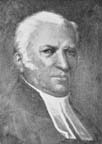
Principal Eliphalet Pearson, who thus struck terror to the soul of the seven-year-old boy, has been called "in some respects the most remarkable man ever connected with the institutions of Andover." More than one historian of those days has lavished superlatives upon him. He was a stubborn, autocratic pedagogue of the old school, powerful in physique, domineering in manner, and exacting in his requirements from his pupils. But he was something more than a leader in the classroom. Washington once said of him, "His eye shows him worthy, not only to lead boys, but to command men." His astounding energy and versatility made him seem to be a kind of "superman." He was an able musician, both in theory and practice: a good bass singer, a performer upon the violoncello, and the author of an authoritative treatise on psalmody. A skilled mechanic, he could take apart an engine or construct his own violin. As a farmer and trader he displayed shrewd business sense. His scholarship was impressive, for he knew not only Latin, Greek, and French, but also Hebrew, Syriac, and Coptic. His restless and eager intellect carried him into almost every field of research.
Pearson's temperament, which was naturally irritable, made him no friends. His students, with whom he was far from popular, called him "Elephant" Pearson, because of his ponderous name and figure; and older people were not inclined to waste upon him any terms of endearment. He once said to his son, "I care not a straw what the world thinks of me." More than once this disregard of the views of others was the cause of his being denied the credit for achievements which were really due to his aggressiveness and persistence. There was nothing flabby about Pearson's personality, nothing vague about his opinions. A dogmatist on problems of politics, education, or theology, he was accustomed to speak ex cathedra and to brook no opposition. His faults, however, were never those of weakness. Even those who disliked him would have agreed with Professor Park that Pearson was "a many-sided and strong-handed laborer for the welfare of his race."
Much of what has been said of Pearson in the preceding paragraphs is applicable to him only in the later stages of his diversified career. At the time when he was Principal of Phillips Academy his real genius was, perhaps, not quite so manifest. Born in Newbury, Massachusetts, June 11, 1752, Eliphalet Pearson was about four months younger than his friend, Samuel Phillips, Jr. He was the eldest son of David Pearson, a thrifty farmer and miller. In order to attend school Eliphalet had to give his father a promissory note for the sum advanced for his education; and he had then to walk four miles each way, through fields and along lonely crossroads, to Dummer School. From there Pearson, in 1769, followed Phillips to Harvard College, where he graduated in 1773, two years later than his friend. Pearson's scholastic record at Cambridge was decidedly brilliant, and his Commencement oration denouncing the African slave trade was considered so remarkable that it was published in pamphlet form.
After graduation, Pearson spent some months in further study in Cambridge, where he made the acquaintance of the widow of President Holyoke, of Harvard, and her daughter Priscilla. In April, 1775, following the news of the clash of arms at Lexington, he promptly escorted these ladies to Andover, hoping that they might there be safe from intrusion. So pleased was he with the reception accorded him by Samuel Phillips, Jr., that be also settled in Andover, taking charge of the grammar school, acting as a kind of private chaplain in the Holyoke home, reading extensively in both theology and science, and filling the pulpit in adjacent parishes. The part played by his knowledge of chemistry in insuring the success of the Phillips powder-mill has already been related.
In 1780, after his election as Principal of Phillips Academy, he married Priscilla Holyoke, who was then forty, twelve years older than he, but who looked and acted like the younger of the two. She brought him a dowry of $8000. Pearson and his bride moved at once into the Abbot House on Phillips Street, just vacated by Samuel Phillips, Jr.; but their life together was short, for Mrs. Pearson died in childbirth, March 29, 1782, leaving a daughter, Maria. Three years later Pearson took a second wife, Sarah Bromfield, daughter of Edward Bromfield, Esq., of Boston, by whom he had four children. She was singularly plain and unprepossessing in appearance, but impressed her acquaintances as being amiable and intelligent. She survived her husband at his death in 1826. (Claude Fuess. An Old New England School. A History of Phillips Academy. Boston: Houghton Mifflin. 1917.)