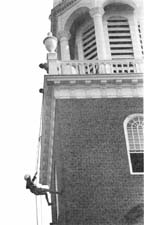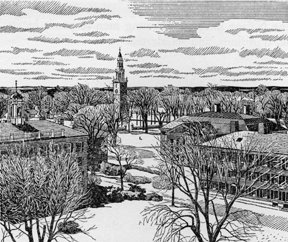
Eight descendants of Samuel Fuller --- the first rector of Christ Church --- offered to give the school a bell tower in memory of the 87 Andover men who had been killed during the Great War. The site selected for this tower was the high ground originally known as the Training Field. Ground was broken in the spring 1922; the cornerstone laying was part of the commencement exercises on June 16, 1922. Under the cornerstone was placed a copper box packed with many symbols of that day --- newspapers, books, magazines, photographs, a baseball, a pack of cigarettes and coins.
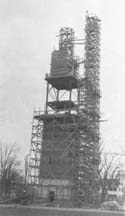
Inability to secure granite and fabricated steel in sufficient quantities made it impossible to make any progress during the summer and work really began in the fall. The tower was built of granite and brick with a white belltower of wood surmounted by a weather vane for a total height of 159 feet. The tower was designed by Guy Lowell and built by E. W. Pitman Co., Lawrence. It was dedicated in June 1923 with the address being delivered by Major Marlborough Churchill, Class of 1896. Inscriptions appear on three sides of the tower, none are on the east face:
West side: MONUMENTUM ET PIGNUS AMORIS
North side: POST EOS LUCET VIA
South side: LOGO SANCTO STABUNT
The granite posts and chain fence around the area were installed in the summer of 1929. (Robert A. Domingue. Phillips Academy, Andover, Massachusetts. An Illustrated History of the Property (including Abbot Academy). Wilmington, MA: RAD Publishing, 1990.)

The school which opened in the fall of 1918 was sober and unelate in spirit. During the summer the Roll of Honor, inscribed in beautifully illuminated letters on parchment by Mr. Charles A. Parmelee of the Faculty, had been lengthened name after name until it recorded the deaths of many boys who, within the year, had been joining in games upon the diamond or the track. The plans of the War Department for registering all those over eighteen years of age were naturally of consequence to Phillips Academy, and the Trustees would have been glad to turn the school definitely into a Students' Army Training Camp. No decision regarding secondary schools could be reached, however, and the Academy opened its one hundred and forty-first year much as usual, although without the considerable number of older boys who have usually meant so much in preserving the student morale. Two of the Trustees, Colonel Henry L. Stimson and Colonel Frederick T. Murphy, were in service at the front; several instructors, including Major Claude M. Fuess, Sergeant Sharon O. Brown, Mr. Samuel N. Baker, Mr. Frank L. Quinby (who went overseas as athletic director in the French Army), and Mr. Archibald Freeman (who was commissioned as Captain in the American Red Cross and assigned to the Balkan service) were away on leave of absence in the army or other war activities. The Trustees pursued a most liberal policy in making it possible for teachers to enter service without financial loss and with the certainty that their positions would be open for them on their return. The places of these men were, however, soon temporarily filled, and the school settled down to the familiar routine, with military training as a fait accompli in student life. Major Davy had returned to the Canadian service, and Lieutenant Wyatt had taken his place as Commandant of the regiment. The first energizing and exhilarating enthusiasm had lessened somewhat, as it always does; the element of novelty was gone, and what had been at first like diversion had become hard work; but everybody set himself in grim earnestness to toil patiently and uncomplainingly for victory. The school, like the nation, was preparing, without any illusions, for a long and taxing struggle. There was, of course, a feeling of unrest among the older boys, who wanted to take their places in the battle line, and not a few left to enlist during the autumn. Three football captains withdrew, one after the other, to enter service. But no other attitude could possibly be expected from young men of nerve and sinew.
And then, quite unexpectedly, came the news of the armistice. First there was spread abroad the false alarm, which the school authorities were none too ready to accept; and the event justified their skepticism. A few days later, in the early morning of November 11, the bells rang out their joyful peal, till all the church-towers were rocking. The boys, clad in pajamas, rushed out into the gray dawn, and, securing torches, formed in parade-line, as in the celebrations of victories over rival schools. Down the Main Street they marched to the square, where all the community, young and old, had gathered to exult over the good tidings; and throughout that holiday the bells chimed and people met each other with happy faces. The Great War was over,---over just as America was ready for a supreme effort, an effort such as this world has never seen. (Claude Fuess. Phillips Academy Andover in the Great War, 1920.)
Of those Andover men who died in the nation's service, nothing that we can say can be adequate. Their records on the following pages speak with their own simple eloquence. When Harvard College, on July 21, 1865, celebrated her memorial exercises for those of her sons who had perished in the Civil War, her Roll of Honor numbered ninety-two names. Phillips Academy, after one year and seven months of warfare, mourns seventy-seven. It is futile to hope that we can find another Lowell to-day who can compose a Commemoration Ode worthy of these heroes. We can, and do, pay them honor in our hearts. We shall hold memorial exercises to show our glory in their achievements and our sorrow at their untimely deaths. We shall have, before many years have gone by, a memorial building on Andover Hill which will be in every respect worthy of those to whom it will be dedicated. But we owe them the further obligation, not merely to cherish their deeds, but also to perpetuate the lofty principles for which they fought and died. Only by so doing can we remit our debt to those whom Phillips Academy counts
Her wisest scholars, those who understood
The deeper teaching of her mystic tome,
And offered their fresh lives to make it good." (Ibid.)
From that moment in 1921 events moved rapidly. Confident of the future, the trustees voted to erect a new dormitory, to be called Osgood Johnson Hall, rounding out the quadrangle on the west side of Main Street. Samuel L. Fuller announced his wish to build a Memorial Tower, commemorating the ninety boys and men, alumni of Phillips Academy, who had given their lives in the recent war. He had been stationed for a period in Fiesole, where he could hear the bells of Florence ringing out from the valley below; and in an idealistic mood he decided to give Andover a bell tower- --"something absolutely useless!" The cornerstone was laid in the spring of 1922, on the old training ground ----a spot which fitted perfectly into Case's plan. On the day before the dedication of the Tower I was walking by and lifted the cloth hiding the inscription to find out whether all was well. To my horror I noticed the word DESCENDANT was spelled DESCENDENT. Although the hour was late I called the architect, who immediately ordered a new block of stone to replace the one on which the mistake had been made. The cutter worked all night, and the next morning the new stone was set in place of the old. Not until years later did I tell Mr. Fuller how narrowly we escaped the ridicule of all good spellers! (Claude Fuess. Independent Schoolmaster. Boston: Little, Brown. 1952.)
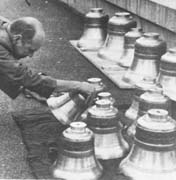
When plans for a new main building were first discussed, the structure was thought of as a memorial to the Andover men who had died in the first World War. The reason this proposal was never carried out was that Samuel Lester Fuller, had offered to give the School a bell tower in memory of the ninety Andover men who had been killed during the war.(46) "Something absolutely useless" was Fuller's characterization of his gift, but it proved far from that. Sited on high ground on what was known originally as the Training Field, across Main Street from Adams and Bishop Halls, this delicate brick "campanile" with a white cupola on top soon came to symbolize Phillips Academy for alumni and friends of the School. A motorist driving to Andover from Boston along Route 28 sees the tower framed by elm trees long before he reaches the School. Ground was broken for this beautiful structure in 1922, and it was finished the following year. The indefatigable Jack Fuess, walking by the tower the day before it was to be dedicated, was horrified to discover that the word 'descendant" in part of the inscription had been spelled 'descendent." He immediately called the architect, who called the stone cutter, who worked all night so the error could be corrected by the time of the dedication the following day.(47) Mr. Fuller had been stationed in Fiesole outside Florence during the war and had been greatly impressed by the beauty of the bells of Florence as they sounded across the Arno valley. He wanted to install a set of bells in his tower to provide a similar beauty for the Academy. This proved to be easier said than done, for no sooner had the word spread that Phillips was in the market for bells than the School was deluged with promotional material from all over the world. Dr. Carl Friedrich Pfatteicher, head of the Music Department, was asked to investigate and spent a summer listening to bells in the United States and Canada. He was doubtless not impressed with one bidder who managed to spell his name wrong in every communication sent. One of Dr. Pfatteicher's responsibilities was to determine whether the Fuller tower should have a carillon, consisting of at least twenty-three bells, or a chime, consisting of a smaller number. The final choice was made easier by the fact that the Church of Our Lady of Good Voyage in Gloucester, Massachusetts, had recently purchased a complete carillon from the Taylor Company in Loughborough, England. Dr. Pfatteicher, Al Stearns, Jim Sawyer, Samuel Fuller, and other concerned Andover individuals went over to hear the Gloucester bells, and all returned convinced that this was what Phillips Academy should have. The Gloucester people had managed to work out a deal with the United States government whereby they were exempt from the 40 percent duty on imported bells, but Phillips Academy had no such luck. Apparently because of a new tariff law, there was no way to win exemption, and thus the cost of the carillon was substantially higher than planned. The Taylor Company moved so slowly on the Andover order that the carillon was not installed when the tower was dedicated. There were further complications when the bells did arrive, for the machinery to be used came into conflict with that of a clock with Westminster chimes already installed in the tower. Eventually all these obstacles were overcome, and the Phillips Academy community was treated to regular carillon concerts.(48) The Memorial Tower with its handsome set of bells was a welcome addition to the plant. As the Bulletin editorialized, Memorial Tower had become "the soul of the school." (Frederick S. Allis, Jr. Youth from Every Quarter. Andover: Phillips Academy. 1979.)
The carillon concerts were not always appreciated by the undergraduates. Dr. Carl F. Pfatteicher, the Musical Director, used to usher in Easter by playing the bells at dawn., One year a group of undergraduates, resentful of being roused from their slumber, managed to lock Pfatteicher in the tower so that he missed the Easter service in the chapel. Apparently this hurt his feelings so much that he seldom played the bells after that. (Ibid.)