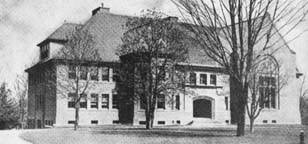
After Miss McKeen's death in 1898 an active memorial campaign was conducted to raise $24,000 to start a new classroom building. These gifts of the alumnae and friends of the school were dedicated in memory of Miss Philena McKeen, Principal for 33 years, and her sister and first assistant, Miss Phoebe McKeen. This main recitation building contained several large and well-equipped classrooms and a study hall for the use of day students. The cornerstone was laid on June 20, 1903, the dedication was held in June 1904 --- coincident with the 75th Anniversary of the Academy. (Robert A. Domingue. Phillips Academy, Andover, Massachusetts. An Illustrated History of the Property (including Abbot Academy). Wilmington, MA: RAD Publishing, 1990.)

Davis Hall was used one year after South Hall was removed, and in 1890 was given up as a school home. The building was taken down to make way for the long-desired recitation hall, erected as a memorial to the McKeen sisters. (Jane B. Carpenter. Abbot in the Early Days, 1959.)
Among distinctive personalities is noted Anne Means, cousin of the principal, who was chairman for five years (1899-1904) of the committee to raise the large sum required to build McKeen Memorial Hall. Appreciative minutes show how with her natural drollery and brisk courage she energized her co-workers to meet many delays and difficulties, and finally achieved the goal with the enviable record of a hundred per cent payment of pledges. There was a crucial moment when the trustees had decided upon the plans, and the builders were pressing to begin work so as to finish in time for the observance of the seventy-fifth anniversary of the School in 1904, and still the goal was by no means reached. Then some one came to the rescue with a loan of $10,000 without interest. It may not have been generally known that this rescuer was Miss Emily Means, then principal, her only condition being that the money be repaid as fast as it came in after the completion of the requisite amount. (Ibid.)
And still there was more to come! In the evening two productions were alternated. Moving pictures of present-day School life were shown in the big tent while in Davis Hall an historical pageant, The Years Between, 1829-1929, was staged by Margaret Kyle, the composer, This consisted of episodes and tableaux artistically and ingeniously arranged to depict the marked contrast in costumes and customs in succeeding periods, using sometimes as a backdrop for grouping the big old oak on the campus, which had looked down on all the changes through the years. Huge framed living pictures showing scenes from the past were eagerly watched by the alumnae spectators of different eras with spontaneous expressions of delight from one and another as her own School days were vividly recalled. A few of these have been with difficulty selected, beginning with the very beginning:
Squire Farrar in black coat with gold-headed cane advising Madam Abbot to found a school for girls; she is seated in her parlor wearing the familiar cap of the Abbot Hall portrait; a group of girls in sunbonnets and high-waisted dresses coming to School on the opening day, May 6, 1829; Harriet Beecher Stowe, sitting in elegance behind the coffee urn at the "Festival "in 1854, which she had helped to initiate and had actively promoted to raise money --- fifty cents admission --- for the furnishings of the new dormitory, Smith Hall. (She was displaying the "superb" gold bracelet in the form of shackles given her in England by the Duchess of Sutherland, inscribed "We trust it is a memorial of a chain soon to be broken.") Fashion styles in 1879, the Semi-Centennial year --- a full length picture of a girl in brown dress with elaborately puffed and pleated sleeves; ten years later, the Gibson girl in stiff linen shirtwaist suit.
Miss McKeen, gray curls and all, seated in her armchair, dressed in black silk with white lace and a bit of blue ribbon at her throat, looking just ready to speak to her girls; one of her older girls, a grandmother, sighs, "What wouldn't I give to be able to drive up in the old yellow coach and be a Fem Sem again! " whereupon her little four-year-old grandson rushes in, throws himself upon her, crying loudly, "Oh, I wish I could be a Fem Sem!"
Miss Phebe McKeen, wearing her scarlet shawl, stands by a great standard globe, her black curls falling over her ears, her dark eyes gleaming behind her spectacles. Something about her pose suggests her love of the dramatic. Dim glimpses of the memories of a grandmother --- croquet in skirts rippling round the heels, dumbbell drill in long-sleeved suits with full bloomers nearly to the boot tops. She watches with amazement the modern gay rhythmic dancers with their colorful floating scarves and bare legs. (Ibid.)
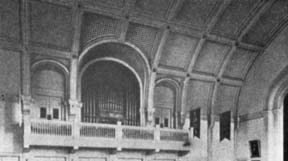
When McKeen Hall was erected in 1905, the assembly room, which
for many years had doubled as a gymnasium, was named Davis Hall
as it was financed by George G. Davis in memory of his father,
George L. Davis, whom he had succeeded as Trustee. The story goes
that when Mr. Davis (George G.) was sitting by his daughter Dorothy
at the Inauguration ceremonies in 1912, he had said to her, "How
would you like to give them an organ?" He knew that the loft
was already designed for it by Mr. Downs, for many years the musical
director. Daughter Dorothy agreed and soon thereafter a two-manual
organ, built by the Hall Organ Company of New Haven, "with
all the modern devices," was presented to the School by her
in a special service followed by a reception in her honor in Draper
Hall. In 1925 again by her gift the "Dorothy Davis Rimmer
Organ" was enlarged for "power and beauty of tone"
and chimes were given in 1918 by Mrs. Taylor in memory of Professor
Taylor.
The organ was of distinct value to the School. It was featured
in concerts by the members of the Music Department, and when once
a month Vespers came to be held in Davis Hall, the organ accompanied
the time-honored Fidelio Chorus. Brief recitals were given after
Sunday evening services by Mr. Ashton until his resignation in
1922, and thereafter by Mr. Howe. The compositions played were
chosen to bring out the resources of the organ. (Ibid.)
At the time of the dedication of McKeen Hall, in 1904, the College Preparatory division of the graduating class took up the custom of planting an ivy, and a double ceremony, of the tree and the ivy. A class song has usually been associated with this event. (Ibid.)
It was not merely the landladies whom Cecil Bancroft had to deal with. There was a hue and cry from parents, Abbot Academy, and townspeople as well. Mrs. Butterfield's boarding house on School Street was close to Abbot Academy, with unfortunate results for that institution. One of the Abbot teachers, Laura Watson, complained that Phillips Academy students climbed onto the roof of Butterfield's and shone a large mirror into her classroom, making it necessary to pull down all the shades. Miss Watson also complained of "insults" shouted from Butterfield's at Abbot teachers. "One ox-like creature," she reported, had called her "darling" and "birdie dear." And Headmistress Philena McKeen wrote the Principal asking that Mrs. Mason not be allowed to rent a certain room to a boy because it looked out on the Abbot campus and the girls would be constantly watched. (Frederick S. Allis, Jr. Youth from Every Quarter. Andover: Phillips Academy. 1979.)
Another alumna writes: "Anything about Smith Hall is inadequate without some reference to Miss McKeen as a permanent resident there. Miss McKeen of Smith Hall was a less formal personage than the Miss McKeen who presided over the entire school in the Academy Hall, for Miss McKeen was Smith Hall. This strong, serene head of our matriarchy to whom we confessed our sins against established rules had a remarkable opportunity to know each one for what she really was. She certainly was very keen to detect subterfuge or untruth and equally just in commending honesty. Smith Hall was her only home and we were her family, in whom she was constantly striving to awaken and develop Christian womanlinesss. As I look at it now I can not see that individuality was at all encouraged, rather we were influenced to conform to a standardized type, but be that as it may, that same type has proved itself a most beneficent center in hundreds of different communities. Every senior received from her a little black book of scripture quotations with certain verses underscored in blue pencil that fitted the individual's need." (Jane B. Carpenter. Abbot in the Early Days, 1959.)
"October 7. Miss McKeen's lecture this afternoon was on
eating, and it made us mad. She said we ought not to eat between
meals at all, except just before or just after a meal. She said
our moral condition and spiritual life were lowered by the pickles
we ate. Said we would not be permitted to go to other rooms if
we went to eat and drink. Then she said we reminded her of the
Israelites in the wilderness, longing for the something and onions
they had in the land of Egypt. Quite a pat illustration, only
I don't long for onions. She reminds me of the headings of some
of the pages in Exodus, viz. 'Divers laws and ordinances.'
"When it rains the electric bell, which rings for 'hours'
of all kinds, does not always strike here --- it is struck from
Smith Hall. Today it did not ring for sermon reports so we did
not give any. I was glad, for I hardly knew a thing he said.
"Miss McKeen (or P. Mc --- pronounced Peemuck, as the girls
call her) charged us all to keep accounts and send home a list
of our expenditures. We owed it to our fathers to tell them how
we spent the money they gave us. So I enclose a list of my September
expenditures in justice to my father. (Ibid.)
FOR the better understanding of the situation in 1912 as to whether the School should continue to be a finishing school or should yield further to the pressure for college preparatory work, a brief outline of successive changes in attitude and policy may be in order. The rapid rise of women's colleges, four in one decade (1870-80), did not at once affect Abbot Academy. It still kept to the traditional lines. Miss McKeen was loath to make any changes. When in 1891 a prospective pupil went to her to ask for studies fitting for college, she was received by Miss McKeen in her bedroom off the McKeen Rooms, where she was doing her weekly mending. The immediate reply was that she might get what preparation she could in existing classes, but that no special arrangements could be made. Individual teachers, however, did make an effort to help such students. Miss McKeen explained her attitude on the subject in Volume II of her History. The women's college movement was to her a shadowing threat because she thought that young women of intellectual power and of literary ambition would then naturally and properly go to college instead of to such institutions as Abbot. If Abbot should accede to the demand for definite college preparation, the danger was that it might "sink to the level" of a preparatory school! She agreed that a thorough training course admitting to college might be allowable, but insisted that the place of honor should be given to the "Academic Course," which should have its own diploma, and with competent teachers and a liberal program should fill a "quiet, useful, artistic niche in the educational system." The alumnae had also put themselves on record in 1892 by vote of their Association that they regarded the work of fitting girls to enter into active life as too important to be subordinated to preparation for college. (Ibid.)
The story begins like this. Miss McKeen's sister, "Miss Phebe," keen-eyed, spirited, stimulating, is said to have been the one who first suggested and who fostered the idea of an alumnae society. Imagine her eagerly presenting it in her clear way to the group of curious and interested women gathered on Anniversary Day in 1871. During the twelve years since the McKeen sisters came, over 600 girls had gone in and out between the tall old pillars, and before that 900 more. What possibilities in a plan for binding these together to stand behind the School and further its interests! There had been conferences and consultations of course and now the time had come for action. "Yes," they agreed, "include all old scholars, graduates being so few comparatively, and teachers as well." (Ibid.)
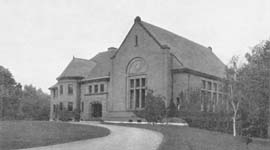
The fiftieth anniversary of the founding of the Alumnae Association had been celebrated in June, 1921, with a luncheon in McKeen Hall, attended by three hundred guests of nearly all the classes from 1854 down. There were birthday greetings from the Boston and New York Clubs, the only ones then in existence. Present were Charlotte Swift, 1858, and Agnes Park, whose combined services as Secretaries spanned the whole history of the organization. Miss Park gave some interesting details about the early days, which she had gleaned from the yearly reports. (Ibid.)
The return of alumnae for Commencement doings became more general after headquarters were provided in McKeen Hall in 1915, and an organized plan of reunions at five-year intervals publicized and put into practice with emphasis on fifty and twenty-five year anniversaries. From 1925 an alumnae marshal and alumnae ushers served at graduating exercises, and the seniors appeared at the annual meeting of the Alumnae Association to be received formally into that organization. (Ibid.)
Three years later, upon the retirement of Miss McKeen, South Hall was made into a home for her and named by her, Sunset Lodge. There amid her cherished possessions, many of them souvenirs of travel or gifts of pupils, she spent the remaining six years of her life in happy serenity. She was very hospitable and delighted in entertaining Andover friends, and "old scholars" when they came back to visit the school. She liked to have the house all bright with lights (that meant oil lamps, too) and was pleased when a Phillips boy said to her, "Oh, yours is the house that looks as if you were having a party every night." She usually had with her either a niece attending the school or some other student.
Every two weeks during the winter season, the parlor was turned into a lecture room, when the ladies of the Art Department of the November Club gathered to receive instruction from their leader, Miss McKeen, and to study the photographs which were always displayed for their use. Many of them had been her pupils in years past and took pleasure in carrying on the thorough work which she still required. On Miss McKeen's part, it was a joy to keep on with her teaching, especially in this subject so much to her taste, which she, as a pioneer, had introduced into the school curriculum. (Ibid.)