
Isham Park, located on Broadway between 211th Street and Isham Street, north to 218th Street, was part of a 24-acre estate purchased in 1864 by William Bradley Isham, a leather merchant who resided there until his death. [...]
Mr. Isham retired from business in 1890 but remained as Director of the Bank of the Metropolis and President of the Bond and Mortgage Guarantee Company. He was also a manager of the Presbyterian Hospital (predecessor of the Columbia-Presbyterian Medical Center) and Vice President of the Hospital of the Ruptured and Crippled.
William Isham was involved with farming and sent the only wheat grown on Manhattan to the Columbia Exposition at the Chicago World's Fair in 1893. He had included as part of the exhibit ground from the old Van Cortlandt Mill from the Bronx.
The 20.097 acres of parkland was a culmination of donations by the Isham family and purchases of land by the New York City Department of Parks and Recreation between 1925 and 1927. Julia Isham Taylor, one of the daughters of William Isham, donated a 6-acre parcel of her estate to the city on June 15, 1911, and October 26, 1917, to serve as a memorial to her father. Flora E. Isham, William Isham's sister, donated her portion of the estate on March 21, 1912. The estate of Samuel Isham bequeathed more land for the park on April 10, 1915.
The Isham family wanted to preserve the views of the estate for future generations. These included views of the Hudson and Harlem Rivers as well as the Spuyten Duyvil. (website)

Miss Flora Isham of New York decided to give the Academy $30,000 for a new infirmary in honor of her three nephews who were alumni of the Academy ---Charles--- Class of 1871, Samuel --- Class of 1871, and William --- Class of 1873. The proposed facility developed by the architect, Guy Lowell, would have cost $40,000 and had to be trimmed to meet her budget.
Work started on Isham Infirmary in March 1912; the contractor was E. W. Pitman of Andover. Constructed of brick with stone trimming it was old colonial in design. The kitchen, heating plant and laundry were in the basement. The first floor contained a vestibule, a main corridor with wards, main dining room, serving room, matron's room, doctor's room, large sitting room and an operating room. Two large wards were on the second floor and contagious wards on the third. The facility accommodated forty patients. (Robert A. Domingue. Phillips Academy, Andover, Massachusetts. An Illustrated History of the Property (including Abbot Academy). Wilmington, MA: RAD Publishing, 1990.)
Another phase of this general development was the opening of the Isham Infirmary on November 14, 1912. In Dr. Bancroft's day Phillips Academy had no facilities for treating sickness, and the Principal spent many an anxious night, apprehensive lest some epidemic might start among the boys. A student who happened to be ill was merely confined to his room, and, if he contracted a contagious disease, he was quarantined where he lived. Even with these disadvantages a remarkable record was made, for, during seventeen years of his administration, Dr. Bancroft was able to say that no Phillips student had died under his charge. Mr. Stearns soon resolved that a change must be brought about, and in 1908 the Track House was made into a temporary infirmary, where serious cases could be isolated and treated. Three years later Miss Flora Isham gave to the school $30,000 for an infirmary, in honor of her three nephews, all graduates of Phillips Academy. This building, which was constructed under the advice of expert physicians, has all modern hospital accessories, including a well-equipped operating-room and contagious wards; and the patients are under the care of a matron, who is also a trained nurse. The minor diseases which break out intermittently through the year are now easily controlled, and more serious troubles are referred to one of a group of eminent Boston medical men who serve as a kind of advisory board. (Claude Fuess. An Old New England School. A History of Phillips Academy. Boston: Houghton Mifflin. 1917.)
If one were to ask what the policy was for boys who got sick, the answer---at least for the first century of the institution's existence---would have been "None," or "Student, heal thyself." The remarkable thing is that the School was able to survive for its first century without a serious epidemic or even disasters to individuals. To be sure, boys living in Faculty houses or in boarding houses run by solicitous landladies must have received some nursing care on occasions. Though the Samaritan House was originally established to take care of sick theologues, it is possible that some Academy boys were cared for there. But the standard procedure, particularly for students in the Latin and English Commons, was to have the sick boy remain in his room until he got well; if he got sick enough, a physician from the town would be called in. Cecil Bancroft was disturbed at this state of affairs and wished to improve the situation, but he was unable to accomplish anything during his term as Principal. It was not until Al Stearns took over that progress in the area began to be made. The first step was to find out who was sick and what was wrong with him. To accomplish this, Al turned to Dr. Peirson S. Page, the Physical Director. Though Page had an M.D. from the International Y.M.C.A. College, his main concern was the program in physical education; he could usually diagnose an illness, but he left the treatment to the physicians in town. Each morning Dr. Page would ascertain what boys were absent from chapel; he would then go to their rooms to find out what was wrong, and report to Al Stearns. Usually his report was of colds and stomach aches, but on occasion it could be chilling. One morning he reported cases of scarlet fever. Nurses for the sick boys had to be found. The Chandler sisters on Main Street were often willing to help out. If there were a large number of cases, the procedure was to put them all in the same dorm and move out those still well. But that was a makeshift policy at best. When a Boston physician, who had been called in to advise on the scarlet fever cases, visited one of these quarantined houses, he remarked that considering the outrageous condition of the rooms in the house, it was a miracle that Phillips Academy had not been visited by the Black Plague. In this particular scarlet fever epidemic it was discovered that the children of the cook at the Commons all had the disease. Since the cook was a Christian Scientist, he had refused to have his offspring examined by a doctor. When the cause, together with the cook and his family, had been removed, the outbreak was brought under control; but the need for an adequate infirmary remained. In 1907 the Trustees voted that the old track house, located near what is now Adams Hall, might be used for an infirmary. Though it was a flimsy wooden structure, it at least had showers and toilets, and for three years it served to house students with contagious diseases. In 1910, with the acquisition of the Williams Hall property, it was found that the building where the coachman and his family had lived would make an adequate infirmary. Though the facilities were excellent, the quarters were much too small to meet the needs of the School. Thus in 1911 Al Stearns must have sighed with relief when he learned that Miss Flora Isham had decided to give the school $30,000 for a new infirmary in honor of her three nephews, all graduates of the School. Dr. William Graves of Boston, son of the old head of the Scientific Department, and Dr. Fred Murphy, later to become a Trustee, were called upon to draw up plans. Their original proposal would have cost $40,000, but Miss Isham said that $30,000 was her limit. There followed frantic pruning of the original plans to meet the financial requirement, and the new facility was opened in the fall of 1912. None too soon: a few years later the School had a polio epidemic, and seven boys were stricken. The new infirmary enabled the cases to be isolated, and with the help of the Harvard Paralysis Commission, all seven eventually came through unscathed. Perhaps more remarkable, as the result of a reassuring letter sent to all the parents by Al Stearns, only one boy was withdrawn because of the polio scare. There was still plenty of room for improvement in Isham Infirmary, however; in 1935 a large wing was added, and today the institution has been designated a hospital, complete with all the latest medical equipment. The care that undergraduates get today in Isham Hospital is indeed a far cry from the "Student, Heal Thyself" program of the nineteenth century. (Frederick S. Allis, Jr. Youth from Every Quarter. Andover: Phillips Academy. 1979.)
Perhaps the most important improvement accomplished during the Fuess years was in medical services. Before the twentieth century Phillips Academy had, in effect, no medical program. When boys got sick, they (as noted) stayed in their rooms until they got well, occasionally calling on physicians from the town if their condition became too desperate. Things changed for the better in 1902, when Peirson S. Page came to Andover as Director of Athletics and School doctor. From the beginning he devoted more of his time to the development of a strong program in physical education than to medical practice as such. He introduced compulsory physical examinations for each boy and a series of physical fitness tests that included such rigorous exercises as the rope climb, 'belly grinds," and swimming and running events. Many an Andover undergraduate, attempting to do the arm-over-arm rope climb, will remember Doc Page saying, "Using your feet---F." Boys who were unable to meet these fitness tests were put in special classes for special training. This group was known variously as "P.I. 's" (physically inefficient) or, the favorite undergraduate designation, "P.W.'s" (physical wrecks). In 1912 a great step was taken in the area of student health when Miss Flora Isham gave the School a small infirmary. For the first time in its history boys who were sick had a place to go where they would receive adequate medical care. Dr. Page dealt with relatively simple ailments---sprained ankles, acne, colds, stomach upsets, and the like. When the complaint was more serious, he would turn to the town doctors or, in truly serious cases, to Boston specialists. Dr. Page's favorite remedy for any kind of abrasion was to "paint it with iodine" and this became one of his nicknames. He also was concerned about the prevention of a common athletic ailment called "jock itch" and used to lecture the whole School on the subject at the start of each year. The remedy, according to Doc Page, was to take "a clean pocket handerchief" and place it between the jock strap and the body. One alumnus remembers an epidemic of pink eye (conjunctivitis) that ran through the School in the winter of 1931. Even though it seemed to be having little effect on the infection, Dr. Page had everyone putting Argerol in his eyes, with the result that everyone looked like a raccoon and was unable to go to class. In short, as Director of Athletics, Peirson Page did a fine job; as a medical doctor he left a good deal to be desired.
All of this changed in 1934 when J. Roswell Gallagher, the most distinguished physician in the history of the School, came to Andover. It is always difficult for an institution like Phillips Academy to attract a topnotch doctor. Most of the diseases of adolescence are hardly those to challenge a highly trained, aggressive physician. After a while athletic injuries begin to pall. Ros Gallagher came to Andover, in part at least, because he was interested in studying the adolescent boy and in establishing norms for the physical and psychological make-up of boys between the ages of thirteen and eighteen. Gallagher soon introduced the concept of the doctor-patient relationship, much to the rage of some of the Faculty. In the past a Housemaster had always been able to call the infirmary and find out what was wrong with one of his charges. Now he was met with a blank wall, for Gallagher believed that this was not the housemaster's business. He would talk with the parents if they wished to call up, but not to the School staff. In like manner he wanted the boys to feel free to talk with him about their problems, and thus it became understood that nothing would go outside his office, even if it involved the breaking of rules. Two examples of Ros Gallagher's modus operandi follow. He once wanted to talk to a boy who, he thought, was seriously disturbed emotionally, but he knew the boy would never come to see him if he called him in to his office. Accordingly, he called him up after chapel, together with a group of other ailing students. After asking how one boy's toe was, how another's cold was, he came to his boy and said, "What are you doing here?" The boy said he was told to report. The Doc looked in his book and then said, "Oh, your X-rays didn't come out. Come down sometime and we'll take some more." When the boy finally came down, Gallagher proceeded to take a lot of X-rays, without any plates in the machine, all the while talking to the boy and accomplishing his original purpose. The other example came as a result of a contagious disease that appeared in the School. Gallagher did not wish the boys to swim in the pool, but he did not want to alarm the school community. Accordingly, he went to the janitors in the gym and asked them what could go wrong with the swimming pool. They were puzzled at first but finally one said that the chlorinating system could break down." "It's just broken down," said Ros, and proceeded to put a notice to that effect in the School bulletin. All of this was a far cry from the health care that Phillips Academy students had had before the 1930's, and in 1935 the facilities for health care were further enhanced by the construction of a large wing on the rear of the old Isham Infirmary. Not only were additional beds made available but complete laboratory facilities as well. As a result, the Phillips Academy infirmary was recently classified as a hospital, and on the basis of its equipment it well deserves the designation.
Under Ros Gallagher the definition of health care was greatly expanded. No longer was it limited primarily to diseases and athletic injuries; every aspect of the adolescent was examined and tested in an effort to make his experience at Phillips Academy as rich and rewarding as possible. For example, Gallagher spent a lot of time testing boys for reading disabilities. He was convinced that in many cases---the national figure was 10 percent---failure in School was due to reading disability rather than to lack of academic ability, and he cited the case of a boy who had great difficulty with reading, writing, and spelling---for example, he always used very short words that he could spell---and yet scored 126 on the Wechsler-Bellevue test, one that puts little emphasis on reading and writing skills. This score indicated that he was in the top 3 percent of the country as far as basic intelligence went, even though he was having great difficulty with work that demanded verbal proficiency. If boys were tested early so as to discover language disability, remedial classes in language training could do much to correct the difficulty before the problem became acute. Al though Gallagher did a great deal of work trying to establish norms of various kinds for adolescents, he was under no illusion that there was such a thing as a "normal" or "average" boy. He was strongly opposed to attempts to establish rules for physical and mental development on the basis of age. For example, he cited the case of Sam, who was fourteen years old, weighed 150 pounds, was 5 feet 10 inches tall, was shaving regularly, but who seemed listless and was difficult for his parents to deal with. In contrast there was Billy, who had an upbringing almost identical with that of Sam, who at sixteen weighed 115 pounds, was 5 feet inches tall, and had no reason at all to shave. He, too, was having trouble at School and was very hard to reach. Dr. Gallagher's point was that while neither of these boys was average, both were normal. The average weight of one group of schoolboys was 127 pounds, but the range was from 80 to 199 pounds. And his plea was that parents should stop worrying about averages; if they would only hide their anxiety, exhibit a great deal of patience, and above all give generously of their affection, the vast majority of the boys would sooner or later attain manhood. Finally, during the war, under a grant from the Carnegie Foundation, Ros Gallagher studied the physical fitness of Andover boys and developed a program to promote it. He was convinced that too often the term was too narrowly defined. It included, he believed, medical fitness, which had to do with the condition of the eyes, heart, teeth, and so forth. It also included dynamic fitness, which had to do with the functional ability of one's heart, lungs, and circulatory system to respond to work. Finally, it included motor skills fitness, which had to do with the degree of skill, coordination, and strength with which one performs such acts as climbing, jumping, and swimming. Only if a boy were strong in all three of these areas could he be judged physically fit. In determining medical fitness Gallagher developed an elaborate set of physical examinations, conducted in large part by outside consultants at the Infirmary, that included dental X-rays, lung X-rays, blood and urine analyses, and many others. To determine their dynamic fitness, boys were required to take a step test, after which their heart rate was measured. And for motor skills testing, a pole climb, fence vault, jumping, and swimming were used. The whole program was an extraordinarily inclusive one and made a signal contribution to the health and welfare of the school. Unfortunately, Ros Gallagher left Andover in 1950, first to go to Wesleyan and later to serve as Head of the adolescent unit at the Children's Hospital in Boston. But he left behind him a tradition of medical excellence that has been carried on by his successors down to the present day. (Ibid.)
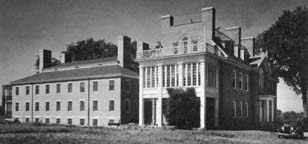
One of my keenest interests then and later was in the health of the undergraduates. Dr. Peirson S. Page, who for years had been not only school physician but also Director of Athletics, was preparing to retire, and came to me himself to recommend that we find a younger man to take his place. We were fortunate to draw from the Hill School Dr. J. Roswell Gallagher --- a doctor with a fresh approach, a passion for research, and a knowledge of adolescent psychology which eventually made him the foremost man in that field in the independent schools. At just the right moment, furthermore, we received a bequest from Mrs. Frederick F. Dennis of more than $300,000 ---enough in those days to allow us to build a modern addition to the obsolescent infirmary and to construct a new dormitory, Rockwell House, for the smaller boys. The new infirmary was completed in the autumn of 1935, with approximately seventy-five beds, and the school was embarked on a health program of tremendous importance. (Claude Fuess. Independent Schoolmaster. Boston: Little, Brown. 1952.)
The medical program started in a modest way by Dr. Gallagher in the 1930's became eventually my pride and joy as headmaster and brought great prestige to the school. Through an annual grant of $10,000 over a period of five years from the Carnegie Corporation, followed by a similar award from the Grant Foundation, we were able to institute and carry on a very significant program of research and experimentation. One thing led to another. When we uncovered a case of mirror vision, we clearly had to do something about it, and soon we were forced to set up small courses in remedial reading. Strange new instruments appeared in the infirmary for testing reading speeds or brain waves or muscular reactions. We tried out the value of various preventive sera, with gratifying results. Especially important was the work done with athletic injuries, which were within a short period considerably reduced in number. Almost perforce the school physician and his staff had to enter the field of what might be called practical psychiatry --- which at Andover was usually a manifestation of "common sense." We set up shortly an advisory board of specialists who could be called upon in emergencies. During my fifteen years as headmaster not one undergraduate died of disease, and only one of accident. (Ibid.)
The whole problem of the so-called "slow boy" has been simplified considerably by the studies of wise physicians and psychiatrists. The high standards of admission to Phillips Academy almost automatically kept dunces out. But there were always boys who were labeled by the faculty as "stupid" or "lazy," and the question was what to do with them.
In the 1930's some of the teachers supported me in adopting a new attitude towards these delinquents. Before asking them to withdraw and thus transferring the responsibility to other more tolerant schools, we deliberately tried to find out the reason for the low marks. Emotional disturbances, lack of motivation, poor health, family dissension---all these, we discovered, often kept a boy from doing good work. But we also noticed, after doing some testing, that we had in the student body certain boys who just didn't know how to read. The American Optical Company generously equipped our infirmary with a metronoscope and an opthalmograph, and we undertook through Dr. Gallagher, our school physician, some pioneer research into the cause of slow reading. The next step was to organize remedial classes for those who were in difficulties. We were not always successful, of course, but the improvement more than justified the experiment.
The chief and lasting consequence, in my judgment, was to start the faculty speculating on the reasons for failure. It was no longer enough to blame low grades on just plain cussedness or human depravity, or to vote disciplinary measures. We tried to get at the root of things, and thereby sometimes achieved an almost miraculous reform. It was one of the great moments in educational evolution when teachers commenced to ask, "What is the real reason why Ned's marks are so low?"(Ibid.)
Kemper refused to budge; but he bore the man no ill will,, as evidenced by the fact that he succeeded in bringing him back to Andover some years later. Finally, he went to the mat with J. Roswell Gallagher, the distinguished school physician, over a basic matter of administrative policy. Under the Fuess regime Gallagher had had a completely free hand when it came to student health. Jack Fuess never interfered, and if Dr. Gallagher wanted something, he got it. John Kemper had no pretensions of understanding student health problems, but he still insisted that final decisions in this area had to be his. To this Dr. Gallagher could not agree, and so they parted company. If the new Headmaster could best someone of Gallagher's stature---for the Trustees supported the Kemper position---it was clear that he was not a man to be trifled with. (Frederick S. Allis, Jr. Youth from Every Quarter. Andover: Phillips Academy. 1979.)