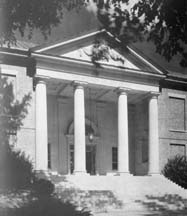
Expansion of the Phillips Academy plant under Al Stearns was an extraordinary achievement. A good start had been made before the Cochran era, with the acquisition of the Seminary property and the construction of the new dormitories and of Samuel Phillips Hall. Yet it was the vision of Thomas Cochran and Charles Platt that transformed the Andover campus into one of the most beautiful educational areas in the United States. (Frederick S. Allis, Jr. Youth from Every Quarter. Andover: Phillips Academy. 1979.)

For some years Guy Lowell, of Boston --- the school's very competent architect --- had been erecting on the campus buildings which were faithful to the Georgian-Colonial tradition. But Tom did not like Samuel Phillips Hall, and when a new science building was contemplated, he was dissatisfied with Lowell's drawings. One evening at the principal's house, Miss Grace Clemons spoke of Charles Platt as a brilliant architect recognized as a specialist on the American Colonial Period. With his usual speed Tom called Mr. Platt by telephone the next morning and soon brought him to Andover as a consultant. Fortunately Mr. Platt was not only an architect but an artist and a landscape gardener, peculiarly suited to Tom's expansive temperament. Platt's imagination knew no bounds, and his adventurous spirit surmounted every obstacle. Cochran persuaded his colleagues on the Board that Platt had just the genius they needed. Platt cared nothing about costs, and neither did Cochran. (Claude Fuess. Independent Schoolmaster. Boston: Little, Brown. 1952.)
The second all-important influence in shaping the Cochran program was that of the New York architect Charles Platt. He had been recommended to Cochran by Miss Grace Clemons, Al Stearns's hostess, and from the very beginning the two hit it off famously. Platt was not only an architect but a landscape gardener, who approached his work from the point of view of an artist, and his visions for Phillips Academy caught Cochran's fancy. As Platt put it:
Why not surround the boys with the very best in architecture and nature and the arts? Why not a bird sanctuary, a really fine library, a topnotch art gallery... (Frederick S. Allis, Jr. Youth from Every Quarter. Andover: Phillips Academy. 1979.)
When Charles Platt first talked with Thomas Cochran about making Andover a beautiful place, he had spoken of the need for "a top-notch art gallery" as an important item in his program. Apparently Cochran was greatly taken with this suggestion, and long before the construction of the gallery itself he appointed a committee to collect paintings and other works of art for the School. Early in 1930, with a major part of his program completed, he was in a position to house that collection, and on 10 January of that year he wrote a letter to the Trustees offering the sum of over $1,480,000 to build a gallery, endow it, and provide a fund for the purchase of works of art. His purpose was stated in the first paragraph of the letter:
Bent on a desire to enrich permanently the lives of the students of Phillips Academy, by helping to cultivate and foster in them a love for the beautiful, I should be glad to establish at the Academy an endowed Gallery of American Art. (Ibid.)
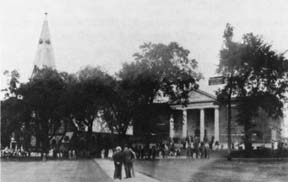
As finally completed, the building was indeed what Cochran called "the real jewel of our crown." As one entered the foyer, it was to see Paul Manship's beautiful fountain entitled "Venus Anadyomene." In a room to the right were exhibited some handsome examples of early American silver. In a gallery at the back of the building was a striking exhibition of ship models, all built to the same scale. The advice of Professor Samuel Eliot Morison of Harvard had been obtained in selecting the models, and the collection was the particular concern of Treasurer Sawyer. Upstairs was housed the permanent collection of paintings, and there was ample room in the building for the mounting of loan exhibitions. All in all it was a triumph---perhaps Cochran's greatest on Andover Hill. (Ibid.)
A reception was held on May 17, 1931, for members of the faculty and staff of the school as well as representatives of the art world and other museums. The gallery opened to the public on May 18. It comprised six exhibition rooms on the first floor and nine smaller galleries on the second floor. The basement housed a library, two study rooms, work rooms and storage. On entering the gallery, one passes through a vestibule into an octagonal exhibition room. In the center of the vestibule is a fountain statue of Venus Anadyomene by Paul Manship as well as paintings on the walls. (Robert A. Domingue. Phillips Academy, Andover, Massachusetts. An Illustrated History of the Property (including Abbot Academy). Wilmington, MA: RAD Publishing, 1990.)
Andover chooses to call the donor of its gallery "anonymous." But most people are sure it was given by Morgan Partner Thomas Cochran, patron and alumnus of Andover and Yale. Headed by Architect Charles Adams Platt who designed the building, the Art Committee includes Mr. Cochran and his good friend Mrs. Cornelius Newton (Zaidee Cobb) Bliss. Because he first became interested in art through the efforts of Mrs. Bliss and her sister-in-law, the late Lizzie P. Bliss, Mr. Cochran is believed to have given the gallery as a memorial to Mrs. Keturah Addison Cobb, mother of Mrs. Bliss. Curator is Charles H. Sawyer. Most of the Gallery's choice paintings were selected by Robert G. Mclntyre of Macbeth Galleries and Miss Bliss (whose private collection was inherited by Manhattan's Museum of Modern Art-see p. 29). Morgan Partner Cochran played football at Andover (1890) and Yale (1894). Returning later to Andover for a commencement reunion, he found it again to his liking, went back to Wall Street to establish a pool from which the school has received some $11,000,000 in anonymous donations. ("Art at Andover", Time , May 25, 1931)
We are all trying to do a real job on Andover Hill and one that will affect the whole question of secondary education in America. It always has seemed a strange thing to me that the rich men of our country have lavished literally hundreds of millions of dollars upon the universities of the land and have almost entirely neglected the preparatory schools such as Phillips Academy. It has seemed particularly strange because every thoughtful man admits that character transcends intellect in importance, and between the ages of twelve and eighteen, when a boy is at preparatory school, his character is in a more formative state than when he takes up his university life later on. 'As the twig is bent so grows the tree,' and thus I believe that our rich men should pay more attention to the schools of the land than to the universities where the development of the intellect is the principal function. This is the great reason why I am interested in Phillips Academy. I believe if we can equip the Academy with adequate buildings and with a well paid contented inspiring faculty that we will place a beacon on Andover Hill, the gleams from which will spread to every state in the Union and will affect secondary education tremendously. At least this is our ambition and this is what we are working for. (Frederick S. Allis, Jr. Youth from Every Quarter. Andover: Phillips Academy. 1979.)
The first major breakthrough for the arts in the history of Phillips Academy, as noted earlier, was the construction of the Addison Gallery of American Art in 1931 and the acquisition of a distinguished collection of paintings and sculpture by native artists to go with it.(3) It was the hope of Thomas Cochran, who was responsible for the building and a good part of the collection, that if Andover boys could be surrounded by beautiful things, their lives could be immeasurably enriched. Cochran suggested that the first Director of the Gallery be Charles Sawyer, son of his dear friend James Sawyer, the School Treasurer. When Thomas Cochran suggested something, it was usually done, and Charlie Sawyer soon took over. Because he had some background in the law, in addition to his interest in the arts, he proved an ideal museum administrator. [...]
In 1940 Charles Sawyer left the Addison Gallery to become Director of the prestigious Worcester Art Museum, where he was to work until, later, he went to Yale. He had laid a firm foundation for the work of the Addison Gallery; it remained for his followers to carry through what he had begun.
Sawyer's successor was Bartlett H. Hayes, Jr., who would hold the position for twenty-nine years, from 1940 to 1969. During that period he made the Gallery---and himself---nationally, even internationally, known. Though Bart Hayes's interests were catholic, his greatest achievements were in the shows he mounted. Some of the most interesting were based upon pictures from the permanent collection, rather than imported works. For example, "Architecture of a Painting" was built around Edward Hopper's "Manhattan Bridge Loop," an item in the permanent collection. The purpose of the show was to teach viewers by a close examination of this one work of art. Limitations of space prevent mention of more than a few of Bart's exhibitions, but some of the more significant showed works by Mahonri Young, Hans Hoffman, and a group of European Artists Teaching in America. Each year there were striking exhibitions of the work of the students themselves. Accompanying all the important shows were handsomely printed brochures, reproducing important pictures in the exhibition and including perceptive texts. Bart the gallery director and Bart the teacher were never far apart, and several of his exhibitions were didactic. "The American Line: One Hundred Years of Drawing" traced the development of American drawing over the past century and illustrated how the changes that had taken place reflected changes in American society generally. "The Naked Truth and Personal Vision" instructed the viewer how to look at a work of art and how to distinguish between the raw material the artist had started with and what he had done with it. Finally, "A Layman's Guide to Modern Art" proved to be an immensely popular explication of this difficult subject, and the resulting book was widely sold throughout the country. (Ibid.)