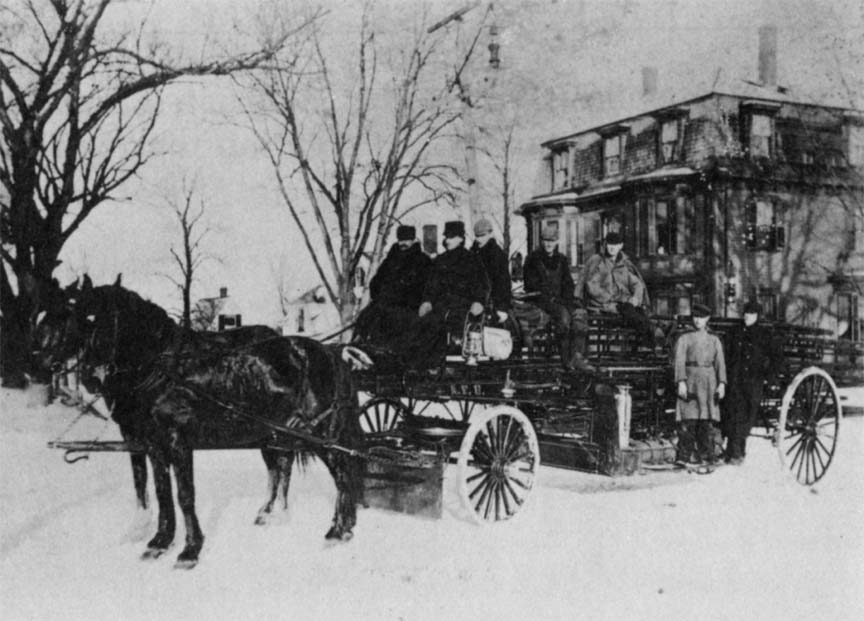
 Seven members of Andover's volunteer firefighting force, the "call" men, at a Highland Road home, c. 1900. |
 Andover's first steam fire engine, at the Barnard Street station; fourth from the left is Al Cole. |
|
Seven members of Andover's volunteer firefighting force, the "call" men, at a Highland Road home, c. 1900. |
Andover's first steam fire engine, at the Barnard Street station; fourth from the left is Al Cole. |
I want to conclude this story of my times by recalling some of the personalities who have left a lasting impression on my memory, including some personal thoughts about my playmates, schoolmates, and business associates.
The early years, the 1920s, were dominated by Billy Wood and Shawsheen Village. I discussed him and his era and his influence quite extensively early on. Others recalled from the twenties are these: Al Stearns, the headmaster at Phillips Academy, also served for many years as town moderator. Dr. W. Dacre Walker, our family physician, who pulled me through pneumonia twice, at age eighteen months and six years, still comes up before my mind's eye. Fr. John A. Nugent, O.S.A., pastor of St. Augustine's parish, was a consummate orator.
Then there were the outspoken members of town meeting: Matty Burns, the blacksmith, John Traynor, the lawyer, William A. G. Judd, the house painter from Ballardvale, and John F. O'Connell, whom I have mentioned in earlier pages.
They were followed in time by Harvey Turner, who served as chairman of the finance committee, and Fred Butler, who succeeded Stearns as moderator. Howell Shepard, Roy Hardy, Everett Collins, Stafford Lindsay, Sidney White, and Dr. Bill Emmons, all of whom sat on the board of selectmen from about 1935 until the manager charter revolution brought in a complete new cast of characters.
The school committee had a host of dedicated members, whom I especially remember starting in 1931, when brother Bill was first elected. Dr. Walker and Mrs. Jerome W. Cross had retired, and Bill, along with Fred Smith, a salesman for Liberty Mutual Insurance, moved onto the board. H. Gilbert Francke was chairman and Fred Cheever was secretary. Other members included Mrs. E. V. French, Mary E. C. Gaegan from Ballardvale, Dr. Nathaniel Stowers, a dentist, and several others. Bill shook them all up when, even though he was a newspaper reporter, he could not be excluded from the previously closed meetings. A couple of years later his friend and our neighbor, Elmer Grover, the editor of the Townsman, joined him on the board.
Elmer had been an honor student at Phillips and a Phi Beta Kappa collegian from Harvard. He later bought the Townsman from the Cole family and operated it as editor and publisher until the late 1940s, when he sold it to Josiah K. Lilly III, scion of the pharmaceutical house that bore his family name. Elmer went to Hartford, where he worked for several years for the largest commercial printing outfit in the insurance capital. He and his brother Melvin, my age, both died much too soon. Their sister, Ida, still lives in town. She taught Latin, English, and probably some other language in the high school before her retirement several years ago.
Joe Lilly, with whom I was quite friendly, stayed on in Andover only a couple of years. The early deaths of his father and then his grandfather forced him to return to Indianapolis to carry on the family name and business. I understand that he is now retired and living on Cape Cod, in the Megansett section of North Falmouth. The Rogers family purchased the Townsman and have published it for about the last forty years.
You can see that my mind wanders as I think of several of the early personalities! In 1960 or thereabouts the new board of selectmen was genuinely new. That board had to immediately advertise, interview, and hire Andover's first town manager. It included Gene Bernardin, Bill Stewart, Pete Wilson, and Phil Allen. While they were getting organized, they were able to enlist Victor Mill, Jr., to serve as interim manager. I think he served without pay, and he brought in his own management skills and really set up the government so that, when Tom Duff arrived in July, the machinery was all in place. I don't think that Vic Mill ever got the credit or thanks of the town to which he was entitled. Vic and I served together on the board of trustees at Merrimack College. Truly, some of the best talent to serve this town, at least in my lifetime, never cost the citizens a dime. They served with distinction and with pride in their work.
Prior to 1960 and the introduction of the new format of administration under a manager and five selectmen, the responsibility for highways, water, sewer, parks, playgrounds, and snow plowing came under the jurisdiction of a five-member board of public works. From the 1920s on, that had been a very important committee, with high visibility.
From my earliest days some of the names that come to mind on that board are Barney Rogers, great-grandfather of the present publisher of the Eagle-Tribune; Frank Buttrick, father of Martha, the mother of the same publisher; Tommy Rhodes, whom I knew only as the man who used to make and sell ice cream to Bill Crowley of Crowley Drugs, where Hughes Pharmacy is located now. Bill McIntyre of Ballardvale came along soon after and served as chairman of the board of public works for several years. Walter Morse, who owned the hardware store before Rod Hill, has already been mentioned. As the years moved along, we had Sid White, Fred Doyle of Doyle Lumber, Ed Hall (the father of Ernie), Gordon and Evelyn Darby, Eddie Doyle, John Kelley from Tyer Rubber, contractor Franny Reilly, and several others.
As playground supervisor I had a lot of dealings with the board of public works. The parks department under Jim Ronan set up our heavy equipment each summer and took it down before Labor Day. The cooperation that I received from those men made it a pleasure to work at the job.
Old Jim Ronan and his son Bill always had the right tools to assemble the most intricate piece of new equipment. Jack Buckley, Connie O'Brien (father of Joe and Mary, who was President Bush's nurse when he was an undergraduate at Phillips), and Bobby Winters used to take care of the Shawsheen and Ballardvale playgrounds. I used to think that those fellows---all considerably older than me---got at least as much enjoyment out of the opening of the playground season as any of the hundreds of youngsters who benefited from there work.
Before I leave this phase I must mention a little-known situation in which the town was the recipient of the largesse of a well-known family. The summer that I was asked at the last moment to take over the administration of the Pomps Pond swimming beach---when Don Dunn was called back to active service in the Korean War---I ran into an immediate problem. A very heavy layer of silt came up close to the surface of the water on the beach front. It was unsightly and, of course, everyone was sure that the place was polluted.
Well, I sought out Joe McCarthy---you've heard me mention him before---Joe had read about it in the paper. His first question to me concerned what kind of sand we had on the beach and in the wading area. It seems that the young lifeguards who were on duty, hoping to make the beach more attractive, had gone to a nearby gravel bank, rigged up a screen, and proceeded to fill the beach with newly screened gravel and to laboriously rake it into the water. They were quite proud of their work, and on opening day it did look good.
However, Joe explained to me that what had been done was about the worst thing that could be done. Because the gravel had not been "washed," it contained a great deal of organic matter. The motion of the water had, in fact, washed out the organic, and thus the silt. Now I am neither a scientist nor an engineer, but I learned my lesson well.
That winter I contacted John Cronin of J. J. Cronin Company in North Reading. McCarthy had suggested dumping washed, screened sand on the beach during the winter and having a small scoop tractor spread it evenly over the ice. As the ice melted, the sand would settle and we would have the start of a permanent base for a sandy beach. The first year, Franny Reilly almost lost a tractor when the ice cracked, but as long as I was connected with the recreation committee, up until the early 1960s, I made an annual phone call to John Cronin. For as many years as I called, the 200 to 300 tons of washed, screened beach sand was made available to the town---at no cost. The town trucks just went down to North Reading and loaded up.
John and his brother Jerry still live in town. Two other brothers, Tim and Connie, have died, but their families still live in town. They represent the finest that Andover possesses. The sand is only a small fraction of the good that those Cronin "boys" have bestowed on this town. I daresay that I am one of very few who can appreciate what they in a very quiet way have done. One of the great things about living in Andover for the last seventy-five years has been knowing such people---and being able to call them friends.
The board of public works had many longtime employees with whom I was acquainted. The first superintendent in my memory was Frank Cole. He was succeeded by Chuck Gilliard, Ted Lawson, Don Bassett, and one or two in between up to Bob McQuade. Among the street department foremen or bosses were Bill Baker, Sylvester Goodwin, Stanley Chlebowski, and up to Ted Surrette.
One night at town meeting, as people were debating the budget, one voter stood up and in a very serious tone asked, through the moderator, if Stan Chlebowski could tell us how much snow we were going to have between then, March 10, and the end of the fiscal year, which at that time was the end of December. Stanley never did tell us!
The water and sewer department was manned in those days by Walter Baker and Jim Goodwin. Between them, those two knew the location of every gate valve and shutoff in the town. Before he retired, Baker taught most of what he knew about the system to Francis McSurdy, who was the husband of Baker's young cousin, Ruth Cashman McSurdy. Ruth was the first permanent, full-time employee of the Doherty Insurance Agency. She came to us while just a sophomore at Punchard and started full-time the Monday after her high school graduation.
Ruth enlisted in the SPARS in 1943 with her friend Helen Crockett and served in the Coast Guard for the duration. After the war she married Francis McSurdy, raised three children, and answered a distress call from me to come in part-time one summer. By September, she was able to arrange babysitting and came back on staff full-time. After about another thirty years---most of which she was my "girl Friday"---she retired a few years ago. If you see her around the office even now, she is probably there in response to a call for help from me.
The public works department has always been a bright light in the town. Our water and sewer systems have always been thoroughly maintained. Our parks and playgrounds have always been safe and manicured. Our roads have always been well-maintained and plowed in winter. Through it all we must raise a toast to all those men who put in the long hours in all kinds of weather to accomplish that end.
Prior to the town manager system, the tree department was a separate unit under a tree warden. Ralph Berry is the earliest warden I remember. He was succeeded in time by E. Burke Thornton and George Abbott. Trees are now under the jurisdiction of the public works department.
The police department was always a most interesting organization. In my early days, the chief was Frank Smith, a very short, almost bowlegged, gent with a mustache. The daytime officer in the square was Frank Napier; the night sergeant was Leonard Saunders, who stood about fifteen inches taller than the chief. It was interesting to see the chief leading a May Procession or Memorial Day parade striding on his short legs with Len Saunders behind him, trying to take short steps to avoid walking over him.
Leslie R. Carmichael was Andover's first motorcycle officer, and soon after him came Dave Gillespie and Carl Stevens. Shawsheen was manned by Jim Walker, Tom Dailey, and Jack Deyermond. Jack moved uptown when Napier retired, and he was succeeded in Shawsheen by Arthur Jowett. Arthur's son served with distinction on the state police force and his daughter, Kay, was a real estate broker for many years; Kay is married to Tom Noyes, retired from the postal service.
Sometime during the mid-1920s a young officer by the name of Black---I cannot remember his first name, although he is listed on the honor roll at the station---was on night duty in the square. Officer Black was shot and killed by a lone gunman right near where the BayBank is located. The gunman ran down the hill beside the bank, darted out across Central Street, and disappeared. Blackie, as he was called, was, I think, the only Andover police officer in town history killed in the line of duty. He was succeeded in the department by George Dane from Ballardvale. Dane rose to the rank of captain---our only captain until recent times---and became chief when Smith retired in the early 1930s.
Also in the 1930s Andover adopted the provisions of the statutes that put the police department under civil service. Several young fellows, friends of mine, took the exams and were eventually appointed. They included Joe Davis, Joe O'Brien, George Dufton, and Dave Nicoll. When the war came along, they all went to serve in the armed forces and some never returned to the department.
Dave Nicoll returned to the department and rose through the ranks to become chief after Dane died in the early 1950s. Others who served on the department in those days were Bob and Calvin Deyermond (Jack's sons), Warren Maddox, Fred Welch, Dick Caldwell, Jim Gorrie, Kilt Robb, Jake Jacobson, Roy Russell, and others. All of these men have retired by now.
Many of the present members of the Andover police do not live in town, nor were they born and educated here. Our society is so mobile today that many of our town employees live out of town. Most of them will tell you that they would love to live here but they cannot afford it. That is a problem that should be addressed. I have a few ideas, but they would take money---and now is not the time to try to do anything that takes money.
The fire department has really developed since my earliest days. I remember well my visits to the station on Park Street with my Uncle Martin. Charley Emerson was the fire chief. He lived on Park Street in the house now occupied by Danny Morin and his family. Emerson also owned a team of horses and a large wagon that he used for moving furniture. The department consisted of one or two trucks and a ladder wagon drawn by two huge horses (at least I thought that they were huge). It was quite a sight to see the crew answer an alarm. There were about three permanent drivers and the rest were volunteer "call men." These parttime fire fighters received about $200 per year---if they reported to all the alarms. Many held down regular jobs in the streets department, or as janitors, store clerks, mill workers, whatever.
They had to love the work. Lester Hilton was the deputy chief. His son, Henry L., a classmate of mine, later served as chief. Al Cole, Sr., father of Al Jr. and John---both later deputy chiefs---Bill Baker, Kerr Sparks, and one or two others were the permanent men and Fred Collins, older brother of Everett, was captain of the call men.
Eddie Buchan succeeded Emerson in the 1930s and he in turn was succeeded by Hilton. Bill Downs succeeded "Lecca" when he retired, and Downs was followed by the present chief, Harold Hayes.
During all this time the station in Ballardvale was in operation and covered that end of town. As West Andover expanded in the 1950s and 1960s, an additional station was built at the corner of Chandler Road and Greenwood Road to serve that section of town.
During my lifetime the police and fire departments have grown many times over. They have protected the lives and property of the townspeople and have been a credit to themselves and the community. They have handled some very delicate situations discreetly and by their rapid and competent reaction have always been a great asset to the town. During all my years in business, I cannot recall a single time that any of the personnel of either department has ever been anything but helpful and courteous.
Among my most vivid and happy memories are those that involved playmates, schoolmates, and business friends. My first playmate was Margaret O'Connor, who lived on High Street at the corner of Walnut Avenue. Margaret was a few months my junior, and so was a year behind me in school. She was a pretty girl and grew up to be a very pretty lady. She married Wally Johnson, who graduated with me from Punchard. They are living in Rye, N.H., now and came home in 1983 for our Punchard 50th reunion for the class of 1933.
I must say that Margaret is still pretty, a perfect lady, and on that party occasion we had a chance to renew old times. Her older sister, Dorothy---a lovely redhead---worked for Roy Wilson in the paper store for several years.
Margaret and I were joined at play five or six times a year by Robert Sims, whose mother was an O'Connell. The O'Connell family lived on the other corner of High and Walnut. Robert came up to visit from somewhere on the Cape, and I have never seen or heard from him since we were about eight years old. His aunt was Florence O'Connell Scanlon, who worked at Greeley's Market; her daughter Anne Anderson lives on Cutler Road.
When I got into school, I developed some friendships that have continued through life. At St. Augustine's my classmates included Tom Connolly, who later served as assistant postmaster; Tom's niece Joyce Connolly has worked in our office for several years (she will shoot me if I tell you how long). Leo Shiebler, who married Mary Ward from Ballardvale, remains the only boy from my class whom I still see. Leo and I go back a long way. Billy Daly and his sister Josephine were both in my class. I understand that Fred Sullivan is still alive, although I have not seen him for at least forty years. His young sister, Alice Parshley, still lives in town. As far as I know, most of the rest of my St. Augustine's fellow students have gone to their eternal reward---John Burns, Connie O'Leary, Carl Kuehner, Joe Sheehey (brother of Gus and John), John Gallant, and one or two others.
Among the girls in my class were Rita Duff Sapuppo, Madeline Gauthier, and Margaret O'Leary Lynch. Mary Doherty Crowe is living in Haverhill. I have lost track of Veronica Doherty, Lillian Carroll, and Rita Buckley. Anne Beer McCarthy and her husband, T. Albert, a high school classmate, are both deceased. Shirley Kemp Cassidy was living in Amesbury the last I knew.
Some of my best friends in St. Augustine's were either a year or two ahead of me or a year behind me. Joe Connor and Joe O'Brien were friends of mine from earliest times. Because their birthdays came after January 1 and mine was in September, they were in the class behind me. Joe Connor married high school basketball star Peggy Wood, who died several years ago. Connor remarried Mary Darby Barry, a school classmate, who had been widowed some years before. Joe was brought up in Elm Court, along with Tom and George Connolly and Carl Kuehner. He ran the gas station on Elm Street next to our present office, drove a school bus, and served for a few years as our auto damage appraiser. That was a nice deal. Joe appraised cars almost always on the day following an accident, and we were able to issue claim checks within a week, sometimes in two days. Joe has been retired now for several years and has suffered from various health problems. He and Mary live on High Street. Along with Leo Shiebler, Joe and I seem to be the only survivors of the carefree group of the 1920s.
Joe O'Brien was a year behind me. When we got to high school, Joe caught up to the rest of us on the football field, where he played tackle for three years. He was the only underclassman on the starting team in my senior year. Joe served on the police department for a few years and later worked as a manufacturer's representative in the furniture industry. Joe had pneumonia at the same time I did as a seven-year-old. I always had the feeling that it affected him more seriously than it did me. A few days before his untimely death several years ago, I was sitting in Ford's coffee shop having a late breakfast. Joe O'Brien came in, waved down to me, and picked up a coffee to go. It occurred to me that Joe had a very strained look. I tried in vain to catch his eye, to invite him to come over and sit down for a minute. Well, about two days later Joe was rushed to the hospital, and a day or two after that, he died.
Even to this day I wonder if I might have been able to slow him down long enough to sit and drink his coffee and relax for a few moments. Perhaps not. Joe was a hard worker; no one could ever accuse him of being lazy or of not being a "driver" in anything he undertook. That same hard, driving force that made him a fine teammate in his teens kept him going all his abbreviated life. He was, like Joe Connor, Leo, and the others, one of my earliest friends and this book would not be complete without a proper salute to all of those fellows.
In September 1929 I went up to Punchard High School along with most of my classmates. John Burns went to Phillips, Veronica Doherty went to St. Patrick's in Lawrence, Fred Sullivan was not interested in school and since he was old enough, he quit and got a job. Most of the rest of us, however, joined about sixty-five graduates of the Stowe School and became the Punchard Class of 1933. We were well into the Depression before the end of our freshman year. The drop-out rate during the next two years was quite heavy. We started with about 80 and graduated 60. We picked up five or six who transferred in, so all told we must have lost about 25 of our original freshman class.
By the early part of my sophomore year I had forged a very close friendship with John Pike. John lived in Shawsheen, played the tuba in various bands, played guard beside me on the second team that year, and then side by side with me on first string for the last two years. He was much bigger and heavier than I, and when he put on the special helmet with the face mask (to protect his teeth for tuba playing), he was a fright to most of the opposing linemen.
We spent most of our spare time together our last two years. Along with Dave Lovely, we were the only boys who survived four years of Latin with Miss Monroe. There were three girls in that class, too. Miss Monroe believed in the academic "curve" with dire results for the three boys. Gallagher got an A, Barnard a B, Buchan and one boy got Cs, and the other two got D and E. The only redeeming feature was that for the first three quarters we rotated grades, but we threw the whole thing into the air late in the third quarter.
Dave Lovely got his hands on a translation, or "trot," for Virgil's Aeneid. The three of us set to work to memorize each day's translations, and we were invincible. To this day I remember when one of the girls---I won't mention which one---was translating a section that had a rather striking idiomatic expression, Dave Lovely, in a real stage whisper, looked around to John and me: "She's using the same trot that we just got." I don't think that Miss Monroe ever heard him. Our strategy certainly put us in the running for the balance of the year, and I have to tell you that the academic curve went out the window; all three of us got Bs for the final marking period of our senior year.
John Pike and I went on to Boston College, where we played freshman football side by side, and John played in the band on Saturdays. He joined the band and a dance orchestra after the football season, his family moved to Arlington, and he drifted off with the musicians. I went on to develop a close relationship with George Curtin from Cambridge, who sat beside me in our first Latin class as B.C. freshmen.
I still see John Pike, or talk to him occasionally on the phone. He is retired from BASF industries and lives in Belmont with his wife Dorothy. John is one day younger than I am. Ours has been a very fine and lasting friendship, one that has meant a lot to me over a long time.
My four years at Punchard High were enjoyable. I will say right up front that I was not a successful student in terms of high marks---although I feel that I learned a lot and retained it. I had fair success on the football gridiron and the baseball diamond. I liked all my classmates and maintained contact with many of them right through the years.
Dave Lovely, son of our coach, has had a very successful medical career in Portland, Maine. Dave Nicoll was Andover's police chief for many years, now retired and also living in Maine. Lester Hilton retired as fire chief and plays golf almost every day. Betty Buchan worked for the Townsman, later in public relations for Ocean Spray; she now lives in Florida. Beulah Dennison worked for the telephone company and is now retired.
Agnes Gallagher was a librarian at Tufts University, I think, and now lives on Essex Street. Drummond Bisset coached at Arizona State with Eddie Doherty, came back to teach in the local school system, and is now retired and living in Methuen. Drummy quarterbacked our football team and was an infielder on the baseball team. He never weighed 125 pounds, but when he hit a ballcarrier in the open field, it was no school, all schools, all day.
Higus Asoian, captain of our football team, worked in some of the mills and later was a janitor at the high school. Higus married Bertha Hilton, from the class ahead of us. They both died within the last five years. Tom Connolly, a grade school playmate, became assistant postmaster under Frank Mooney. He died several years ago. Dorothy Lewis, the baby of a prominent West Andover family, and wife of Arthur Peatman, was, I think, also the baby of our class. Members of the Lewis and Doherty families were classmates at Punchard over a span of about twenty years. Dorothy died shortly before I started this book.
Mary Doherty, the swimmer, married Milton Crowe of Haverhill, and has lived there ever since. I keep in touch with her through her cousin Peggy Downs Heard, sister of selectman and retired fire chief, Bill Downs. Bill and Josephine Daly, longtime friends, have both died since our 50th reunion. Isabel Greenhow, who was office manager at Capital Distributing Company for many years, died a few years ago. She and Agnes Gallagher were traveling in Europe and missed our 50th.
Ella Cedeberg, sister of Dorothy Daly, a former employee of our office, is retired and living on Lowell Street. Barbara Lee, a pretty blonde, married Harold Johnson, a long ago neighbor from Harding Street. She ran the office at Fred Doyle's lumber yard. Ruth Pratt, another blonde, was one of my favorite people---we were just good buddies. In senior year, Ruth would be the first one into school each morning in Room Six---senior homeroom---and she always had a very cheery greeting for all. She did not make our reunion either, but I think she is living in the Manchester, N.H., area.
Others that come to mind are Harry Meadowcroft, Jack Deyermond, Bobby Nicoll, Mickey Mime (deceased), Standish Perkins, who came on from California for our reunion, Al McCarthy, who married Anne Beer. Al worked for the post office and Anne was Sam Resnik's secretary in the Musgrove Building. Both have since died.
Helene Hall from High Street married and moved to New Jersey. Elinor Frye married a contractor named Fitzgerald; she died several years ago. Bill Hurley married Theresa Burbine; he also died a few years ago. Edith Flint from Bailey Road is married to John Thompson, an electrical contractor in North Andover. Eddie Howe is retired and living somewhere in New Hampshire.
John Pike would be disappointed if I did not say some nice things about our special friend, Mary K. Barnard. During senior year, the three of us spent a lot of time together, during; between, and after classes. Then John and I went off to Boston College, and Mary to the University of New Hampshire. She married and moved to Connecticut, and her husband died about ten years ago. Happily, Mary came up for our 50th reunion, and John and I agreed that she was just as attractive as ever.
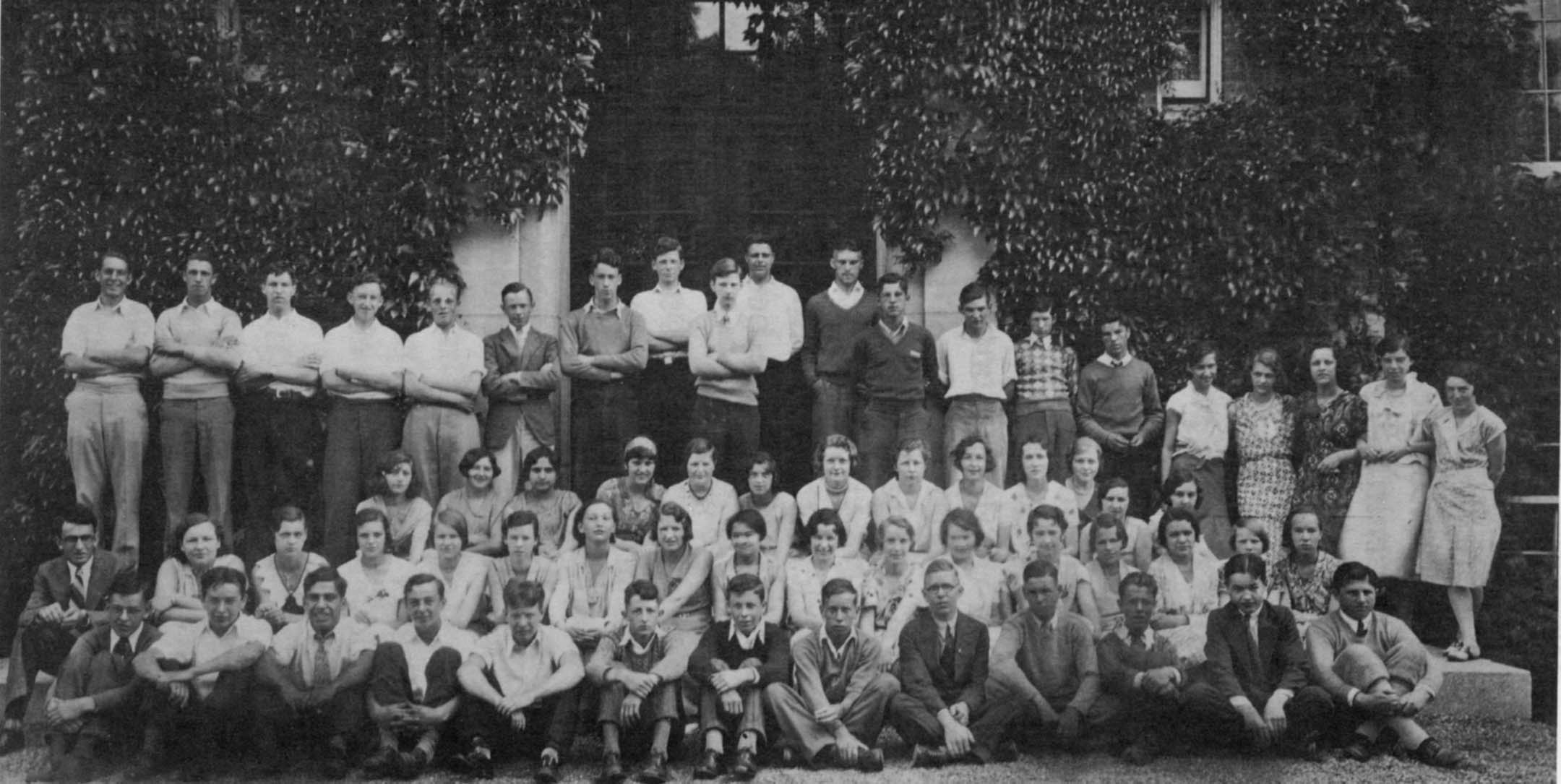
That covers the story of my classmates. Some stayed around and still live here in Andover. I believe that we have had some impact on the town---police and fire chiefs, a Townsman editor, post office assistant, people in business, and others who contributed by living good productive lives.
As I sit here now in 1991, I am inclined to wonder what some of the "old-timers" of the 1920s would say were they able to come back and visit today's Andover. I think of some of the Civil War veterans who still paraded on Memorial Day way back when---John Cummings, Henry Clukey, and the restresplendent in their Union blue uniforms---the last survivors of the Grand Army of the Republic. They were in their seventies then, perhaps no older than I am now, but they looked so old and spent, to my young eyes.
They would certainly recognize the library. Two new wings stretch across the front and a big addition has extended the rear, but the front entrance is the same as it was on that raw November morning in 1918 when a grateful town turned to thank God for the end of a terrible war. The upstairs meeting room has been redecorated, but the names of their comrades who served and died to preserve the Union still have a place of honor on the wall.
If these men were to retrace the route of their Memorial Day parade, they would start from the library and march south up Main Street. The Musgrove Building has been renovated and changed its occupants. Not one of the businesses that were there in their day is there today. Bud Simeone's grandfather had his ice cream parlor and tobacco store where Century 21 is now located. Bud's father moved to the present location in the fall of 1933.
The Campion block is now the Macartney block and Valpey's market is now the Kitchen Korner. The Barnard Block on the east side is still standing, but marchers would look in vain for Miss Hiller's, Buchan and Francis, Harry Hyland's shoe store, and Crowley's Drug Store.
On the west side of Main the Burns property is still the same, painted and redecorated several times over the years, but where is Flander's Lunch, the Burns Co. clothing store, and the Ginta grocery store? The Andover National Bank building has had extensive changes to the basic structure, mostly interior, and the old center entrance has been moved over to the side. But gone are any familiar faces---Chester Holland, Fred Gould, Marion Farnsworth, Mrs. Bliss, the McCoubrie sisters, and Ella Petrie. Other than Mary Leone, who has been there for many years, they would not recognize anyone. Even the bank's name has been changed.
The old Town Hall would certainly be recognizable, although it has undergone quite a facelift. The old-timers would not find the town offices there, but they would be happy to see the post office back where it was when they were much younger. Across the street they might want to stop at Mrs. Basso's fruit stand to buy a coconut-standard for Memorial Day---but would find a shoe store in its place. The rest of that west side, up to the savings bank, would all be foreign to them.
Mr. Rivard's jewelry and watch repair shop has been replaced by a specialty shop on the corner of Barnard Street, and passers-by would look to no avail for Billy Higgins standing in the doorway of his store, where the Andover Optical is now. The Christian Science reading room has replaced the Evergood Store, and the new building constructed to house the Woolworth Five and Ten is now occupied by Regina's and Raspberries.
All the stores in the ARCO Building have been replaced since their day---Chase Sporting Goods, Ames Butter and Egg, Chase Paper Store, Carl Elander, Western Union---all gone and replaced by CVS, and now awaiting new occupants. My friends in blue would never comprehend the changes the rest of the way up from the corner of Chestnut Street. The Andover Press building is still in place but it has changed in appearance---I must say for the better. And what happened to that drug store run by that young Hartigan lad who used to work for Frank Stacey in the Musgrove?
The veterans would be appalled at the sight of a gasoline service station where an open field had stood, to say nothing of the big post office building, which proved to be not big enough and now stands empty. Their surprise would know no bounds when they noted the demise of those stately homes giving way to a vast parking lot lined with many stores and offices. On the other side of the street they would be mildly surprised to see the site of Dr. Abbott's home being transformed from a parking lot into a modern retail/office extension.
That bank building is nice, they would say, but what happened to those houses in the rear---and what happened to the town's first real commercial garage? It contains Brigham's! The only Brigham that they ever knew was Frank Brigham, special agent covering Maine, New Hampshire, and Vermont for the Merrimack Mutual. Frank lived at the corner of Punchard Avenue and Bartlet Street, across the street from Mrs. Bergstrom, where Paul Cronin lives now.
Surprisingly, the rest of the Main Street, up to the Academy, is about as it was when they last paraded, along about 1930-1931. If we were to take these same men---in fancy---for a ride around town after the parade, their wonderment would know no bounds. They had seen Billy Wood build Shawsheen Village, but to take them to the "farm belt" in West Andover and show them the changes would, I am sure, simply "blow their minds."
You see, in my very early days, in the summertime, I went out for a ride almost every morning with my Uncle Martin. I have mentioned that he had to stop steady work early in life because of a very debilitating asthmatic condition. He had a horse and wagon before 1920, just as my father had one also. But in 1920, Martin bought a Chevrolet touring car, and I was his almost constant companion. Dennis Sweeney, who lived on Central Street, was the rural mail carrier in West Andover, and whenever he was sick or needed time off, Martin was his replacement. He knew every farmer, how many children he had, on every farm in West Andover. In later years, through the 1920s, it was usual for him to drive out into the "country" and stop to visit old friends. As a result I got a first hand education in geography.
Uncle Martin knew everybody, it seemed. He knew the farmers; he knew the policemen and firemen; he knew all the postal service employees; he knew every shopkeeper; and he even knew the brakeman on that last train to run from South Lawrence through West Andover to Lowell. My father worked every day and I, being the youngest of my generation, traveled with Uncle "Mart."
In later years when I would pick up my own children after school, or after Girl Scouts or Little League, there was always some girl or boy from the outreaches who needed a ride. When they started to give me directions, I would always stop them short and ask for just the street and number. I could invariably take them right to their door---and give them a brief history of their neighborhood. In those early days of the 1920s there were about 50 miles of roads in Andover. Today there are more than 200 miles, exclusive of state and federal highways.
As I get down near the end of my story, I am reminded of a few incidents and personalities that I passed over earlier with the intent of returning to them before concluding.
I have mentioned that the fire department became partially mechanized before my time, but for years the ladder wagon was pulled by a team of strong gray horses. Bill Baker was the usual driver along with Bill Rea. One night a fire alarm sounded for a blaze in Shawsheen Village. Neither of the regular drivers was on duty --- I don't know why---and thus there was considerable consternation when the alarm came in. The horses ran from their stalls and backed themselves in under the harness that was suspended from the ceiling, ready to fall into place on their backs, to be hooked and buckled.
But who would drive the long ladder wagon? There was a bit of a panic for a few moments, until Scott Shattuck stepped forward. Scott owned his own team of horses and ran an express business. The doors opened as soon as someone handed Scott the reins. Out of the station dashed the horses and they made the wide left turn down Park Street toward Main. Scott was doing fine as he pulled the rein to make the right turn on Main Street to head for Shawsheen, but Scott forgot that he was driving a much longer vehicle than his express wagon. The horses made the turn, and so did Scott, but the rear of the long wagon went up over the curb, took down the light standard, and left the rear axle of the wagon draped over the hydrant that still sits in front of the drug store. I hope it was only a harmless grass fire that night, because it took quite a bit of work to get the apparatus back in working order.
Scott had two sons, Ralph and Charley, who carried on his express business. They mechanized and expanded to about ten trucks, all of which were always clean and painted and covered with quality canvas tops. Charley Jr. carried on the business for several years, and sold it about ten or twelve years ago to a combine that ran it into the ground. It was a flourishing business for half a century and it was sad to see it die.
Just so that no one will think ill of Scott Shattuck as a driver, I must say that I did see Bill Baker once clip the curbing as he made that same turn from Park onto Main. The big diesel powered trucks with their lights and sirens, will never compare with the sight of the team of horses, their manes flowing in the wind, racing down North Main Street, with the driver holding the reins and two or three volunteer fire fighters hanging onto the side of the wagon. Somehow, it seems unfortunate that kids today have never had an opportunity to experience the thrill of life as it was about sixty-five to seventy years ago. No, I would not want to return to those days, but---like serving in the armed forces---it was an experience that I am glad to have behind me.
Let me now mention one of the most interesting neighborhoods in the entire town in my generation. North Main Street, between Lewis Street and the railroad bridge, a distance of about 200 yards, more or less, was known in my younger days as the "Pike." That small section produced an amazing number of young people who served the town and the surrounding community with great pride and distinction. If I am not mistaken, they were all of either Irish or Scottish descent.
Anne Harnedy served as principal of the Shawsheen School for many years, and when she retired, the town named the short roadway approaching the school Anne's Lane. Her cousin, Helen Collins, a lawyer, was secretary to Dan Murphy at the Arlington Trust and served as in-house counsel to the bank. Her sister, Margaret, worked in the bookkeeping department at the same bank. They are both retired now and living in Methuen (they told me Andover is now too expensive).
Dave Nicoll, from the Pike, president of my high school class and football and baseball teammate, rose through the ranks to become chief of police. Henry Hilton, another classmate and teammate, served as chief of the fire department prior to his retirement. He is living in town. Drummond Bisset, earlier mentioned as a classmate and teammate, also grew up in the Pike neighborhood.
Those three, along with Higus Asoian, who later married Hilton's cousin Bertha, formed the starting backfield for our high school team for two years. Eddie Doherty never was big enough to make a real impression in high school, but after a year or so at Tyer Rubber and a year of prep school, he became the darling of Frank Leahy's years at Boston College. Eddie went on to coach at Arizona, then returned to Andover and Lawrence High, Holy Cross, and finally settled back in Arizona, where he is living in retirement.
Eddie's sister, Mary Doherty Crowe, a classmate through grammar and high school, represented the Lawrence YWCA in swimming meets at the Boston Swimming Association when we were in high school. Mary was a gifted athlete and a real good friend. She is now living in Bradford, and I keep tabs on her through her cousin Peggy Downs Heard.
Peggy's brother, Billy Downs, succeeded Hilton as fire chief and after his retirement ran successfully for the office of selectman. Archie Maclaren, who lived just around the corner on Lewis Street, was, and is, a very well-regarded architect, with offices in town. Archie, by the way, was the architect for our office building on Elm Street. Drummond Bisset's brother (I think his name was Bobby) came along a few years after us and quarterbacked another undefeated Punchard team, along about 1936 or 1937.
Dave MacDonald, the "Ad King," and former vice president of the Merrimack Valley Bank, was born on the Pike, but his family moved to Chestnut Street when he was quite young. He still lays claim to the old neighborhood, though.
Among the others who grew up in that distinctive neighborhood were Jim Gorrie, the policeman, and Alfred "Kilt" Robb, who became a sergeant in the police department. George Connors, the "Baron," moved over from Lawrence and served as a volunteer coach for several of the youth leagues in town. He is still a great fan. Harold "Max" Bishop, now semiretired from his position as sportswriter at the Tribune, moved over here from North Andover, lived on North Main Street and made a name for himself as a first baseman at Punchard.
I hope I have tagged them all, but I fear that as soon as this goes to press I will remember another name. But, true to my promise to myself before I started, I am not going to research it further than my memory. I know of no other section of the town that nurtured so many who have distinguished themselves and left their mark on the history of their town. All came from "blue collar" families, and none ever had anything handed to them. It has been my good fortune to have befriended every one of them. The town is better for their having served it, and I take pleasure in saluting the "gang from the Pike."
To have written about Andover---its geography, its people, and its events---of the last three-quarters of a century has been relatively easy. God did endow me with an excellent memory---not much else, but a good memory. I have loved Andover. I would hate to have to leave it. The town has been good to me and my family. I have enjoyed over fifty years of helping people with their insurance and real estate problems. I never considered myself as a "salesman"; I just love sitting down and talking to people. There is so much satisfaction in getting someone to smile, to react favorably.
I do not feel that I have any enemies. Yes, there are some who disagree with me, or with whom I disagree, but I do not consider any of them to be "enemies." Every person I meet I consider a potential friend. I enjoy going into any store or office in town and being greeted in a friendly way. With the exception of my experience with Walter Lamont at the planning board meeting in February 1942, I have never had a "problem" with employees of the town, regardless of their tile or rank, and I consider them all to be, or to have been, my friends.
This is the way I was brought up: be courteous and friendly to others and they will almost assuredly be friendly in return. When I hear someone accusing a public servant of being rude or discourteous, I am inclined to think that the window should be turned into a mirror.
In my youth Andover was a small town. In many respects it was a farming community, although a great many of the inhabitants worked in the mills and factories, both here and in Lawrence. Everyone knew almost everyone else. When Andover went to church---no matter what church---on Sunday morning, most everyone walked to and from services. And it was customary to stand outside and chat with friends and neighbors afterward. The occasional new family moving in to the community was quickly recognized and greeted and welcomed in. Life, in general, was much slower and more deliberate.
After World War II an automobile became almost a necessity, and with it the pace of life quickened. We now rush everywhere. If we want to go from Elm Square the four blocks to Olde Andover Village we drive---and even then we get quite frustrated if someone tries to cross the street in front of us, or if the Chestnut Street lights turn red. We hardly know our next door neighbors, and don't even wave as we drive by the people who live three doors away.
We used to have an amazing sense of community. When I was growing up on Harding Street, my father and mother and all of us children could recite the names of all the members of every family on Harding Street, High Street, Walnut Avenue, and most of Maple and Wolcott Avenues. Today, I am not sure of the names of some of my immediate neighbors on Juniper and Chandler Roads.
The town has changed. In some ways, of course, it has improved, but in others it seems to have regressed. Yes, we have better roads throughout the town. We have bigger and better schools---although I still contend that Latin should be a part of the curriculum for every college-bound student. The mental discipline that such a course teaches would help a lot of our present-day journalists and broadcasters to understand and use the English language much better. (I have been trying to find a place to make that point ever since I started this book.)
Our public safety departments are much better trained and better equipped. At one time, it seemed, individuals were appointed to the police and fire departments because they could not get a job anywhere else. In the early days we really had some beauts, but there is no point in dwelling on that. They were all honest, but some didn't have much common sense. Let's let it rest at that.
Our library and our town offices have become more responsive, it seems, to the needs of the people. All departments are staffed with bright, qualified professionals. Anyone who might dispute me on that point just was not around in the 1920s and early 1930s.
But, with all of our progress, we also seem to have lost something. I have mentioned above all the town families walking to church services on Sunday mornings. When I was in St. Augustine's School, of course, every student attended Sunday Mass---and even God could not help you if you did not have a valid excuse for missing. Whole families went. It was the way of life. When I got to high school, practically every student in the school attended Sunday services in one of the Andover churches. The sanctuaries were filled every week. That was when the town had a population of less than 10,000. Today, with our population of almost 30,000, we are certainly a long way from tripling our church attendance.
In the 1930s the annual town meetings in the Memorial Auditorium always had an overflow of attendance onto the stage and gymnasium. It was not unusual to have 1,200 voters attend to transact the town's business. Today, with three times as many registered voters, we usually have to wait well beyond the appointed hour in order to get the required quorum of 350 in order to start the meeting. And if we don't schedule a controversial issue for the final article, we run the danger of someone questioning a quorum because people do not have enough interest in their own duty and responsibility to see the process concluded.
I tend to pass the latter situation off as the result of our having so many residents move in to Andover from outside New England, where they are conditioned to let a city council or a board of county commissioners rule their lives. They don't realize what they have here, and the pity is that they are too preoccupied to go and find out about it. The few who do, soon learn to understand it; then they participate.
Andover---and I---have seen a lot of changes in the last seventy-five years. Like any community in the twentieth century, Andover has seen the growth of the age of electricity, the increased use of the auto, the changes occasioned by the airplane. We have also seen the almost total demise of the railroad system as we once knew it. What a pity that other countries, with our aid, are able to build state-of-the-art rail systems, while our own has been replaced by 18-wheeler trucks and millions of cars. Someday we may get a president and a congress who will have the will to rebuild the railbeds and replace the rolling stock. It is still the best way to move large numbers of people and heavy loads of cargo. All of that is beyond the capabilities of the people of Andover, but I wanted to say it anyway.
It was suggested to me some time ago, by three or four different people, that I should make a few observations concerning what trends I anticipate for the future, or what issues I think need to be addressed. As I have moved through this work I have hinted, sometimes strongly, about things that have been forgotten or neglected. Obviously, I don't feel that it is my place to forge a "master plan" for Andover; some people have been working at that for about twenty-five years. That tactic sounds good and makes a lot of the citizens happy, but in about five minutes I could write on the back of an envelope the things that should and must be addressed in this town in the next ten years. The priorities will manifest themselves as emergencies arise. If we have a major failure in the hundred-year-old underground utilities in the older, central section of town, then the new school facility will have to wait; the addition to the public safety building will have to wait; and the new pumper and cruisers and street sweeper will have to wait.
All of those purchases and investments are important and can be prioritized in any order you wish, but if we don't have any money---and it looks as though we will not have very much for the next three or four years at least---then why get excited about it? We must continue to maintain and improve our educational system. We can rant and rave till the cows come home, but the reason we have an educational system is to ensure the continuation of our culture and our way of life. I'm sure that no one seriously wants us to step backward in that area.
I see Andover addressing all these problems in the next ten to forty years just as we have done in this century---laboriously, fretfully, and sometimes with resentment over failures, but we will maintain our town as the greatest community in the world in which to be born, grow, get educated, work, raise a family, and write a book about it. Someone asked me the other day what I thought was the most significant event in my lifetime. The question begged for a personal opinion and response. Another friend rephrased the question: "What do I feel has been my greatest accomplishment?" The answers are very simple. My greatest achievement was convincing the most wonderful person in the world to become Mrs. Jim Doherty, and with her, to raise the five finest children anywhere.
Perhaps life in Andover would not have been so wonderful if I had not had the family ties that have been mine for seventy-five years. My parents, aunts, and uncles were solid citizens. They appreciated the town and its opportunities. They paid their bills on time.
They went to church on Sunday. They voted at all elections and attended all town meetings. They were not wealthy. They never aspired to belong to the country club set. My generation were given an opportunity to acquire a little better standard, and I hope that my children will have more of this world's benefits than I have had. Alter all, that really is what we all seek.
Mary, Sheila, Joanne, Jay, and Fran have all had the benefit of their mother's love, kindness, and discipline, and so far they have made us proud. There is not much more that you can hope to attain in your lifetime. If they stay close to God, to each other, and give something back to the community in the way of service, they they will have been as successful as Sheila and I have been.
If the generations that follow us will persevere and give of their time and talents to help solve some of the problems that co front our town in the next fifty years, and if our houses of worship continue to be filled each week with God-fearing men, women, and children, then I can safely predict that the best years of Andover are still to come.